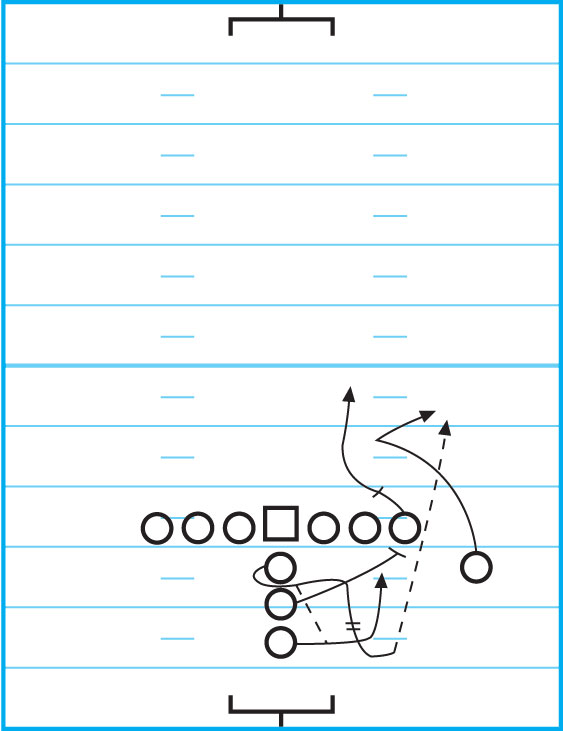
WHEN I FIRST BECAME a head coach, I used my experience as a defensive coordinator to put together an offensive system. I took the best and hardest offensive formations and series to defend from several different teams. We eliminated some things and customized others, until we developed a complete offensive package.
The foundation of the offense is a play we call the “O.” The name “O” comes from the action of the off-side guard pulling and leading through a designated hole (O=Off-side).
By utilizing multiple formations, the “O” can be run from virtually any set. We prefer to use motion and overloads to create problems for the defense.
The beauty of the “O” is that it can be a sweep, power off-tackle or an isolation cut back depending on what the defense gives you.
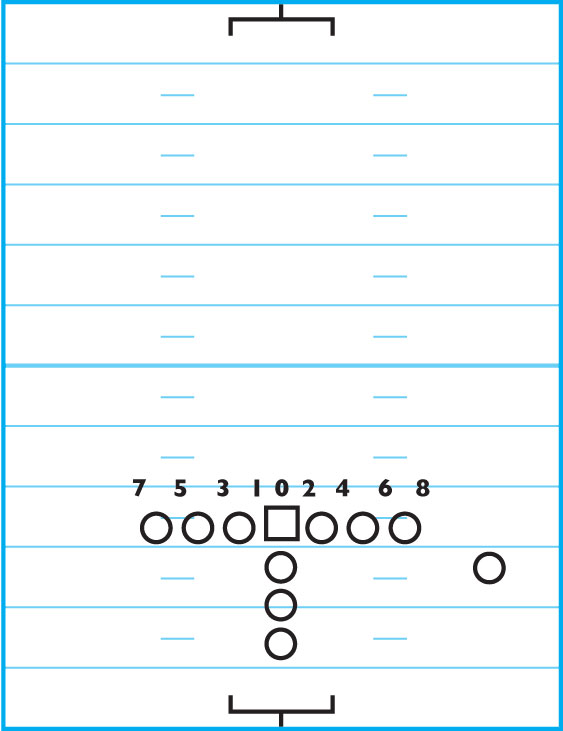
Numbering The Holes:
DIAGRAM 1: In our hole numbering system, the even numbered holes are to the right and the odd to the left.
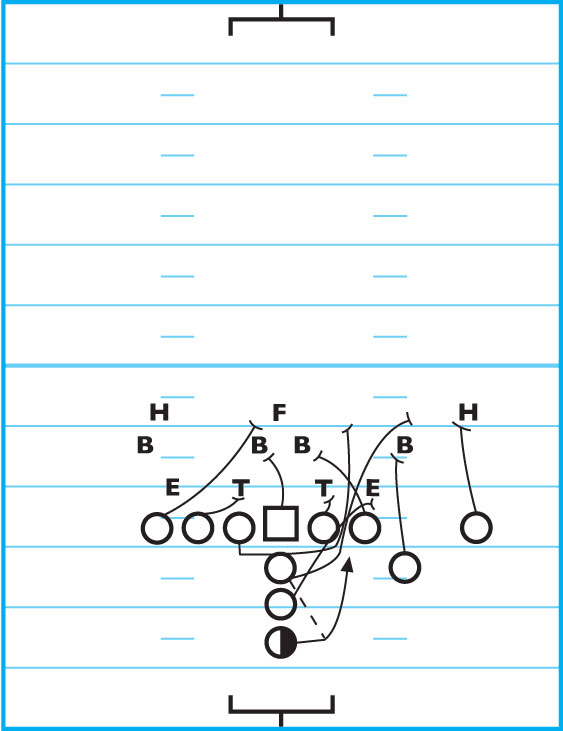
The 36 “O” Vs. a 5-2 Defense:
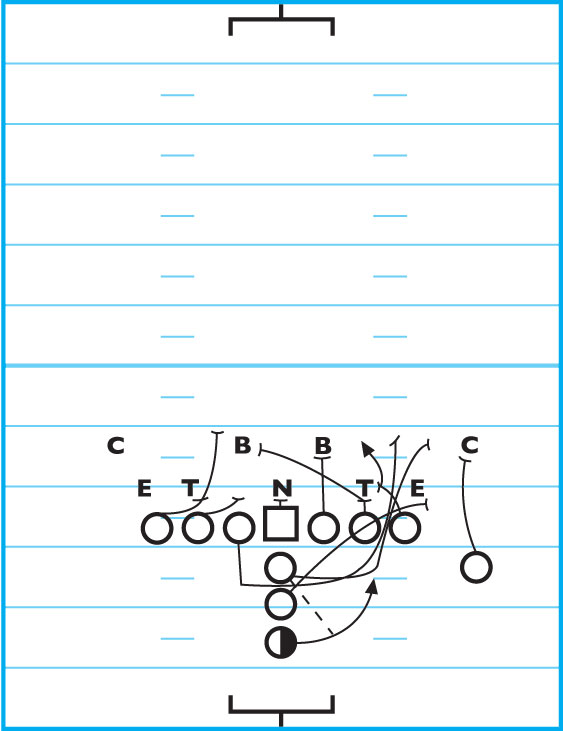
DIAGRAM 2: The play call is 35-36 “O”. “O” stands for the blocking scheme used by your line in which you base block with the off-side OG pulling and leading through.
Player Responsibilities
Î The center and play-side OG have a base blocking rule. The base rule is In-On-LB-Outside. So the center blocks the nose and the OG blocks the play-side LB.
Î The play-side tackle combos with the tight end on the defensive tackle. If the DT slants, the OT will ride him down. If the DT stays head up, the OT and TE will double him off the line of scrimmage. If the DT loops out, the TE will take him and the OT will scrape off to the backside LB.
Î The TEs rule is to combo down on the DT. If the OT handles the DT or the DT slants, the OT will take him and the TE combos off onto the playside LB. This is an important seal block.
Î The backside OG pulls down the LOS and turns into the 6-hole looking inside for a pursuing LB or safety. The OG must be quick and always looks to seal inside. The OG may turn up at any time, eyes on the LB.
Î The backside OT must fill for the pulling OG and allow no penetration. The backside TE fills for the OT, and then gets to the TD alley. Many key blocks are made by a hustling backside TE that springs the tailback for the touchdown.
Î The receivers are responsible for TD alley vs. zone and man coverage. If they are wide, they are to run the defensive back off. They must look to wall out and maintain contact.
Î The fullback has the kick-out block on the defensive end. The FB must crossover step to put himself at the proper angle for the kick-out. He kicks the DE out, but if the DT closes hard, he can hook him to the inside. The FB must take advantage of the DEs charge.
Î The quarterback, who reads overloads and is free to audible at any time, must reverse out to 3 o’clock with his first step on 36 “O” or to 9 o’clock on 35 “O.” This first step is very important, as it leads the QB through the hole. If he steps deeper, then he hinders the play. The QB will pitch the ball with both hands simultaneously with his first step. Tell him to pull the ball from his holster like a gunfighter. He must lead through the hole and block the first color (usually the strong safety) to the outside.
If the SS or the outside LB is firing on the outside, the QB will pick him up before entering the hole. When run properly, the backside OG and QB will be shoulder-to-shoulder leading through the hole.
If the FB hooks the DE, then the OG and QB will lead outside and the “O” turns into a sweep. Your team will gain the most yardage when opposing ends crash to force outside.
Î The tailback’s first step is a crossover. The second step is toward the hold. Both steps are very slow. Speedy steps will carry him out of the proper angle to cut back, bounce out or hit the lane.
These first two steps are critical to the play. The TB will catch the ball on his second step, then read the FB’s block. If the FB kicks out, then the TB turns up and goes to daylight. If the LBs over-pursue, the “O” will cutback across the grain for big yards. If they are sealed by the backside OG and TE, the key block turns to QB on the SS.
Assignments Vs. The Even Front
DIAGRAMS 3, 4
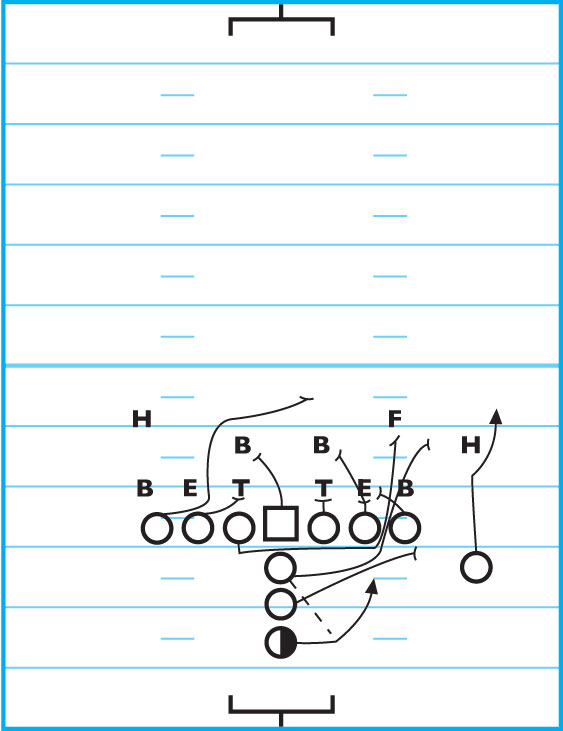
Î The center will block the backside DT or backside LB, whichever player he feels is more dangerous.
Î The play-side OG and OT will combo the play-side DT and LB. Practice very hard to prepare for their stunting capabilities. It’s a two-on-two situation.
Î The play-side TE will down block if the OT is covered by a DT or a LB. If the OT is uncovered, the TE blocks (out on 4) the outside LB.
Î The backside OT fills for the OG on the DT.
Î The backside TE fills for the OT and then goes to TD Alley.
Î The pulling OG, all backs and receivers execute the same as they would against any defense.
Adjustments
There are many kind of adjustments that you can make. The TEs assignment is the easiest to change. In the past, we have put our FBs kick block on the DT, OLB or even the cornerback, depending on the goals for the play.
Add the word “freeze” for the playside OG to show pass block, then block the nose or the backside LB. The TE/OT combo would pick up the play-side LB.
ComplEmentary Plays To 35-36 “O”
(DIAGRAMS 5-8)
DIAGRAM 5: 21-22 Trap
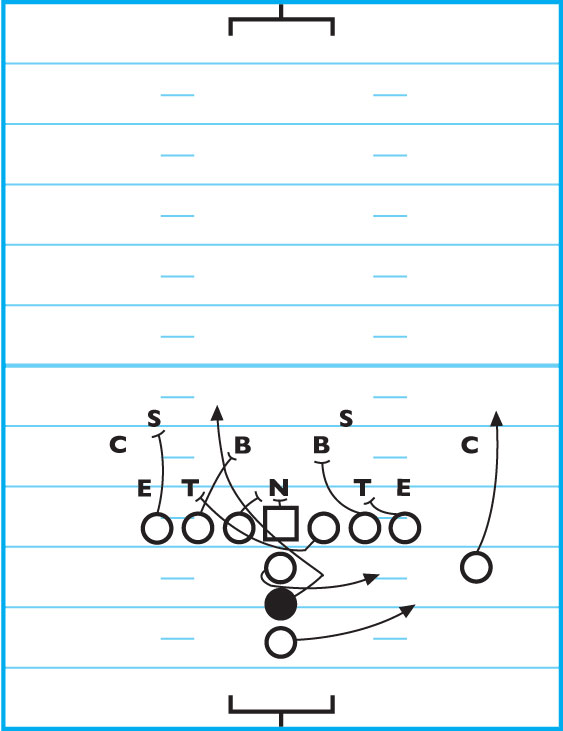
DIAGRAM 6: 35-36 Counter
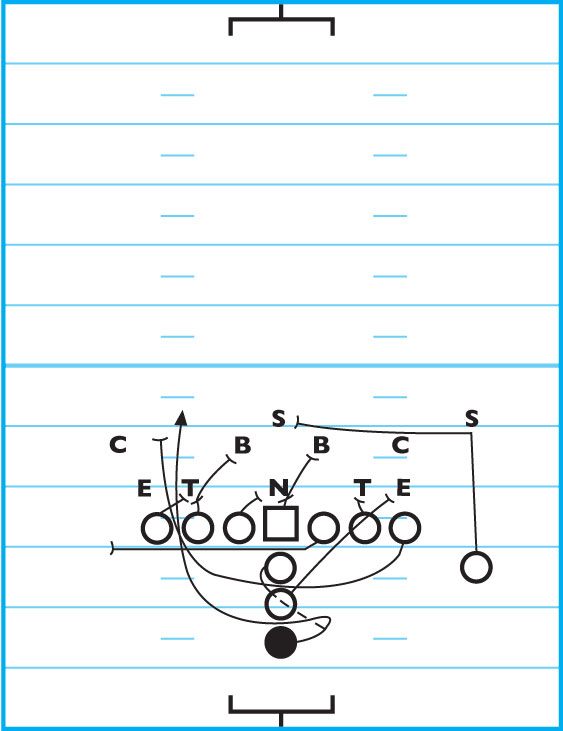
DIAGRAM 7: 35-36 Quick Pass
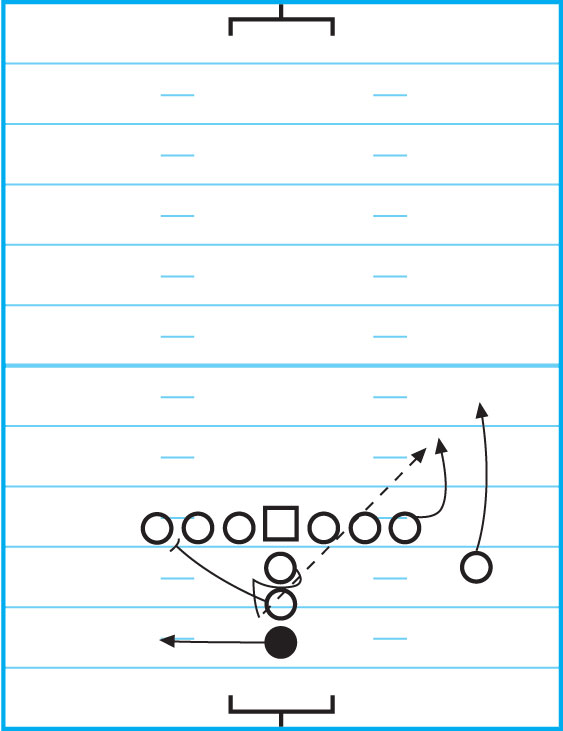
DIAGRAM 8: 35-36 “O” Pass