Wide receivers have many areas in which they must be proficient. The receiver must be properly drilled and taught fundamentals to succeed in each area of play. When a receiver is properly drilled and given tools for success, you then have accountability. With accountability comes trust and confidence. When a player is confident, he is not thinking. He is able to play fast and execute his techniques.
What is Expected
of Your Wide Receiver
1. Leadership - A football team or any other organization can only be successful if it has proper direction and positive leadership. Leadership is a quality that can be learned and acquired. It can also be the result of actions performed. Not all men are leaders, but leadership can be developed if certain principles are applied and carried out.
2. Attitude - Attitude of the individual toward his responsibilities is very important - it should be positive, not negative. The personality one exhibits to his teammates should be pleasant and confident, but not arrogant or cocky. It is easy to acquire this trait if you have a good attitude toward your school, your teammates, your coaches, and yourself. Knowledge of your position will also assist you. Try to completely absorb the details of your position. Develop an ability to concentrate and execute your position flawlessly. Sarcasm and wise cracks are out of order. The object the game is to win and not show up your teammates. Your association with your teammates off the field is not a prerequisite for leadership, but it will help you gain a deeper understanding for each other, develop mutual respect and contribute to team morale.
3. Ability - Ability is an essential requirement of a good wide receiver. We, as a staff, feel there are three areas that are critical - can he run, can he block, and can he think? We could go into great detail on each one of these characteristics but it is more important to know they all are essential and the player who is deficient in any one area should have great emphasis placed on that particular skill in order that he can develop into a complete wide receiver. The great wide receiver always has some degree of leadership, character, and athletic ability. The ability to work and develop these traits is essential to becoming successful.
4. Willingness to Learn - Leadership, athletic ability, and performance are necessary in different degrees of perfection. However, one must remember that these traits can be developed and learned and are essential in developing the type of wide receiver needed to consistently win in this caliber of competition.
5. Self-Control - Celebrate big plays and get excited, but not overly excessive as to draw a flag. Personal fouls will not be tolerated!
6. Confidence - Always be confident. Your teammates must believe in you. Be consistent!
7. Character – Finally, remember that the true character of a player is not created during pressure situations, it is merely displayed.
Basic Wide Receiver Principles
1. Know your offense thoroughly.
2. Know the score, time to play, yards to go, down and distance.
3. Find out as much as possible about your opponent.
4. Know what defense to expect, but be able to recognize any defense.
5. Understand the importance of field position.
6. Have a reason for what you are doing.
7. Don’t do anything that will hurt your team.
8. Know your 2-minute offense, philosophy and rules flawlessly. Games can be won and lost in these situations.
MENTALITY
The WRs will be energetic, smart, tough, and physical players who will be relentless in the pursuit of perfecting their craft day-in and day-out. They will strive for technical perfection in their releases, route-running, break points, catching, yards after catch, and blocking. They will know assignments on each play, they will know the opponent better than they know themselves, and they will have the best ball security. He will achieve success as a unit, and every single opponent will know they are in for a fight.
START
On his start, he must roll over the front foot and have a quick, explosive first step from the back foot. He can’t raise his body up, and he can’t lunge with a first step. Having the quick first step keeps him balanced and allows him to get into a natural running motion faster. His head and eyes must be up, looking downfield through the defender, and he must pump his arms forward at the shoulders and have good body lean, shoulders over toes. Elbows must be bent, and he runs on the balls of his feet. He attacks the defender with the threat of beating him vertically.
He wants to step on the defender’s toes, and does not panic when contact takes place. He leans into the defender when necessary, using his elbow (not extending his arms) to separate. He attacks the defender in off-coverage with the intent of squaring him up, and he attacks cloud corners with the intent on widening them to create larger throwing windows (he rips up through his jam attempt). While he wants to square defenders up, at times he has no choice but to attack a shoulder if the defender attempts to wall him off from an inside-breaking route.
An example would be a defender, playing off-technique with a hard inside shade, who continues to stem inside at the snap, not allowing the WR to square him up to run a curl route. In this instance, he must readjust his stem to his outside shoulder, lean against the defender while incorporating his hands (low/high arm bar to keep his hands off), and use a throw-by technique at the top of the route to come back to the quarterback. Not everything happens to perfection on the field, so he must readjust, be physical, and fight.
STANCE
Legs
a. Inside foot is back.
b. Weight distribution should be about 70/30 front to back.
c. Slight bend in the knees.
d. Should be on the balls of your back foot.
Head and Shoulders
a. Head and eyes should be upfield looking at defense first to recognize keys and coverage.
b. Then look down line of scrimmage for snap.
c. Shoulders should be square to line of scrimmage.
d. Shoulders should be over your front (outside) foot.
e. Turn head slightly to look at football.
Hands
a. Hands should be at about chin height ready to fend off contact at time of snap.
b. Hands should not be down by your side.
Alignment
1. When you are the wide receiver to the strong side of the field your alignment should be at the top of the numbers.
2. When you are the wide receiver to the weak side of the formation your alignment should be at the bottom of the numbers.
3. When there are twins, the inside man should be at the hash.
4. If you are in the slot, you should be at 1 and 1. (one yard back and one yard out).
Areas of Pass Coverage
(See Diagram)
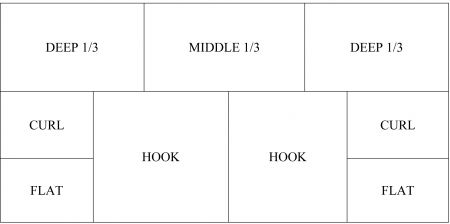
1-Flats; 2-Curls; 3-Hooks; 4-Deep 1/3’s.
The defense can defend these areas by playing zone-type coverage (cover 1, 2, 3, 4) or a combination of man and zone.
Catching the Ball
1. Snap around head and pick up the flight of the ball.
2. Zero in on the point of the ball and watch the ball into hands.
3. Catch the ball with hands making a noose. By doing this you can see the ball all the way into your hands.
4. If ball gets into your body you can lose sight of the ball, and there is a chance of the ball ricocheting off your pads into the air, with the chance of an interception.
5. When facing the QB and the throw is chest high, have your noose ready with thumbs and index fingers forming a noose. If ball is low, have little fingers together with arms and elbows under the ball.
6. When running downfield and the ball is coming over your shoulder, have your thumbs out and little fingers together reaching up at the last moment to make the catch so the defender does not have time to react and knock the ball away.
7. Ball will not always hit you in stride. Under thrown balls should be caught by slowing down, stopping, or coming back and catching the ball at its highest point.
8. After catching the ball, tuck it under one arm with forefinger and middle finger over the point, keeping the elbow in to provide pressure on the rear of the ball.
Release and Break
a. Begin forward movement by exploding off back foot.
b. Show release with same intensity and quickness on every play regardless if run or pass.
c. Gain speed to break down cushion between you and DB. This forces DB to drop quickly into deep coverage, opening up opportunities for short
and intermediate passes.
d. Direct release: drive at defenders area of responsibility.
e. Inside release: Come off to the inside and up the field to gain advantage on route.
f. Outside release: Come off to the outside and up the field to gain advantage on route.
g. When you approach proper depth of your route drive at the defenders’ shoulder opposite of break.
h. At breaking point, bend knees to drop center of gravity
i. Keep weight over feet. Do not lose speed in your break.
j. Maintain forward lean on the break and explode to get separation from defender.
Tight Coverage Release
a. Do not waste time trying to fake out opponent.
b. Be aggressive in the release with leverage
c. Ward/Slap off hands as you burst up field.
d. You can use one of two techniques;
rip or swim.
Rip:
1. Drive off front foot, stepping with the back.
2. Drive off at slight angle to enable yourself to get by defender, at the same time rip through the nearest arm knocking defender’s hands off.
Swim:
1. Club and try to swat defender’s hand off you.
2. Simultaneously swim over with your near arm bringing it down hard to eliminate the defender’s hands.
BLOCKING MECHANICS
1. Blocking Man On
a. Drive off of the line and create indecision in the defender’s mind.
b. The instant the defender stops his backpedal and locates ball carrier; shorten your stride and bring your body under control.
c. The closer you get to the defender, you should widen your base.
d. Keep your feet moving in short choppy steps to position yourself between defender and ball carrier.
e. As the defender comes closer, you should focus on the middle of the numbers on his jersey.
f. To prepare for the block, you should bend at the knees but not at the waist, keeping back straight and head up.
g. At point of contact, move your elbows to your sides, with forearms up and angled to the center of your chest.
h. Both hands should be open with fingers up, palms facing the defender.
i. Hit the defender with the heels of both hands. Generate the force from your legs and then with an up and out motion with the hands and arms.
j. After initial contact, keep your balance by not lunging out at the defender.
2. Blocking Downfield
a. When blocking downfield, anticipate the defender to try and avoid the block and go to one side or the other.
b. To make it easier on yourself, shorten your stride and widen your base as you approach the defender.
c. Use the same mechanics listed before as you make contact.
READING THE COVERAGE
A. READING 2 SAFETY LOOK
1. When both safeties are aligned on or near the hash area of the field:
A. If safeties are aligned DOWN (8-12 yds) the WR should think man coverage. You should be mentally alert. There will be a heavy rush on QB. The defense could back out of zone. Check alternate keys.
Conclusion: When both safeties are DOWN, expect the corners to play man or deep zone.
B. If safeties are aligned BACK (14-18 yds)
1. If corners are up and eyes at the QB, you should be alert for cover 2. If both corners are soft and eyes more to you (WR), you should be alert for cover 4.
2. If just one corner is hard and other is soft, you should be alert for roll coverage in the direction of the hard corner or combination coverage.
3. From this alignment, you can eliminate Cover 6 and 6 Free from the alerts because it is difficult for the safeties to play the TE of Weak RB man-to-man from this depth. If both corners are working inside out and eyes on the WR, you should be alert for Cover 2 Man or 6 Free Robber.
Conclusion: When both safeties are BACK, anticipate minimal blitz. Check corners for alternate keys to the coverage. Anticipate a corner aligned hard to cover man (2 Man, 6 Free Robber) or flat (2, 3 Roll, 42) and corner aligned soft to cover deep zone (4).
C. If safeties are aligned UNEVEN (1 Down and 1 BACK), the WR should look for which secondary defenders will cover the flat. If both corners are soft, except the DOWN safety is hard, then expect cover 42.
Conclusion: When safeties are UNEVEN, expect 3 of the 4 secondary defenders to play a deep zone and the other to play a flat. Anticipate cover 42 or 3 Invert by alternate keys.
B. READING 1 SAFETY LOOK
When the strong safety lines up in a relatively TIGHT alignment, odds are that it will be some form of three deep coverage. The alignment of the Free Safety (FS) will help with identifying the coverage.
If the Free Safety is BACK and between the hashes with the corners soft and eyes through you to the QB, be expecting cover 3.
Conclusion: When the safety is BACK expect the corners to play man (6 Free) or deep zone (3). If the safety is DOWN and the corners soft, be alert for Cover 1. If the corners are hard with eyes to you, then expect Cover 6.
C. READING NO SAFETY LOOK
When both Safeties (F and $) line-up in a relatively TIGHT alignment, odds are that it will be some form of man coverage with pressure.
If the Free Safety is BACK and between the hashes with the corners soft and eyes through you to the QB be expecting Cover 3. If both corners align inside and eyes are on you be alert for 6 FREE.
D. Coverage Identification
For our ability to communicate in reference to coverages, we will have the following types of coverage.
Man, Zone, or a combination of both:
Each identification of a coverage will be given a number followed by a key term to indicate Man or Zone underneath, if necessary.
1. Cover 0
Blitz/Crash coverage with 6 rushers; FS covering or coming.
2. Cover 1
Man coverage with FS free; 5 rushers.
3. Cover Rat
Man coverage with FS free and LB robbing crossing routes.
4. Cover 2
2-Deep Zone underneath.
5. Cover 2 Man
2-Deep Man underneath (Always 2 D- backs playing zone in their deep ½ of the field).
6. Cover Robber
Man coverage underneath with FS free and SS robbing crossing routes.
7. Cover 3
3-Deep Zone with SS or C force.
8. Cover 3 Invert
A 3-Deep Zone invert to boundary.
9. Cover 3 Backer
A 3-Deep Zone invert to field.
10. Cover 3 Roll
A 3-Deep zone rolled to boundary.
11. Cover 3 Cloud
A 3-Deep zone roller to field.
12. Cover 4
Quarters coverage using Man and Zone principles.
13. Cover 42
Quarters Coverage to strongside and ½ coverage weakside.
14. Cover 7
Zone coverage with 7 defenders under and no deep, used primarily in the Red Zone.
15. Cover 9
A robber coverage that the FS and SS read the #2 strong receiver route to dictate their responsibility to rob a particular receiver.
16. Cover 26
2-Deep Zone and 6 underneath defenders and 3 rushers.
17. Cover 35
A 3-Deep Zone with 5 underneath defenders and 3 rushers.
18. VICTORY
3 or 4-Deep with jammers underneath; generally 3 rushers.
Because our job is to catch the football, we will use the football in every drill we do every day. We will also work on blocking every day in the inside run game, and perimeter run and pass game. We will be the best in getting off the jam vs. press coverage, and we will work on these techniques every day in individual drills, one-on-one, and team periods. The cones will be our best friends, as we will use them every day to work on our breaks. Remember, the greatest receivers are the ones who can get open on any kind of route. Also, the longest reception and gain after the catch means nothing if we fumble. p
About the Author:
Cedric Shell recently completed his fifth season on the staff of McPherson College. 2011 was his second year as Passing Game Coordinator and for all five seasons he has coached the wide receivers.