THE G-SERIES IS a fullback off-tackle series that requires the pulling of the on-side guard who traps the defensive end. It’s always run to the tight-end side and can be run out of multiple formations.
This series has maximum blocking at the point of attack and bases its success on the ability of the FB to strike quickly and with power. Angle blocks also occur, which allow your offensive linemen to make easier blocks. When threatened with the complementary pass of this series, an opponent’s defensive secondary is put into conflict.
This series is best run out of a double TE set for three reasons.
1. It forces the defense to play balanced, which simplifies your blocking decisions.
2. It allows you to change the play to the side of the formation where the easiest blocks occur.
3. You can take advantage of defenses that declare their strength, or eagle to one side or the other. If this happens, change the play to the other side and exploit the defense.
FB G-Series Is Effective
Our team runs the FB G-Series because it gives our players the ability to hit defenders quickly and keep opposing LBs from flying out to defend our toss-sweep play.
DIAGRAM 1:
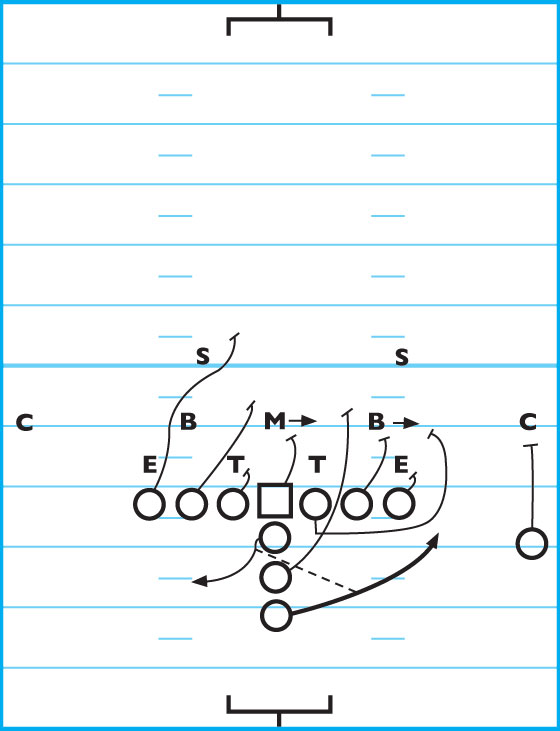
If the LBs key on your tailback or pulling guard and fly to the toss sweep, they will over pursue the FB.
- Quarterback Assignment. The QB always reverse pivots and reaches the ball deep to the FB on the handoff. After the handoff, he must carry out a fake around the play-side end to freeze the defensive corner or strong safety.
DIAGRAM 2:
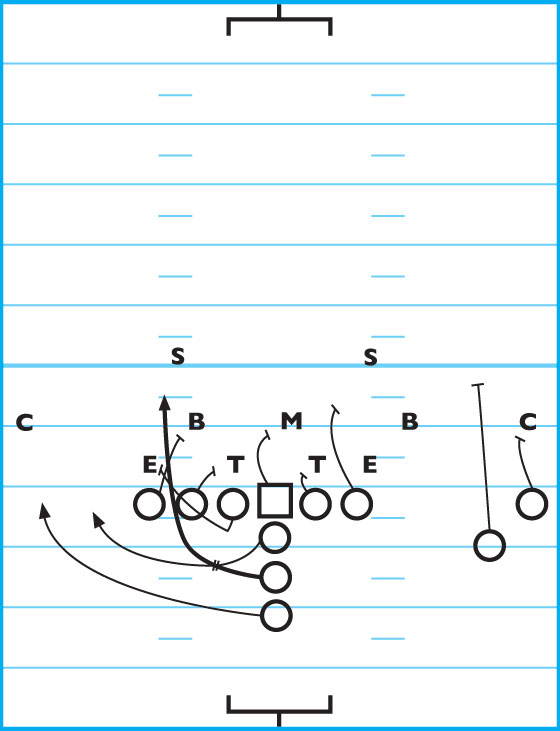
If you’re running the FB G-Series with two backs in the backfield, such as in an I-formation, the QB carries out an option fake with the TB.
- FB Assignment. The FB initially assumes a 3-point stance with his feet 4 1/2 feet from the front tip of the football. If you’re running to the right, the FB’s first step should be a crossover step with his left foot. He aims his first step at the outside hip of the tackle and gets square to the hole as quickly as possible.
Instruct the FB to stay on course as long as possible after he receives the ball. Tell him not to break outside until he is at least 3 yards past the line of scrimmage.
- Play-Side TE Assignment. The play-side TE’s priority is always to block down on the first person on the LOS to his inside, unless that person is playing a 7-technique. If this happens, he steps to the outside and loops around the DE to the first LB to his inside (see diagram 3).
DIAGRAM 3:
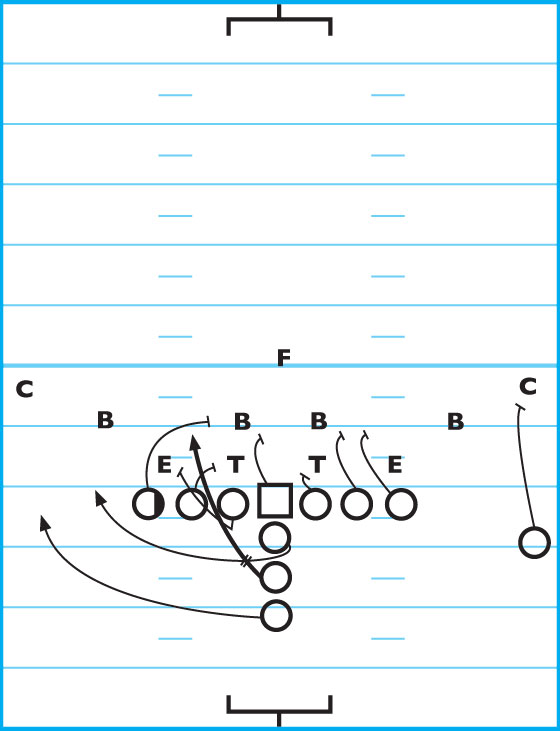
TE loops around the DE and blocks the first LB to his inside.
DIAGRAM 4:
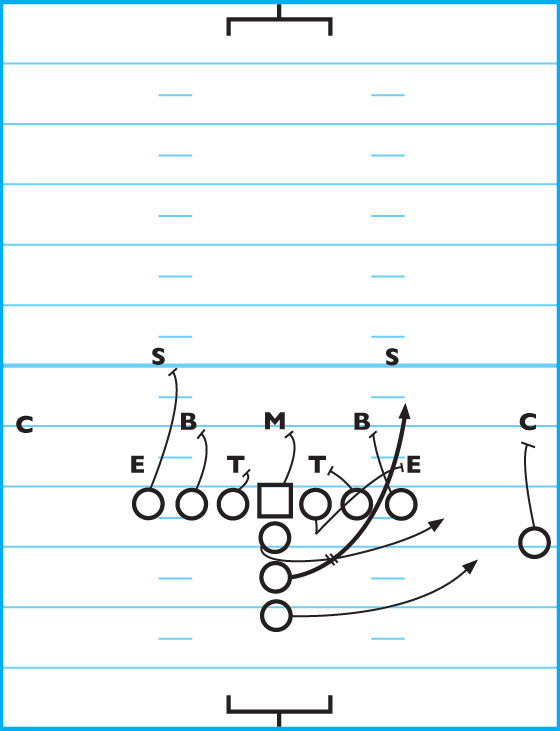
If the play-side tackle is uncovered, the play-side TE blocks the first LB to his inside. You may get this look when you face a 4-3 defense.
DIAGRAM 5:
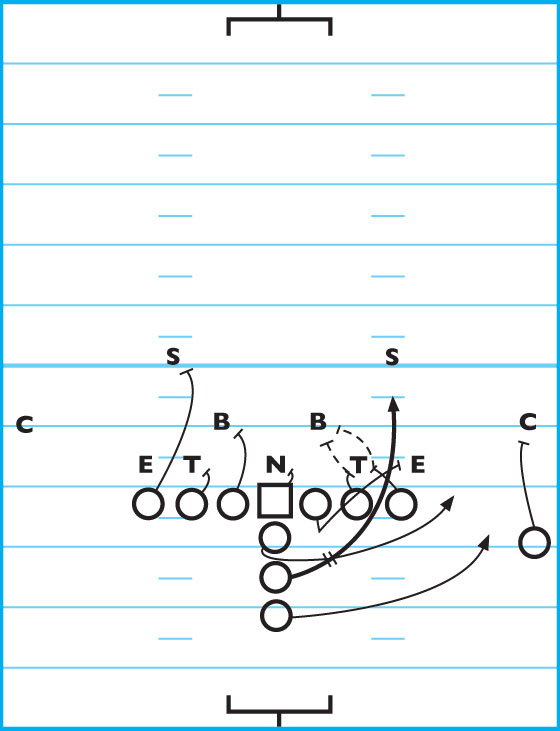
If the play-side OT is covered vs. a straight up 5-2, the play-side TE combo blocks with the play-side OT, gets movement on the defender and goes to the LB.
- Play-Side Offensive Tackle. The play-side OT’s priority is to block down on the first person on the LOS to his inside. If he’s covered and the offensive guard is not — such as in a straight up 5-2 defense — he combo blocks with the TE.
DIAGRAM 6:
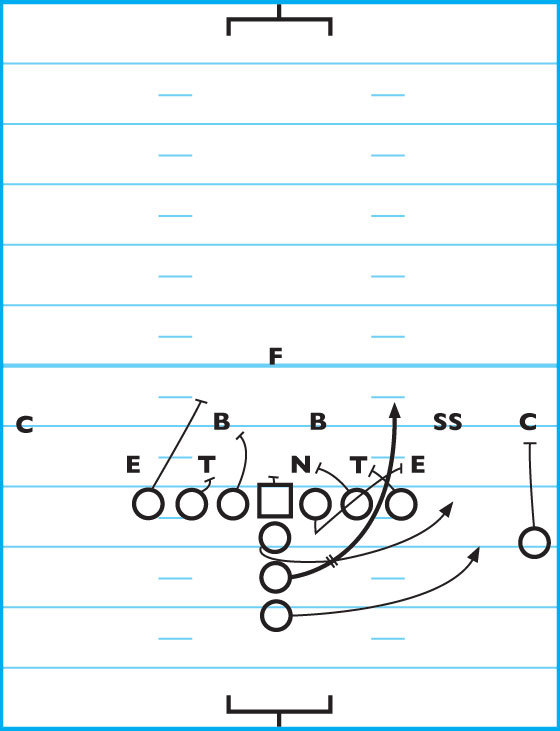
If there is a man in the center-OG gap, the play-side OT must help the center with his block.
DIAGRAM 7:
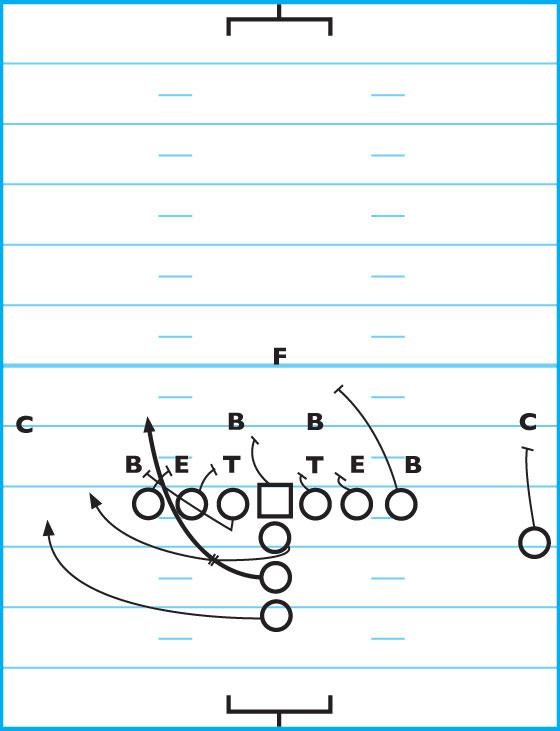
When a defender is lined up in the A-gap, it nullifies a combo block with the play-side TE. If both the play-side OG and OT are covered, the OT’s priority is to block down on the man over the play-side OG.
- Play-side OG. The play-side OG pulls and kicks-out the DE. He should stay tight to the LOS, but take a big enough drop step to clear himself from the other blocks that are occurring. He must stay low to the ground and keep his arms churning as he runs, so that he doesn’t get knocked over easily from any defensive penetration.
When making contact with the DE, have the play-side OG keep his head on the upfield side, so the DE can’t roll over into the hole.
- Center Assignments. Blocks to his play-side gap first. If shaded to his play-side gap, he double-teams this person with the play-side OT.
DIAGRAM 8:
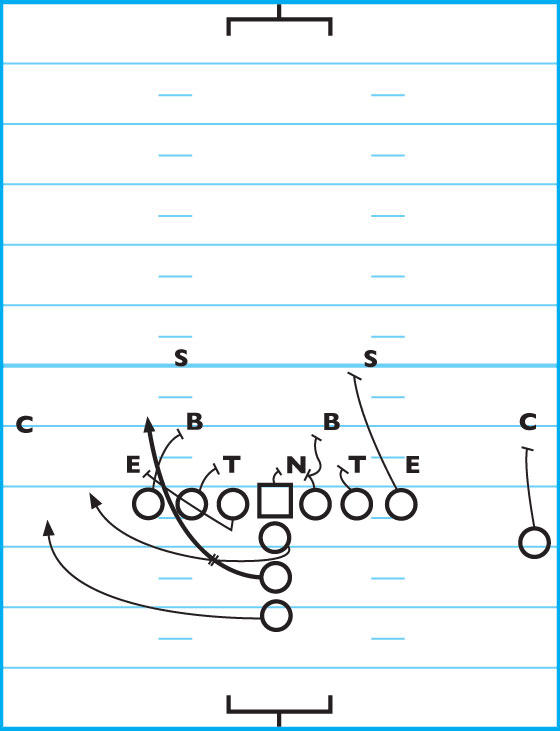
QB Audible. If you are in a double TE set and the nose is shading you to the play side or is directly in the A-gap, your QB must audible and run the play away from that defensive lineman. You can clearly see the advantage of running this play from a double TE set.
- Backside Linemen. All backside linemen must secure the play-side gap first, then block downfield. They must be alert for an audible from the QB, especially if your team is in a double TE set.
G-Series Pass Plays
The G-series pass is a good complement to the FB play. Call this play when the opposing defense’s strong safety is stepping up to stop your FB, or when the weak-side cornerback does the same.
DIAGRAM 9:
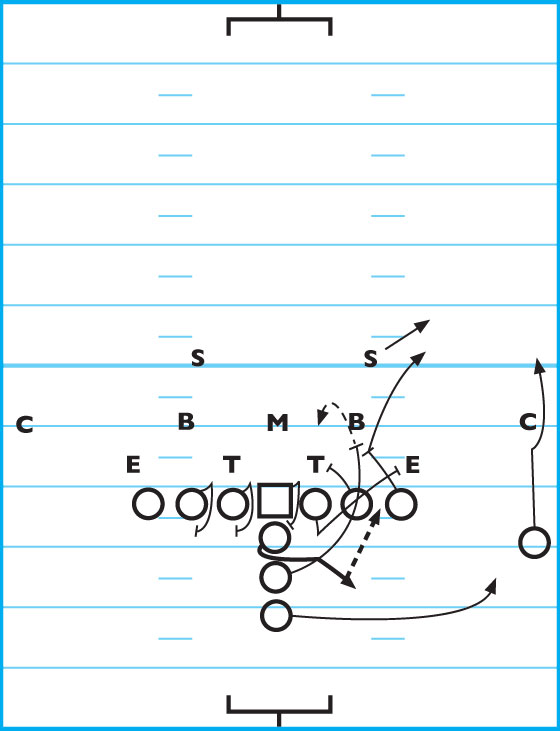
G-Series Pass Play. The entire interior blocking to the play side is exactly the same as the run. Block as aggressively as possible to the play side to sell the run fake. Backside offensive lineman should secure their inside gap and hinge protect.
PLAYER RESPONSIBILITIES:
- QB. The QB has the same technique as on the FB G-Series plays, but he rides the FB to his front hip, steps back with his left foot in front of the right and then steps back with the right, planting the right foot and throwing the ball. Make sure he doesn’t drift toward the sideline, or he’ll run into the DE that’s being kicked out.
If no one is open, the QB must be aware that the OG has kicked out the DE and he can cut up inside this block. Otherwise, he should throw the ball out of bounds.
- FB. Makes the fake and blocks the first LB inside the DE if he comes up to stop the run or blitzes. If you’re having success with the FB G-Series play, this block should be made with ease. If there is no one to block, he can curl at 3 to 5 yards.
- TE. Blocks down for a one count and releases to a point that is 8 yards deep and 3 yards wide of his initial alignment, looking for an open area between the safety and the corner. He should look for the ball over his outside shoulder.
G-Series Receiver Routes
If the play is run to the flanker side, the FL should run as deep and wide as possible to occupy any safety help on the TE.
DIAGRAM 10:
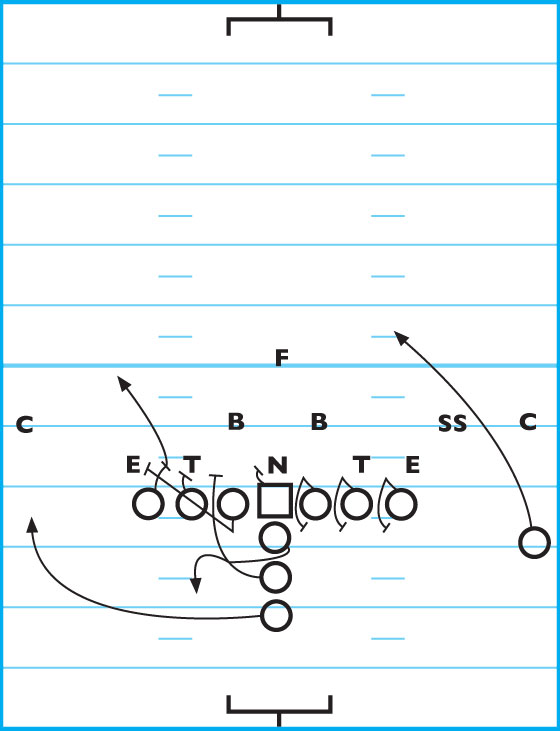
FL Motion, Route. The FL can also be sent in motion across the field or aligned away from the play side. If this occurs, run him deep down the middle of the field.
DIAGRAM 11:
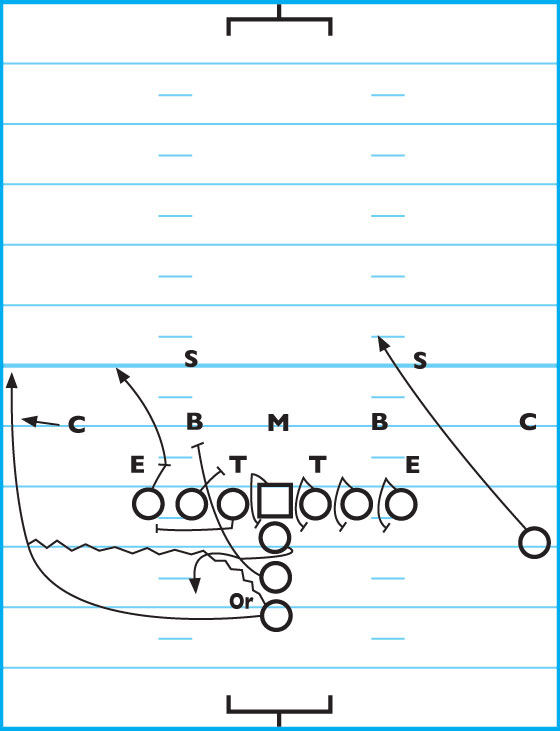
TB Motion, Routes. The TB can also fake his option route and run a flare route looking for a dump off by the QB. He can also be sent into motion and run the same route as a play-side flanker.