THE BASE OF OUR PASSING attack is the 3-step drop. We’ll use this series for the entire game if the defense does not adjust. With good execution, you can complete 70 percent of these throws.
The quarterback will take a 3-step drop and throw the ball on time to the necessary distance to get the first down. You may have the QB set at 3-steps, fake, drop back 2 more steps and throw.
We have developed 9 pass route combinations for our 3-step drop package. Every one of the 3-step routes includes a double move. These double moves are very effective in the red zone and are used to score touchdowns. They are also effective in third and long (7 yards or more) situations.
Most defensive backs are thinking about the double move, so they will bail out and try not to get beat deep. This is the reason the stutter-and-stop routes are used.
This article provides details on the stutter off of the hitch-and-out routes. The stop is used off four vertical fade combinations.
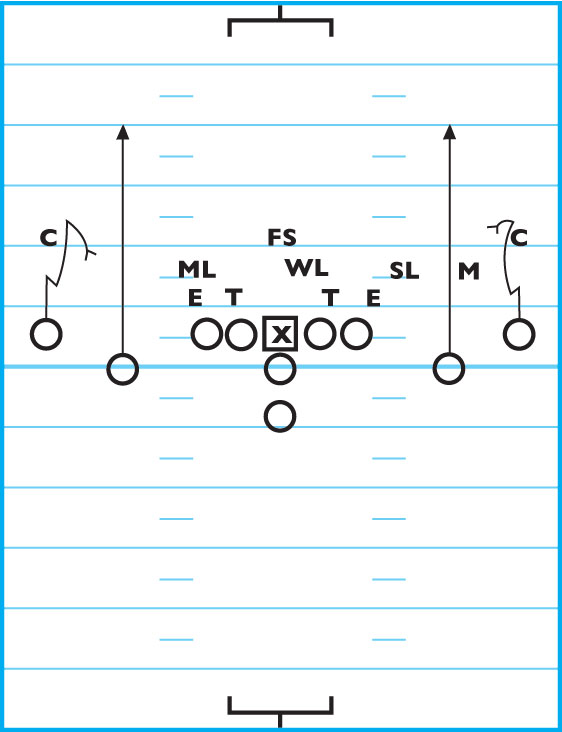
Hitch/Seam Stutter Route
DIAGRAM 1: This stutter route is used off of a hitch/seam route combination. You want to be in a doubles set. The outside receivers run a sloppy, very hurried hitch route at about 3 to 4 yards. The receiver then makes a take-off move as if he is running a hitch-and-go route.
The receiver must sell the go route; causing the corner to turn his hips and start to run. The receiver will stop and turn his shoulders inside facing the QB at the distance needed for the first down. This looks like two hitch routes.
|
|
Slant/Out, Fade/Out Routes
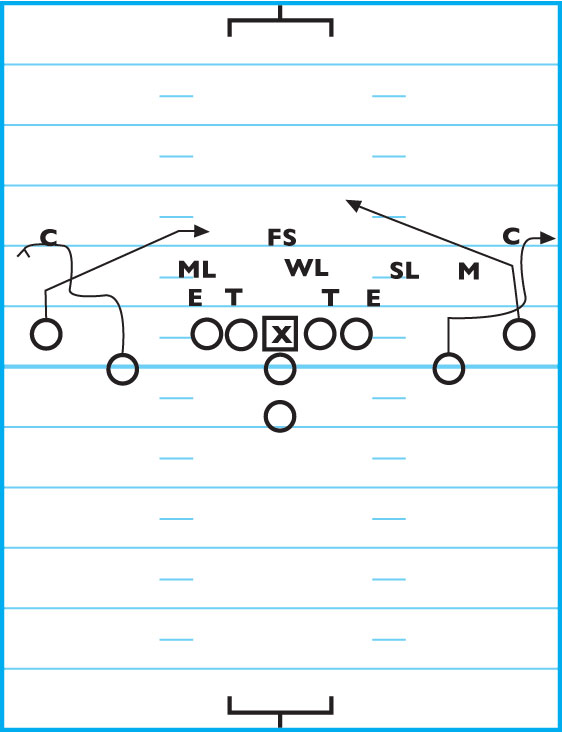
DIAGRAM 2 AND DIAGRAM 3: These two routes are used off of slant/out and fade/out route combinations. The out is used with the stutter.
When running the out stutter, the receiver is going to run an S-shaped out-and-up route. We call this the chair route. It must be run very fast to sell the defender on the route. Your player must turn his hips and force him to take off running.
The receiver will then run another out route at the distance needed to get the first down. It is very important that the outside receiver clear out the corner.
|
|
|
|
Spread 68 Stop
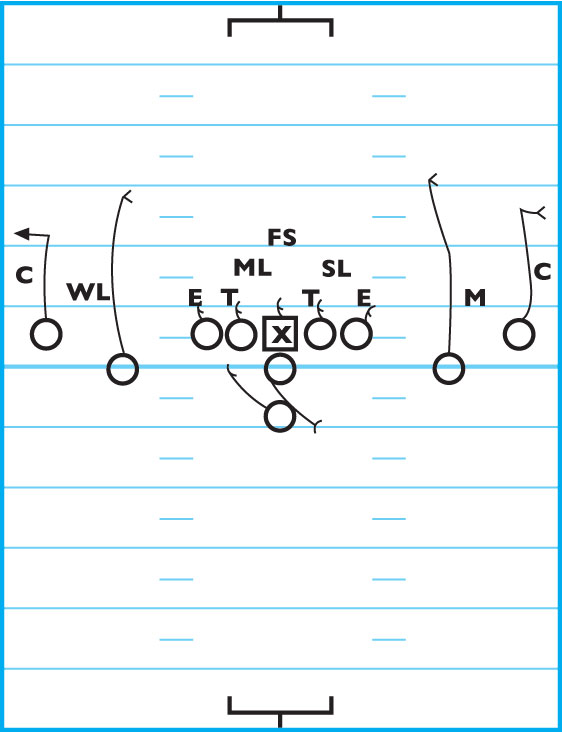
DIAGRAM 4: The stop route is almost impossible to stop, but the timing of the throw takes work. It also takes trust by the receiver and the QB.
We like to run this route off our four vertical packages. It is very good versus a cover 3 defense. The outside receivers must sell the fade route. It is important for your receivers to get the corner to turn his hips and run to stop the fade.
At the necessary distance, the receiver stops and pivots to the outside. Teach your players that this move is like a basketball player running a screen-and-roll move.
The QB takes the desired drop and throws it to the outside. You will either get a completion or the ball will sail out of bounds.
|
|
Get Creative
It is possible to run stutter routes off many other combinations. Only your imagination will limit you. This has been a good addition to our 3-step drop package.
Uncovered Receiver Principles Vital to Success
YOU MUST FORCE DEFENSES to cover down on all receivers. This affects the number of defenders they can use to stop the run, and how many players they can rush with.
Uncovered throws should be completed 100 percent of the time.
An uncovered receiver is a receiver who can catch the ball freely and end up with a gain of at least 4 yards. This can be an inside receiver that has no one within 5 yards or an outside receiver having no one within 8 yards.
There are two basic types of uncovered throws and routes. Each type has a special audible or cadence indicator. Use common sense with your uncovered receiver principles and don’t call them on a third-and-ten play.
*The 9 Call: This is usually thrown to the number 2 receiver, but it can be thrown to any receiver. The receiver takes two 45-degree steps up field, then turns and shows the quarterback his numbers, continuing to work up the field.
All other receivers use releases that turn the defensive back’s hips. The QB takes one step and releases the ball.
*The 8 Call: This route is like a quick screen that takes advantage of the angles of underneath defenders. You will be able to use good angles to block the defenders because they are covering down on your receivers. This is always thrown to an inside receiver.
The receiver will run a miniature bubble-screen route. On the first step, the receiver loses depth, the second step is a flat cross-over step and on the third step, he squares his shoulders and faces up field, working up field. The QB wants to throw the ball slightly in front of the receiver.
Fakes
These routes each have a fake-and-go or a sit. These fakes are needed as the defense starts to read or creep up on the uncovered routes.
*The 19 Call: This is a fake off the 9 call route. The receiver is going to run the first part of the route, and then run by the DB.
*The 18 Call: This is a fake off the 8 call route. The receiver runs the first part of the route, and then sits down in the soft area.
Jerry Teel
What Causes Interceptions?
1. Throwing off the back foot.
2. Throwing over the middle.
3. Throwing behind receivers.
4. Poor passing mechanics.
5. Forcing the throw.
6. Throwing a long pass short or a short pass long.
7. Late passes.
8. Throwing over linebackers instead of between them.
9. Throwing off balance.
10. Improper coverage read and pre-read.
11. Eyeballing receivers.
12. Always going to your favorite receiver.
13. Tipped passes.
14. Panic passing.
15. Not understanding routes and receiver selection.
16. Throwing into a crowd.
17. Improper read of a defender.
18. High or lob passes.
19. Disregarding the throw-away or the option to run.
20. Lack of discipline.
21. Poor receiver patterns.
22. Throwing after a bobbled quarterback-center exchange.
23. Receiver one-hands catch attempt.
24. Poor protection.
25. Throwing when you have to.
Pete Ventrelli,
Head Coach,
Downers Grove High School, Downers Grove, Ill.