At the United States Naval Academy, our philosophy is simple: We will be more fundamentally sound, more mentally and physically tough, and play harder and more passionately than anybody we play. We may never be the biggest, fastest or strongest football team in the country, but talent isn\'t a prerequisite for effort. Over the past five years, former Head Coach Paul Johnson has raised the bar and the expectation level of our football team and has achieved what many thought was no longer possible at a service academy.
Coach Johnson and our staff took over a program that had posted a 3-30 record in the three years prior to our arrival in 2002. Following a 2-10 mark in our first year, the Navy football program has enjoyed a 35-15 record throughout the last four years; a school-record four-straight bowl games; and most importantly, a school-record four-consecutive Commander-In Chief\'s Trophies, bringing the Naval Academy back into the national spotlight.
We are asked all the time about the resurgence of the Navy program; we are expected to give out some secret recipe or some magic reason as to how we were able to accomplish what we have so quickly. The answer is simple: HARD WORK. To be successful on the football field, just as in everyday life, there is not an easy way. If you have watched the Navy football team play the past few years and it seems that our guys are a little bit shorter, a little bit lighter, and maybe a step slower than almost everyone we play, it\'s probably because most of the time we are. With the academic standards as high as they are here at the Naval Academy, and the reality of the war in Iraq, we are not always able to pick and choose whom we want to suit up for us on Saturdays. But we make no excuses for about who we are; we simply play hard to make to the most of what we have. The physical tools and God-given ability are something that our young men have no control over. However, there are some things that they can control, and that we, as a coaching staff, demand of them. They must know and execute their assignments, play with great pad level and fundamentals, and play with unrelenting effort and emotion, all of which are learned skills. This is why the biggest, fastest and strongest don\'t always win. Games aren\'t played on paper and at scouting combines. Games are played and won with young men whose immeasurables often outweigh their measurables and who care more about their teammates than they do about themselves.
Navy Linebackers
Great defense always has and always will begin with great linebacker play. A linebacker must have a team-first attitude, as well as a burning desire to excel and be someone special. I don\'t want to associate with guys who want nothing more than to be average and ordinary, and I definitely don\'t want to coach them. A linebacker must be a great leader and take it upon himself to set the tempo of practice, working hard from the time he walks on the field until the last rep is run.
Linebacker Drills
The Navy linebacking corps, and the entire Navy football team, has adopted the Marine Corps saying which states, \"We must train the way we fight because ultimately we will fight the way we train.\" That\'s the attitude that we take into practice and drill work every single day. We start every drill with a great stance and perfect body position and FINISH each drill with great effort. Anything less and you are wasting your time and are, in fact, just engraving bad habits into your player\'s minds.
As I start my fundamental period or begin my drill sequence, I make sure I have a plan and I\'m doing things that are going to make my guys better football players. I never do the drills just to do drills. Each drill must have a purpose and help perfect a fundamental or technique. Each drill must also be both position and game specific and have a distinct start and finish. I will work three main drill sequences during my fundamental time in practice every day. The Wave Drill, the Cage Drills, and the Run Read Drill are the building blocks I use to develop the linebackers at Navy.
The Wave Drill
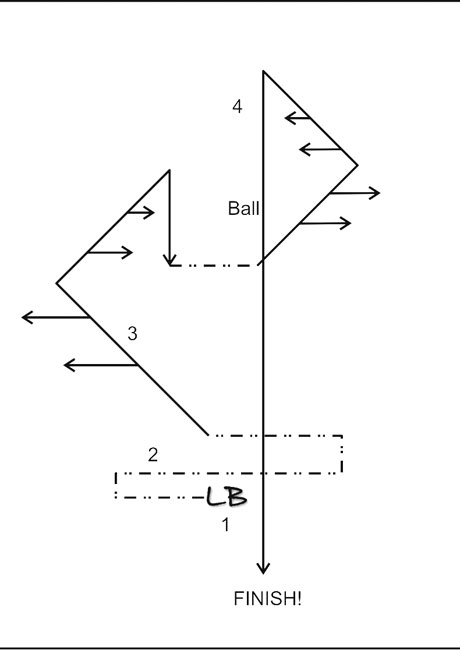
(See Diagram 1)
|
Diagram 1: The Wave Drill
The Wave Drill is a drill that I modified from our defensive coordinator Buddy Green\'s defensive back drill which he has used for many years. The Wave Drill is simply a change of direction drill that emphasizes body position and has pad level throughout each phase. The drill can be broken down into four phases: 1. The stance and start phase; 2. The shuffle phase; 3. The 45 degree ‘flip-the-hips’ phase; and 4. The transition phase. We go through each phase in this progression twice before the ball is thrown and the drill is complete. If the ball is dropped or the LB\'s pad level is too high and unacceptable, the drill is repeated over and over again. The players will learn the importance of maintaining good body position, catching the football, and finishing the drill. There can be no wasted motion in playing good defense. Poor body position can make fast players slow and slow players even slower. This is why it is imperative that the body position in the initial stance and start phase be maintained throughout the drill and throughout the football game. If there is constant raising and lowering of the hips and shoulders in order to change direction, then you are wasting valuable time and are ultimately playing slower than you should play.
The Cage Drills
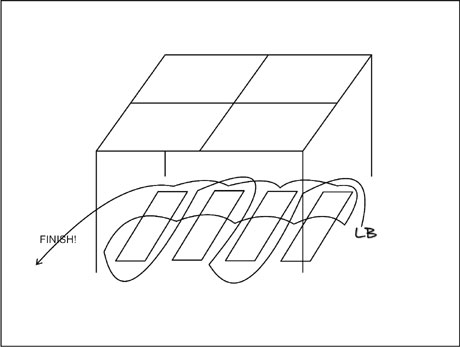
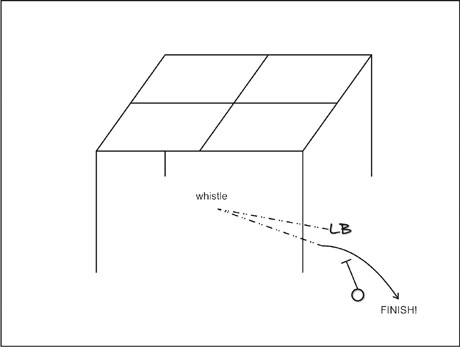
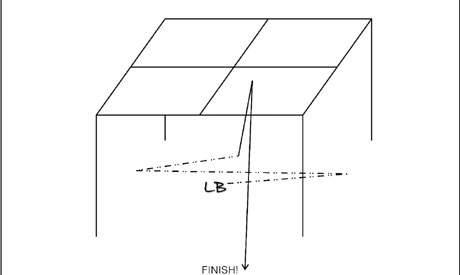
(See Diagrams 2, 3 and 4)
|
Diagram 2: Bag Drills
|
Diagram 3: Counter - Cut & High Block
|
Diagram 4: Side-Side/Back- Forward Drills
The majority of the other drills that I use every day in practice are done under a 10\' x 10\' x 54\" metal square, affectionately known as ‘The Cage.’ Great knee bend and body position are required to get under the cage and perform the drills without hitting your head on the metal poles as you enter and exit. Every one of my guys needs this constant reminder. We will do three main drills under the cage: 1) Bag drills; 2) Counter: cut and high block; 3) Side-to-side drills, backward to forward.
First, we will do all of our bag drills under the cage. I do not like doing the traditional linebacker drills outside of the cage because of the linebackers’ propensity to raise their shoulders and get too high as they pick their feet up to go over the bags. The cage simply acts as a reminder to keep their pads down and their chest over their toes. I like to vary the bag drills and combine some of them in a sequence in order to keep it fresh and break up the monotony that is sometimes created in practice. The diagram illustrates an example of a typical sequence used in practice. We will go in order: 1) Back pedal and break; 2) Over the top drills; and 3) Sink the hips and play the cut block. Once the LB has performed the sequence in order, he will finish through the cones and the drill will be complete.
Next, we will work on block disengagement. The linebacker will start on the edge of the cage in a perfect stance. On the first whistle they will shuffle under the cage waiting for a second whistle. On the second whistle they will shuffle back the same way, emulating the counter. As they exit the cage, another teammate will either high block or cut block the exiting linebacker. On the high block, the linebacker will shoot his hands out with his thumbs up and his elbows aiming for the blocker\'s breastplate. The linebacker must beat the blocker to win inside hand position and punch and separate as quickly as possible. Remember, it’s a punch, not a push. To take on a cut block, great knee bend and body position are required. The linebacker will drop his outside foot and keep his eyes on the blocker until he clears the cut. To take on the block, the linebacker will shoot his inside hand on the blocker’s shoulder pad and his outside hand on the front of the blocker\'s helmet. If his hands ever end up on the blocker\'s back or the top of the helmet, he will be cut and the drill will be repeated.
Finally, we will perform the side-to-side, backward to forward drill, which is self-explanatory. The linebacker must maintain great pad level while moving in each direction. The objective is to improve the change of direction and to ingrain the importance of great knee bend and body position.
The Run Read Drill
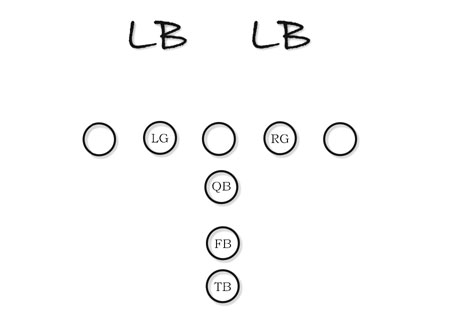
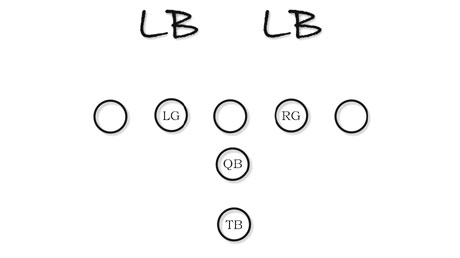
(See Diagrams 5 and 6)
|
Diagram 5: 2-Back Run Read Drill
|
Diagram 6: 1-Back Run Read Drill
Formations, personnel groupings and offensive strategies will obviously change from week to week, but football, at its core, will always return to some basic fundamental schemes. Each week offenses will show you something that you have never seen before, so your linebackers need to be good at reading blocking schemes and making the correct reaction. If you work the basic fundamental blocking schemes on a daily basis, you will be ready for anything that might be thrown at you come game time. I work the Run Read drill with a center and two guards along with two trash cans as offensive tackles. I work both one back and two back schemes and change our gap fits based on the defense called. The linebackers must know where their gap fit is and where their help will be from the secondary. Football is a simple game that can sometimes be made too complicated.
The bottom line is: players will do what you ask them to do and will play as hard as you make them play. If they won\'t, you are probably playing with the wrong guys to begin with. You cannot baby and coddle your players during the week and expect to coach them hard and have them play hard on game day. Be consistent, raise the bar and coach \'em hard!
If you have any questions
you can email the author at:
DannyORourke@GridironStrategies.com
POINT OF VIEW
Ron Roberts is the Head Coach
at Delta State University. His Statesmen finished among the top four Division II colleges in the nation in five different defensive categories last fall.
“I like Coach O’Rourke’s drills because they have a plan and a purpose. They stress fundamentals and techniques and you can’t overdue their importance.
“I like his chute or cage drills the best because it teaches flexibility; being able to bend at the knees and the hips and that is where the game is played. It’s about power angles and these drills are so important for linebackers. It also gives them a chance to redirect and change direction as well as have leverage on blockers. The only thing I would add is starting some of the drills outside the cage and go right into it as well as from starting inside the cage itself. When you’re up and running, linebackers also have to learn to transition from up high to go low to leverage blocks.”