2010 was a record breaking offensive season at UAPB. The success we had on offense couldn’t have been accomplished without the development, hard work, and consistency of our record breaking wide receiver Raymond Webber. Webber led the NCAA in receiving yards, receptions, and yards per game. When I arrived on campus in January, 2010, our offensive staff was able to identify that we had one big play WR and we wanted to do everything to get him the football. The entire coaching staff brainstormed each week on ways to move Raymond Webber around and what plays would feature his ability. As the season progressed, we saw many different defensive schemes that were geared to contain Webber. That is when our coaching staff had to really come up with even more creative ways to develop mismatches for him. There are three main priorities that were always at the forefront of every weekly meeting – the QB progressions, ways to get Webber the ball as an outside and inside receiver, and what formations will best create mismatches.
We have simplified the passing game for our quarterbacks. There are three primary reads we teach at UAPB – coverage reads, object reads and safety push reads. Once our QB learns these three basic principles, he will always know exactly where to go with the football. Coverage reads are always dictated by the number of safeties on the roof (See Diagram 1).
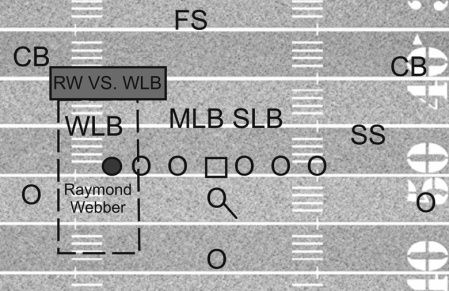
Diagram 1
This allows us to develop 1-safety and 2-safety beater sides to a particular play. We now are able to determine pre-snap which receiver may have a better chance of getting the football. The object reads allow the QB to read an area or a particular defender. Based on the movement of the object, the QB will work to the opposite of the specific defender’s movement (See Diagram 2).
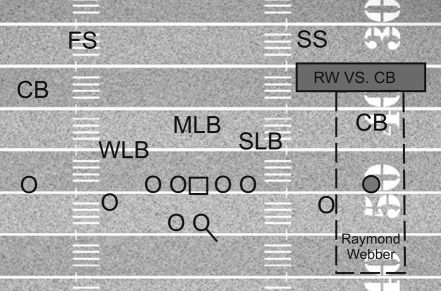
Diagram 2
The WR will be taught to find the open window opposite the object’s movement. Safety push reads are designed to work away from any safety rotation and take advantage of potential one-on-one match-ups with WRs and CBs (See Diagram 3). All these reads are directly related to where we should place our best playmaker.
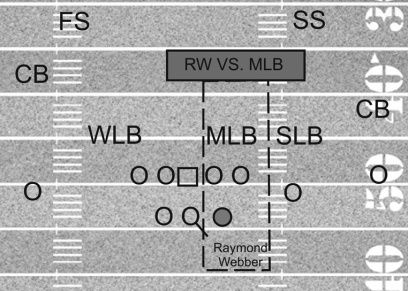
Diagram 3
In our system, outside wide receivers and inside receivers have a few different techniques they need to be taught. Our outside receivers will likely face CB’s and receive much more press coverage than our inside receivers. Inside receivers will face LB/SS body types and are likely to get re-routed more than the outside receivers. Inside receivers must understand leverage, landmarks, and be taught how to read defenders much more than our outside receivers. We decided to cross-train Webber and teach him exactly how to attack defenders to get a vertical push. We were able to work with him 10 minutes before and after practice for one-on-one time.
The before practice routing was mainly releases from the outside wide receiver position and the after practice segments were inside receiver releases. The main releases we focused on at the outside receiver position were cover 2 releases and man releases (single stick, double stick, and slap and rip technique). The inside receiver position focused on dip and rip techniques and slipping and resetting the stem. The different techniques helped him understand the match-ups he was facing and how to defect each defender.
Each week after all the film has been broken down, our offensive coaches look at each formation individually. We are always trying to find mismatches, where the leverage is, and a specific weakness in the defense. We tried to place Webber at different positions in each formation to allow him to touch the football. So for example, he may play a single receiver in a 3x1 formation one week and be a #3 receiver the next. Therefore, if defenses wasted their time trying to bracket him because they thought he would be an X-receiver, imagine their surprise when he was matched-up on a linebacker (See Diagrams 4-6 on specific formations used to get Webber the football). We also had him shift pre-snap and in motion on many plays. We constantly tried to allow him to run “On the Move Routes”. These were routes where he didn’t have to run full speed and then stop suddenly to get to a landmark.
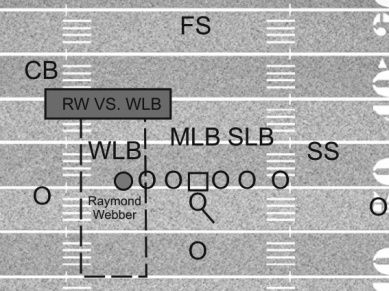
Diagram 4
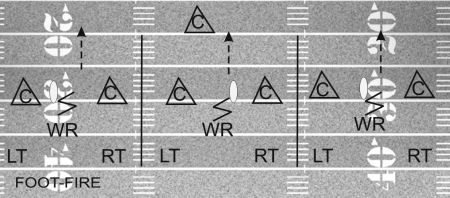
Diagram 5
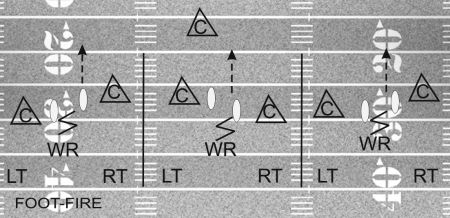
Diagram 6
We made a commitment to Raymond Webber to feature him and, in return, he made a commitment to our staff to work hard and learn all the intricacies of the position. This was a total team effort and required trust from both sides.
About the Author: Jerry Mack serves as both the offensive coordinator and quarterbacks coach at the University of Arkansas at Pine Bluff. Mack previously was the passing game coordinator at the University of Central Arkansas, wide receivers coach at Jackson State and running backs coach at Delta State.