“Multiplicity Through Simplicity”- this short phrase is a pillar of our offensive philosophy. Multiplicity means we want every player to understand that we can run our offense out of as many looks as we can. Simplicity means we define roles and alignments ahead of time for our positions to fit into those looks, and then teach our QBs how they all tie together. We are able to utilize the spread, no-huddle components of our offense while staying in 21 personnel (2 RB, 2WR, 1TE).
The first component of our offense that gives us the ability to become multiple in 21 personnel is our formation/alignment structure. We have hard calls for fifteen formations that are the sum of the pieces we can put together in any personnel grouping. The quarterbacks in our system learn that each formation/alignment combination is like a math equation. Through our meetings and homework, they learn how to see the solution. This system has reduced mistakes in alignment by all of our skill players. Our quarterbacks have also developed a better understanding of field awareness, defensive alignments, and matchup advantages.
We designate nine spots on the field for alignments that we tag using position-specific wording. For all motions, we have the same spots numbered 1 through 9, which are universal for all positions. Using this method, we are able to get into a variety of looks out of our base pro formation (Diagram 1).
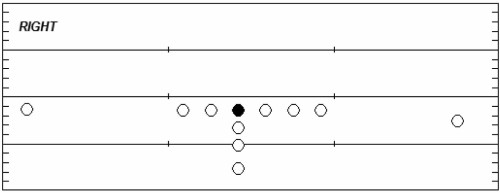
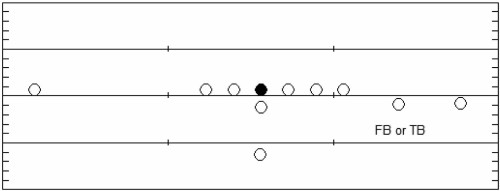
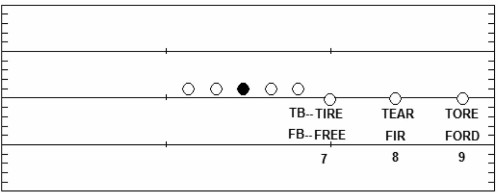
Displayed in Diagram 2 and 3 are the tags we use to the right of the field for the tailback and fullback, as well as the corresponding motion labels. Starting in our base formation, right, we can get to a TE trips look by naming the formation “Right Fir” or by motioning “Right-T8.” Furthermore, we can get to an empty backfield by naming the formation, “Right Fir-T2.”
The second component to being multiple is our Two-Play Check system. We send our offense to the LOS with a 2-Play Check around 60% of the time. We teach our QBs what we are looking for in each check so that on Saturday they can run the show.
Our QB will get us into the correct play on the LOS through his cadence. We are able to package 2-Play Checks with Run/Run, Run/Pass, and Pass/Pass. Unless we have a younger QB, or there is a new look from the defense, we rarely take over for the QB from the sideline. If we have to do so, only the QB will look to the sideline, get the check, and then communicate the play in his cadence. Overall, this system allows us to snap the ball in a timely manner, and keep the defense from baiting us with a look before the offense looks to the sideline. Whether a 2-Play Check is on or not, our cadence system remains the same so as to not trigger the defense that we are changing a play. The communication needed to change a play is coded in to the cadence. This system also puts our QB in charge and gets him more in tune to the defense and how our game plan is designed to attack each week.
The following are a few packages we utilize out of 21 Personnel. In 21 Personnel, we use a FB and TB, and other times we use two TBs. We experiment each spring and fall camp with all of our backs (TB and FB) to better understand the skill sets they have so we can best utilize those skills in the season. We teach all of our backs the footwork and blocking assignments for all of our run plays. In our individual and group periods, we have all of our backs receive handoffs and work blocking fundamentals with each other. This allows us to get a lot of reps as the drill never stops to wait on anyone to get lined up, and either position can fit in at FB or TB. Whether we are working two-back or one-back plays, they are all constantly working. The past three years we have had two fullbacks that we have been able to use at times as a heavier tailback. These players had a knack for seeing Inside Zone, Power, and Counter, as well as one-back protection. Also, keeping the FB in the backfield and splitting out a TB only expanded what we could do in our personnel packages.
One formation we utilize with a great deal of efficiency is a Trips Closed formation (Diagram 4).
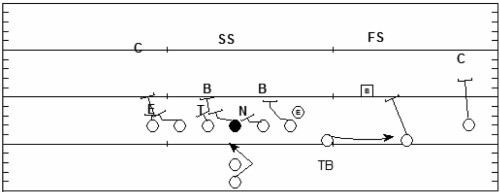
In this formation, we call a variety of 2-Play Checks in order to best utilize the numbers game against the defense. This line of thinking gives us some great advantages in the “Green Zone” which we define as the 25-yard line and in. We use this term instead of the “Red Zone” because that is a defensive-minded term which means “stop – we want to go.”
The formation call in Diagram 4 is “Lt Over Tire.” Lt Over (Twins) is the base formation and the “Tire” tag moves the TB to the wing position, aligning us in a trips closed formation. We define alignments ahead of time. Using these definitions limits the amount of memorization for each position, and allows us a variety of ways to use all of our personnel to become multiple. The remaining RB in the backfield can be either a FB or TB. Either of the backs left in the backfield are expected to lead block on QB runs. The play call in Diagram 4 is Zone Read Left. With this play, we will bubble #3, which in this case is our TB. We tell our QB that with any leverage advantage we get to the trips side to go ahead and throw the bubble (this decision can be made pre-or post-snap). If the bubble is not thrown, the QB will read the “C” gap defender for the give/pull read. Built into our play are two chances to quickly get one of our RBs the ball, one in space with the bubble and one with our base run play.
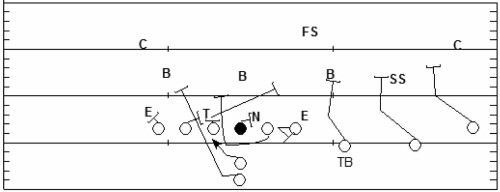
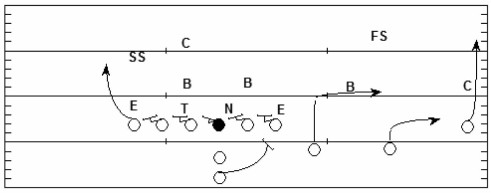
A 2-Play Check out of the same formation is QB Power to the right or quick game to the left. Our QB looks at the number’s match up to our trips side. If we get anything close to a 4-on-3 by the defense, we will run the play strong. If we get a 3-on-3 match up by the defense, then we will run the Quick Game call. Diagrams 5 and 6 show each check based on the defensive alignment.
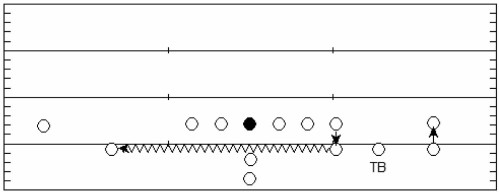
The next two plays are counter read plays that we use in 10/11 personnel that we have adapted to 21 personnel. The formation call is “Right Tear-Y2” which changes us from a TE trips look, with the TB in the slot, into a 2 X 2 open formation with the TE motion (Diagram 7).
The first play is an OT counter, with a QB read option built in (Diagram 8).
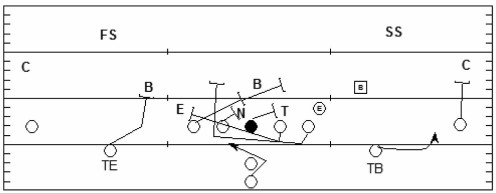
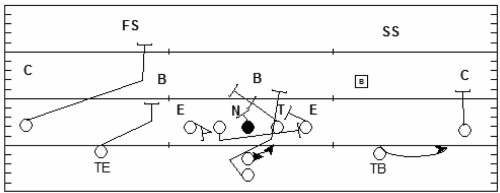
The playside tackle and TE or guard are working down to the backside LB, the C is back blocking to first man to the back side. The pulling guard is kicking first to show and the pulling tackle is working to the playside LB. The QB has a backside bubble (which is run by the TB) for any leverage opportunities, and he can also pull the ball if the C gap defender chases and the support player runs with the bubble. We can 2-Play Check this play with itself based on numbers, or with a passing concept based on safety structure.
The last play is a variation of our two-back counter, pulling the backside guard to kick out and using the FB to lead on the playside LB (Diagram 9). In one-back formations we make this a QB run call. First the QB will read the bubble to the play side for leverage. If support chases the bubble, the QB will follow his lead blocker, which is whatever back we leave in the backfield.
Finally, we are able to vary tempo in 21 Personnel. To execute a no-huddle pace out of 21 personnel, we incorporate a handful of plays on our No Huddle/2-Minute Band that each player wears each week. We are able to jump into this pace anytime we have 21 Personnel on the field. Our 21 Personnel No-Huddle has the pertinent information on the band for each position. First, we signal the play number to the QB, he echoes the number to the other players, and then the ball is snapped. The QB and WRs will have the full call and formation. The OL will have the run play or protection where formation is not necessary for them. The TEs will have the formation and specific route or run play. The RBs will have the formation, run play/protection.
We have worked to align our offense with the most basic of our personnel groups so we are not limited in our calls. We also want to try to break tendencies and rhythms in opponents’ play calls. We arrived on campus three years ago with a variety of personnel on our roster, and have continued to recruit that way each year. “Multiplicity Through Simplicity” has created an environment for our players, recruits, and coaches that allows all of us to expand our skills and play to our differing abilities throughout the course of a season or career.
About the Author: Ryan Majors is in his third season at William Jewell, serving as both offensive coordinator and quarterbacks coach. He previously was the head coach at Shawnee Mission North High School (KS) for five years and also was a graduate assistant at Pittsburg State. Majors was a quarterback at Emporia State University and a three-year captain. He has a Bachelor’s Degree from Emporia State and a Master’s Degree from Pittsburg State.