The concept behind going to a spread formation came about because of a need to force people to defend the whole field. As the offense spreads out, so does the defense. What has happened, however, is that we are a bit too simplistic in our alignment. Thus, defenses match up with us pretty easily. Most people have gone with an even front (4) and two inside LB’s… 6 in the box and played 3 deep with a man on our Flex End playing man coverage and a walk-away OLB to the SE side.
We have occasionally gotten an odd front with 5 down linemen and 2 ILB’s. Even with the odd front, people have still played a 3 deep shell with M/M on our Flex End. We got a tip from a coach who told us that when we see the DE/OLB to the SE side come up on the line, just throw a quick stop pass to the SE. He’s got one-on-one soft coverage and the QB just catches, sets and fires it out there. This was our first experience with throwing “quick fire” (what would be our 90’s series… 3-step drop from under center) passes and it was very effective against a rival high school with little practice (See Diagram 1).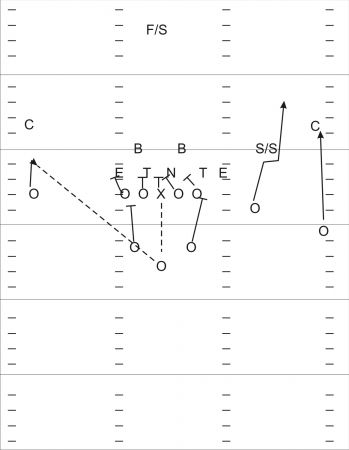
|
|
Diagram 1
After evaluating game film in the off-season, I realized that it is very easy to match up with us since we sit in one formation. The question that I’ve been mulling over is: How can we keep things simple, provide adequate protection for our QB, yet still create mismatches against defenses? The concept came to me one morning: MOTION!
Send the HB in motion to the 2-receiver side. By motioning the HB to the Flex TE/Flanker side, we are now in a trips formation. The defense will have to adjust someone or we have them out-numbered (See Diagram 2).
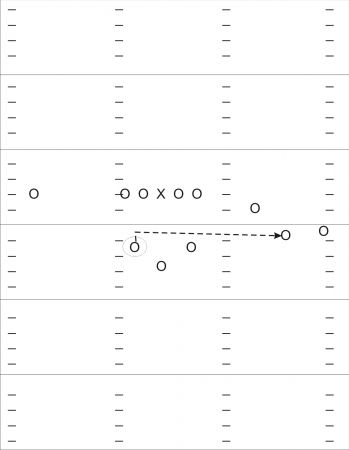 |
Diagram 2
The first question we need answered from the spotter in the box is: “What are they doing with their Free Safety?” If they keep F/S in CF, then they are covering down ALL of our receivers? RESULT: Throw the Screen to our Flanker (See Diagram 3).
|
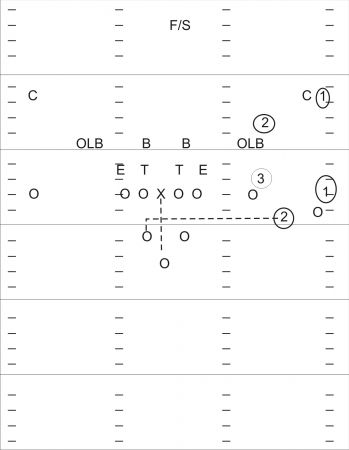
Diagram 3
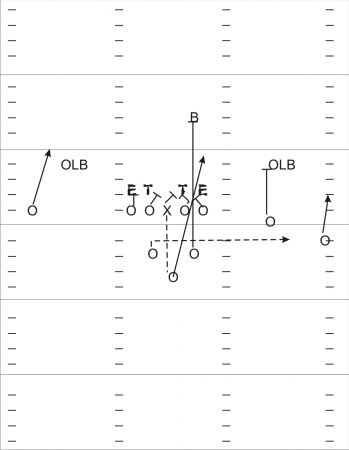
NOTE: We coach the motion HB to pick a point half the distance that the corner is aligned depth-wise and run to that point. By the time the corner reacts up, the motion HB will be in position to kick-out block the corner coming up to tackle the flanker. If you want to run the ball, the QB lead to the strong side gives your QB an effective straight shot into the line (See Diagram 4).
|
|
Diagram 4
If the FS stays in CF, then they may be moving the OLB to adjust to trips. RESULT: the OLB covering the TE moves out to pick up the motion HB. Then, stick it in there to the TE in the seam (See Diagram 5).
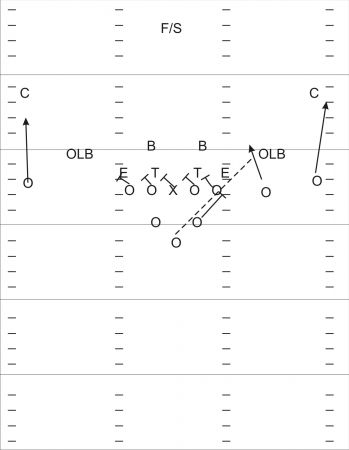 |
Diagram 5
If they move the F/S out of CF, how far removed is he?
RESULT: If F/S vacates CF, we have the backside SE one-on-one with the CB and we can throw the post to him or hit the TE with a Pop Pass up the seam to the inside (See Diagram 6).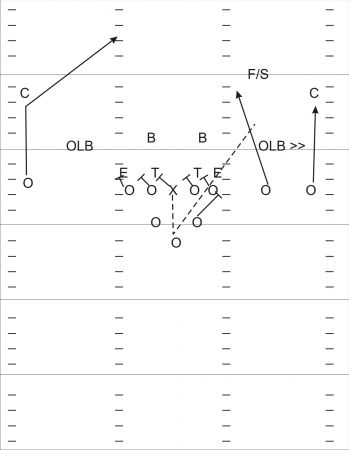
|
|
Diagram 6
The second question we need answered is “What are they doing with their Inside LB’s?”
If they slide the ILB’s to help outside with the trips, how many are left in the box? RESULT: We will run FB Trap (See Diagram 7).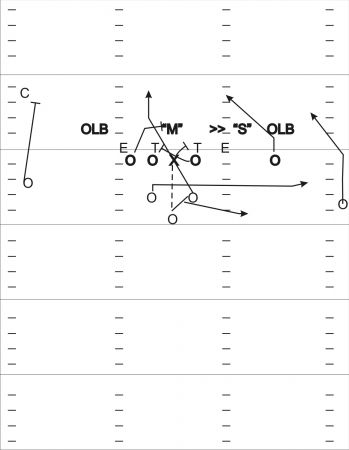
|
|
Diagram 7
If they slide all the LB’s (including the SE side OLB) how many are left in the box?
RESULT: We throw to the SE who’s one-on-one with the CB or Belly (83/87) Trap to the SE side (See Diagram 8).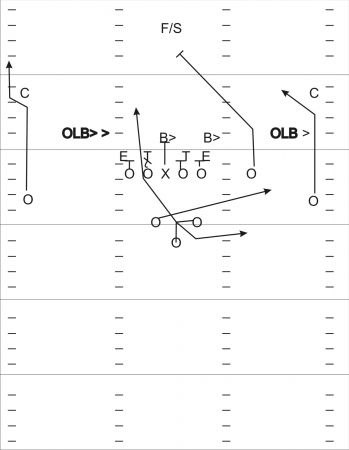
|
|
Diagram 8
Alternate Patterns:
We also have 91/99 “Sucker” pass off of the Screen. If the CB tries to support too quickly on the screen to the flanker, pump and throw to the HB going past the CB up the sideline (See Diagram 9).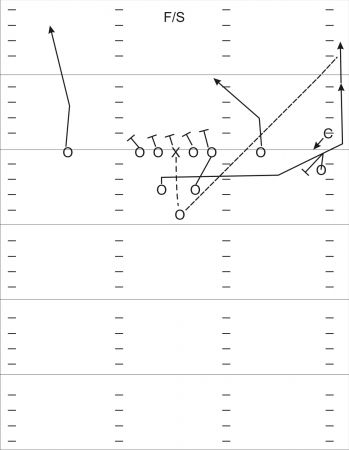
|
|
Diagram 9
We also like to throw a “defender altering” pattern where one of our receivers will cross in front of a coverage man and attempt to cause two defenders to block out each other. The following is an effective pass vs. man coverage. We throw it from our ‘Quick Fire’ series (See Diagram 10). 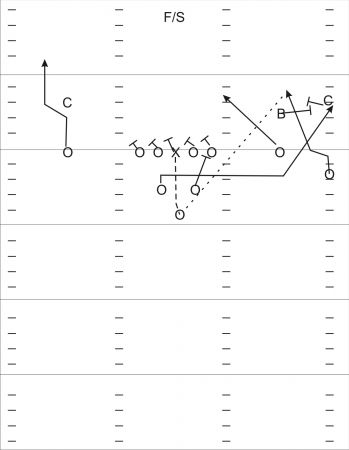
|
|
Diagram 10
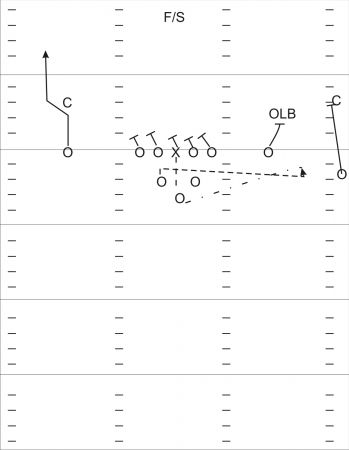
We can also motion the HB and designate the HB as the man we will throw to on the ‘bubble’ screen. Now the TE and Flanker block and the motion HB catches the ball and works down the sideline (See Diagram 11).
|
Diagram 11
“HOT” READ: If the OLB covering our Flex TE slides out, we want to hit the Flex End on a Quick Seam pass. We still call 91/99 Hitch Screen but the QB has to read that the Flex End is no longer covered down (See Diagram 12).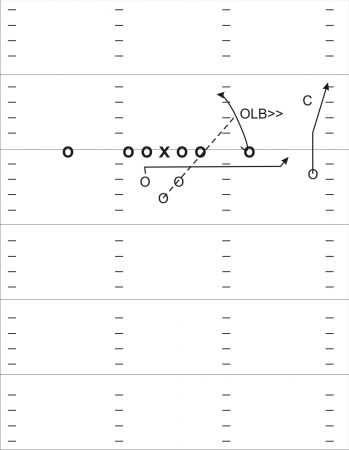
|
|
Diagram 12
IF they slide the ILB’s to balance out to our Trips, then we call 24/26 Trap. Our thinking is that they only have one LB covering the middle in which we have a numbers advantage and we need to attack there (See Diagram 13).
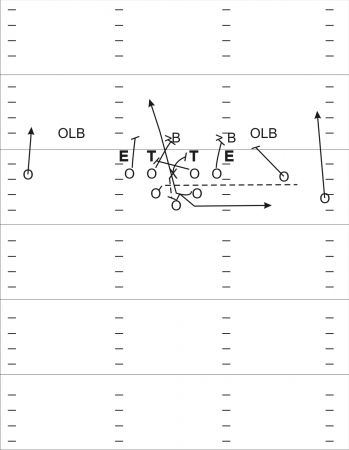
|
Diagram 13
If they slide the LB’s to the strength, it can also open up the flank to the SE side both inside and outside our offensive tackle. Another effective play we can utilize is FB Belly to the SE side because we have a numbers advantage (See Diagram 14).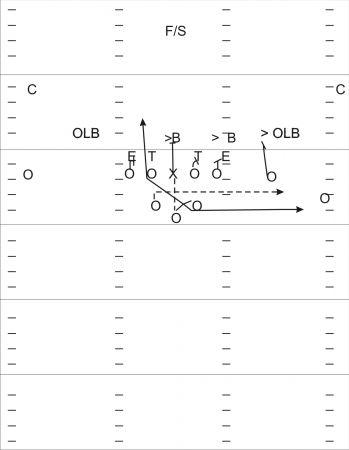
|
|
Diagram 14
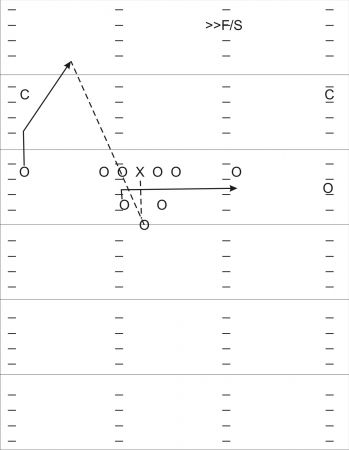
IF they vacate CF by moving the F/S over to cover the SE or Flanker, we can hit the SE on a 93/97 “skinny” post on the back side since he’s one-on-one with the CB (See Diagram 15).
|
Diagram 15
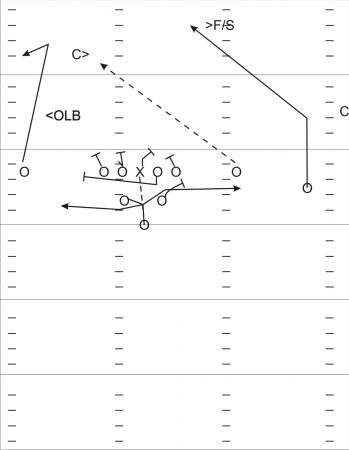
If they just move the zone over to compensate for our trips alignment, we can throw 32/38 Nike (boot-leg). Now we have 3 receivers flooding back against the rotation of their coverage (See Diagram 16).
|
Diagram 16
HB motion to the SE side (twins): We can also motion the HB out of the backfield to the SE side to create twins to that flank (See Diagram 17).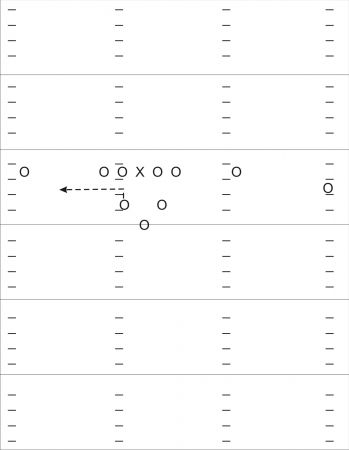
|
|
Diagram 17
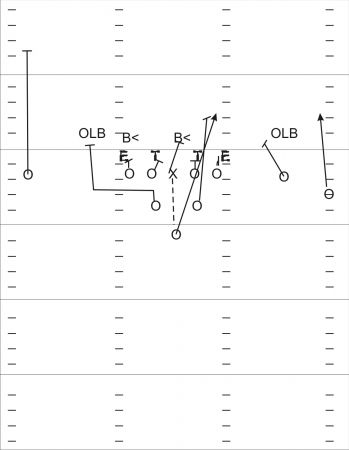
We get the same reads that we look for to the Flex End/Flanker side to determine what is the most effective play to call. With the motion towards the SE, the LB’s are going to shift towards that motion. One of the most effective running plays we’ve used against that defensive shift is the QB Lead/Follow to the Flex End side away from motion (See Diagram 18).
|
Diagram 18
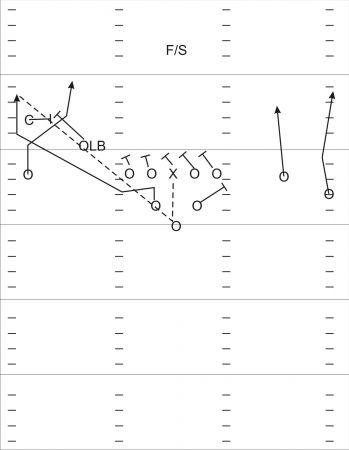
With only 2 receivers to the SE flank, the screen is not as effective to that side. The pass that has been most effective is the “pick” pass to the SE. The prime receiver, though, is the HB up the sideline. It is almost like the classic “wheel” pattern where the corner bites inside on the SE slant and the HB gets behind the corner up the sideline. The SE delays until he sees the HB pass in front of him and then he runs a skinny post up inside of the hash marks.
NOTE: Coach your QB to get rid of the ball as the HB turns up the sideline! It is NOT designed to be a deep pass. As the Corner jumps the slant route and the HB starts up the sideline, throw a dart to the HB as he gets square upfield. This can be an effective pass against man coverage or 2 deep if the QB hits the HB early enough (See Diagram 19).
|
Diagram 19
SUMMARY:
As offensive coordinators find effective ways of attacking defenses, defensive coordinators are looking for the means to stop them. Spreading the field has proven to be a way to pressure the defense into covering the whole field. It is much easier to detect and then exploit a weakness in the defense simply because it is much more difficult to cover the “weak link” when everyone is exposed in covering a spread attack. We found that we needed to add a “twist” to our base Spread Shotgun Wing T package just so defenses couldn’t “dig in” on us. I heard Coach Joe Taylor, formerly of Hampton University, say once that, “motion creates paralysis.” Defenders’ anxiety level increases as offensive receivers begin to move before the snap. This has given the Spread Shotgun Wing T package something else that defensive coordinators have to scheme. The Next Generation of the Spread Shot-wing continues to evolve into an offense unto itself. Combine it with a base Wing T system and it has proven itself to be very difficult to prepare for.
WHAT IF?
Q1.What if you continue to face linebacker blitzes with your motion series? Do blocking assignments or responsibilities change?
Nothing changes. That’s the beauty of the system. You keep your Wing-T principles, blocking rules and play calls the same. Blitzing calls for screens. The motion series has ‘built in’ screen passes so it is tailor-made for pressure defenses.
Q2. What if the defense has had some success with stunts by the defensive end and tackle? Do you adjust in any way with your offense?
The blocking of the 90 Series (Quick fire Passes) is such that zone blocking counteracts twists and loops by defensive linemen. Our offensive linemen step to their play side gap (much like pat protection) and pickup whomever tries to penetrate that gap.
Q3. What if in your motion series you have press coverage by the corners on each respective side of the field? Do you make any checks and do routes change on pass plays?
Press coverage would call for hitting the motion back going deep down the sideline after pump faking the hitch screen to the flanker or SE (depending on which side you call the play). We would also call ‘hitch and roll’ to our SE. He drives four steps, plants and turns to the QB. He throws up his hands to lure the corner and as the QB pump fakes the pass, the SE rolls into a ‘fade’ route and goes wide and up the sideline. The QB recocks and drops the ball over the aggressive corner’s head.
Lew Johnston is the former Head Coach at Western Branch High School in Chesapeake, VA. You can reach him at LewJohnston@GridironStrategies.com.