The offensive coordinator was frustrated trying to block the inside veer with a three technique defender who kept slanting into the B-gap. This wrecked each scheme they came up with. They finally developed a series of plays to counter the defense.
The first play snapped that next Friday night was the mid-line option. The B-gap lineman shot upfield, the ball was handed off, the guard hit the linebacker and the free safety tackled the fullback 10 yards downfield. The rest is history and the mid-line option was here to stay.
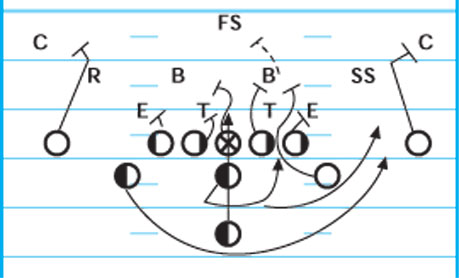
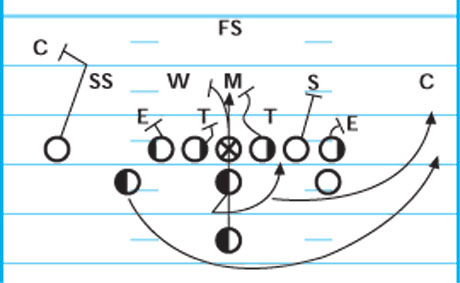
We block the 8 man front and the 4-3 from different formations. These plays are run from an I-formation.
Here are the player responsibilities for the Mid-Line Option:
Frontside Tackle: Block #2 at the line of scrimmage. Against a 4-3, combo with the tight end on the 7 technique defender.
Frontside Guard: Veer for the playside LB.
Center: Power scoop.
Backside Guard: Power scoop.
Backside Tackle: Hinge and protect the backside of the QB.
Tight End: Block the 6 technique on out. Against a 4-3, combo with the frontside tackle on the 7 technique defender.
Playside Halfback: Read step, go through the B gap for playside LB to the FS.
Backside Halfback: Gain pitch relationship with QB.
Fullback: Mesh with QB. Keep inside arm up. Aim for the middle of the center’s butt.
Quarterback: Cheat step back and over with opposite foot. Mesh with the FB. Read the man over guard on out. If you get a pull read, duck it and run in the B or C gap. If the B and C gap is closed, bring it out and pitch it off 1st support.
Wide Receiver: Cut off your corner.
The Mesh, The Read
Never practice this play without a manager, trainer or back up center giving the QB a snap. This prevents the QB from getting into the bad habit of pulling out too early from the center.
The QB takes a short 4- to 5-inch over-and-back step to remove himself from the FB’s path. This first step is taken with the foot opposite the play hole (have your QB step with the left foot if the play is going to the right). The QB then pushes the ball back with his left forearm (if the play is called to the right), trying to race the ball back so it is in mesh position at the same time his second step lands.
The QB’s knees are slightly bent with the ball suspended in the air directly behind the middle of the center’s butt. If the center never moved, the middle of his butt is the mesh aiming point for the QB and FB.
The QB’s focus is the shoulder pads (particularly the inside shoulder) of the defensive tackle. The QB never looks at the FB. There is no time to peek at the FB or to know what the read key is doing.
The FB’s first step is a short 4- to 5-inch step with his playside foot. On his second step (a longer natural step), he starts to form a pocket to receive the ball. We often lay a 3/4 by 4-inch wide board under the FB’s path in practice to keep the FB from stepping underneath himself.
This teaching tool has given us a solid mesh for many years. We mesh for 10 minutes a practice the first 3 days during two-a-day workouts. After that, we mesh for 5 minutes a day prior to our half line and team segments of practice.
DIAGRAM 1: Blocking scheme vs. 8-man front from a Doubles Formation.
|
DIAGRAM 2: Block scheme vs. 4-3 with a Tight End Formation
|
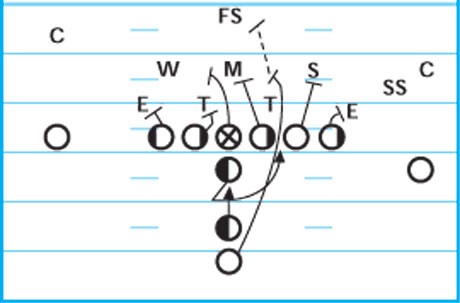
DIAGRAM 3: Mid-Line from the “I” Formation vs. 4-3
|
Note: The backside guard is not pulling (like Nebraska). We would still read our way out, use the tailback to block and the play would become a double option with the FB and QB.
Success With The Mid-Line Option
The Mid-Line Option is one of the hottest plays in college and high school football. Execution and practice are the keys to making this attack successful.
Stress the importance of the player responsibilities and make sure that each player knows his role. Make sure that your QB knows where he is going and what his aiming points are.
Repetition during practice will ensure that the movements of the play become second nature and it will keep your players from developing bad habits.
Rice University’s offense rushed for 3,660 yards in 1997 (second in the NCAA to Nebraska). The Mid-Line Option series was a big part of that yardage, but more importantly, it really helped open up the rest of our rushing offense.