As we see more spread offenses and shotgun/zone option schemes, the key aspect that we have tried to focus on is keeping our teaching concepts consistent so that we do not have to change what we are teaching on a week to week basis. This allows us to maximize our repetitions and individual time in practice. Because we do see different schemes from week to week, we can’t afford to change what we do.
Therefore, we have to find a way to apply our concepts to every brand of offensive football. Typically, we teach our linebackers to key the backfield. Against a traditional I backfield, our key would be the tailback because he is the most frequent ball carrier. We try to keep this concept the same, relatively speaking, against shotgun offenses as well by identifying the most frequent ball carrier. Another concept we try to keep the same is our option responsibilities. Against triple option teams, we always want to have a dive player, a quarterback player, an alley player that is inside-out from quarterback to pitch, and a pitch player. When seeing zone option teams, we want these concepts to stay consistent.
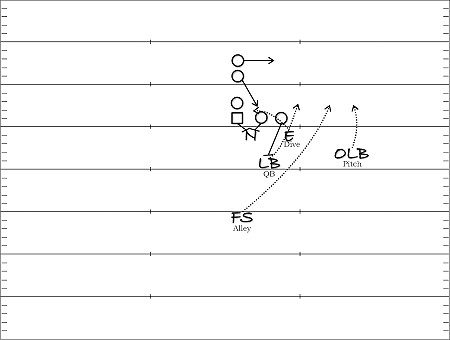
The biggest difference we have seen is that vs. traditional triple option schemes run to a shade/five technique. The alley fit is almost always outside the offensive tackle in the C gap (See Diagram 1).
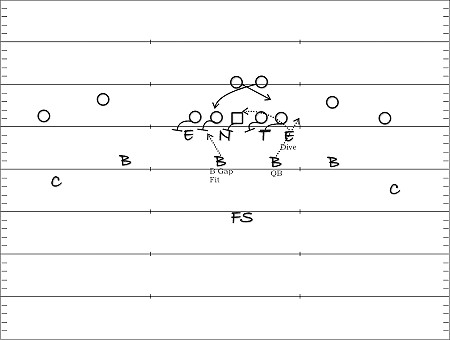
But vs. a zone option scheme to the same front, the alley in many cases can wind up being in the B gap (See Diagram 2).
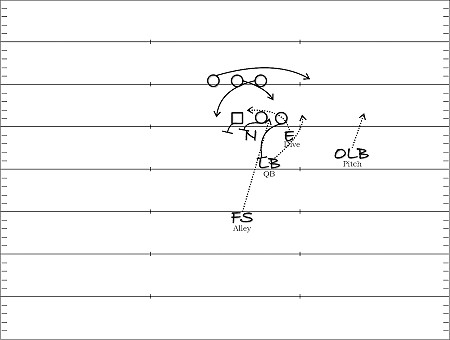
Many offenses are now teaching the zone-blocking backside offensive tackle to simply turn out the scraping linebacker rather than continuing to climb to the next level. This allows the quarterback to keep the ball in the B gap with the defender assigned to the quarterback being blocked.
It may seem elementary, but the difference in key flows with linebackers is that a traditional triple option play is a full-flow play. Dive back, quarterback, and pitch back are all going in the same direction as the blocking scheme. A zone option play is, by nature, a split flow play. The zone back is going in the same direction as the blocking scheme, but the quarterback and pitch back (if there is one) are not. However, option responsibilities must still be executed.
Most offenses show a preference for running the zone play to either the three technique or the shade. What we try to identify through film study is: 1) where do they show a preference for running the zone? 2) who is the primary ball carrier in a two-back set? Once we get a feel for those two things, we can begin to form a plan of attack.
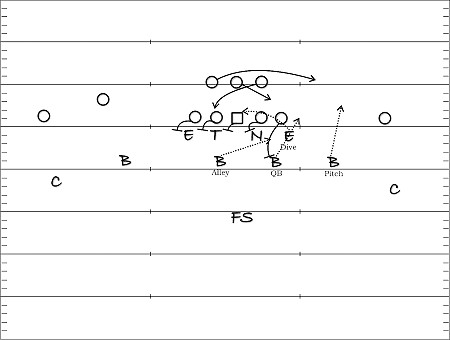
There are two different ways that we can play the zone option from an eight-man over front. The first has the free safety involved in the strong side running game from a three-deep structure. Our option responsibilities would have the defensive end close for the zone back and eliminate the cutback in the B gap. The nose guard then must collapse the A gap with the center and play from A gap to A gap. Both inside linebackers are quarterback players. One is a C gap player and one is a B gap player. The outside linebacker/safety is the pitch player (See Diagram 3).
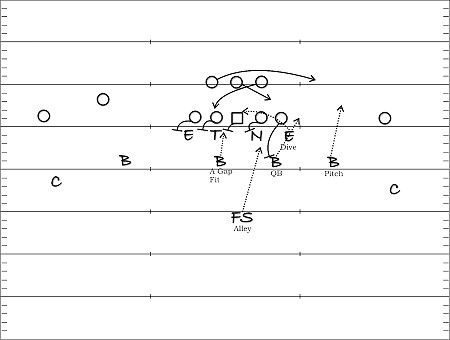
The second way would fit the playside linebacker in the strong side A gap. The backside linebacker and the outside linebacker/safety would have the same C gap and pitch assignments, respectively. The alley (B gap) player would be the free safety from a man free coverage scheme (See Diagram 4).
Against one-back sets, our linebackers generally cross-key the quarterback and running back. We try to set the three technique to the offset back or post-snap slant to the offset back as much as possible. This allows the linebacker who is assigned as the quarterback player to scrape freely over the top since he is protected by having the three technique to his side (See Diagram 5).
Last season, (while I was the DC at Warren Central) we played five Spread teams, two I formation power-running teams, one Run ‘n Shoot team, one Wing-T team, and one Triple Option team. We don’t like to change what we teach weekly so taking our base teaching concepts that we start every season with and applying them to the shotgun running game has made it simpler for our players to adapt from game plan to game plan.
Scott Marsh recently became Head Coach at Indianapolis Howe Academy. He was previously the DC at Warren Central High School (IN). He can be reached at ScottMarsh@GridironStrategies.com