It gives me great pleasure to share some ideas regarding the “Greatest Play” in football. Some of the concepts may be implemented in any system, but for the Wing-T, the concepts should be a neatly-managed package that will enhance not only your waggle, but your entire offense.
In keeping with the fundamental principals of the Delaware Wing-T, the waggle can have a number of alternatives, limited only to one’s creativity, imagination, and ability to execute. Some of these concepts will create additional conflicts for defensive personnel. These “Key Breakers” will create an unknown factor to your opponent. This unknown factor may surprise an opponent or could add a sense of doubt at the most critical time during the game.
The waggle is an integral part in many offenses, but in the Wing –T, it is a staple. With the execution of buck sweep to the tight end and split end flanks, it is important to develop variations to the waggle, and when you do it, it can be a thing of beauty.
These “Key Breakers” are easy to communicate, simple to execute and fun to incorporate into the offense. As you gradually implement a few of these plays into your system, your players will continue to grow and you will put them in a position to take full advantage of defensive personnel who have conflicting reads in defending the Delaware Wing-T.
929 WAGGLE “SWITCH (AT 5)”
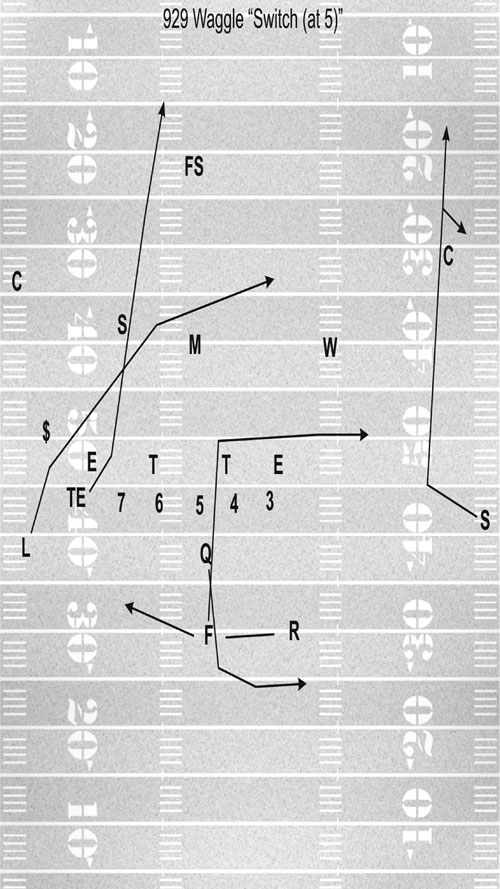
In this example, there are two terms tagged onto the play call. The first term is “Switch”. This term is simply having the tight end and the halfback switch responsibilities in their respective route assignments in waggle. This switching of responsibilities will allow the crossing route to be executed by the HB, who probably runs better routes, has better hands, and can gain more yards after the catch than most tight ends. It is important to understand that, regardless if “Switch” is used or not, both receivers must take their initial steps as if the buck sweep is being executed.
The term “at 5” is utilized to alert the QB that the crossing route should be examined before reading the “Flat” route by the fullback or the “Go” route (“Even-Leavin”) by the split end. This term is used when the linebackers have vacated the middle drop zones in their coverage on previously executed waggles.
RIGHT “NO MO” 129 WAGGLE “SUCKER BLOCK”
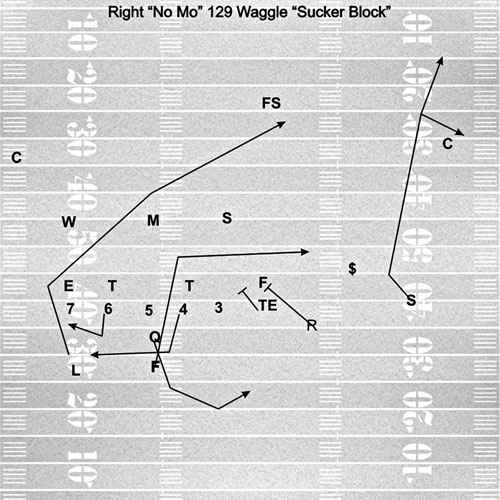
The waggle is very effective in the unbalanced package as well. But, to add a new wrinkle to the play, we tag a couple of terms to execute conflicting reads by the defensive personnel.
First of all, the term “No Mo” is utilized to inform the right halfback not to go in motion. The term “Sucker” is used to inform the guards to pull in the opposite direction and influence the linebackers and defensive front. Finally, the term “Block” is used to inform the right halfback to block the flank to protect the QB.
The execution of this play allows for more than enough protection. The right halfback, tight end (who is ineligible by formation), and the right tackle are all blocking to their inside gap. Both guards are blocking any pursuing defensive personnel. The waggle blocking rules remain the same for the center and left tackle.
The route progression for the QB reads remain the same as well. The fullback will execute his “Flat” route, the split end on the “Go” route (“Even-Leavin”) and the “Crossing” route by the left halfback from his set position.
929 WAGGLE “CHASE”
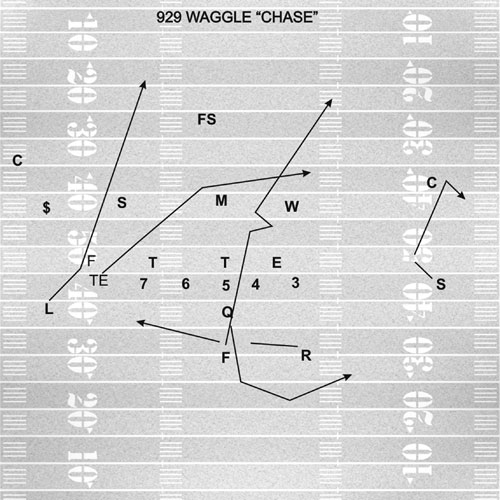
This particular term added to the waggle is the word “Chase”. This refers to the fullback changing his pass route responsibilities. Some coaching points for the fullback should include setting up the linebacker with a head-and-shoulder fake, as well as a stutter step to his typical “Flat” route on waggle. The fullback must then find the seam behind the corner and in front of the free safety. The split end simply changes his route to the “Out” pattern.
The QB simply reads high to low in his progression. The fullback is the primary route for the quarterback progression. A good look at the “Out” route by the split end may force the corner to jump the pattern, thus opening up the fullback. The quarterback should then progress back to the crossing routes.
X TO - 429 WAGGLE “SUCKER” – “BLOCK”
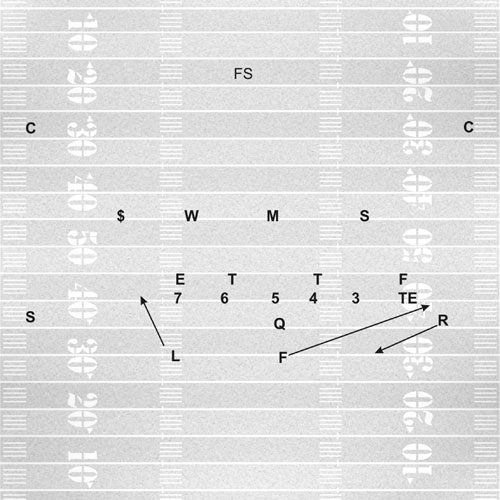
This particular play is a little more sophisticated. It includes a shift by all three backs before the center snap. The fullback shifts up to the right wing position, the right halfback shifts back to his set position. The left halfback shifts up to the left wing position. This particular shift creates recognition problems immediately for the defensive personnel.
On the center snap, the fullback now secures the flank, the right halfback fakes buck sweep, the left halfback executes his “Crossing” route, and the tight end executes his “Seam” Route. The “Sucker” call directs the guards once again to pull and influence the defensive line and linebackers by pulling in the opposite direction blocking any chasing defensive personnel.
The quarterback simply reads the tight end “Seam” route to the “Crossing” route by the left halfback. The influence of the guards will create conflicts for the linebackers and free safety.
SUMMARY
I believe the concepts shared in this article will assist offensive coaches in their ever expanding knowledge of the Wing-T and defenses designed to stop it. But regardless of what play is called, it must be understood that the players remain the single most important element in any play that is to be executed.
As with any offense, it is essential to package the primary attack soundly. With the addition of a couple of special plays in the waggle package, the defense will be surprised with the variation that they have not anticipated. These variations are true to the principles of the Wing-T and are simple, fun and exciting to implement. But, the offense needs to be able to execute and master the basic plays that will win championships. In doing so, the “Key Breakers” will leave defensive personnel in doubt and question their reads. That, in itself may be the difference in your team’s success.
About the Author:
Greg Christodulu’s football playing experience includes lettering at Syracuse University (1982-1983), and then transferring to the University at Delaware and lettering in (1985-1986) under Tubby Raymond. His experience coaching at the college level includes the University at Albany (1987-1988), James Madison University (1989), Susquehanna University where he was Offensive Coordinator (1990-1995). Interscholastic experiences include Gloversville HS (1996-1999), Assistant OC ’98-99, and currently, Shenendehowa HS in Clifton Park, NY, since 2002. He can be reached at ChriGreg@SHENET.ORG.