OUR OFFENSE IS based on the belief that we must run the ball to win, but we also shoot for balance within our offensive production. That doesn’t mean we’ll attempt an equal number of runs and passes. By balanced production, we’re referring to offensive output.
On any given night, we’ll probably throw the ball more times than we run it. Yet our average run play often gains more than our average pass attempt.
So, why don’t we run the ball more? The answer to that question lies at the very heart of our offensive philosophy. We throw the ball to set up the run. Success in our running game is directly attributed to the mismatches and advantages created by our passing game.
Jab Draw
No single play in our package is more dependent on a passing game than our “Jab-Draw.” The jab stems from the 5-step, half-roll action of the quarterback. The versatility of this play enables you to execute the jab from a variety of offensive sets. The base jab is executed with an “influence block” on second-level defenders (linebackers). The half-roll action of the QB can draw LBs out of normal coverage areas into the middle of the field.
DIAGRAM 1: Jab-Draw To Play-Side Guard/Center Scoop.
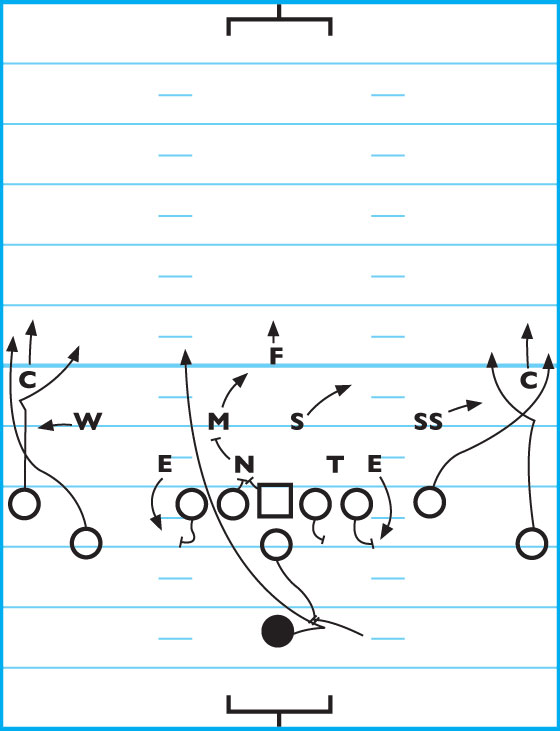
This allows the play-side OG to come off the “scoop” combo with the center to cut off the LB recovering to the hole, helping to set the running lane for the ball carrier.
When you’re unable to account for the play-side LB with the base-scoop technique, you must get another offensive player involved at the point of attack.
To assist in making this block, make one of four adaptations to the jab scheme.
1. Add A Fullback
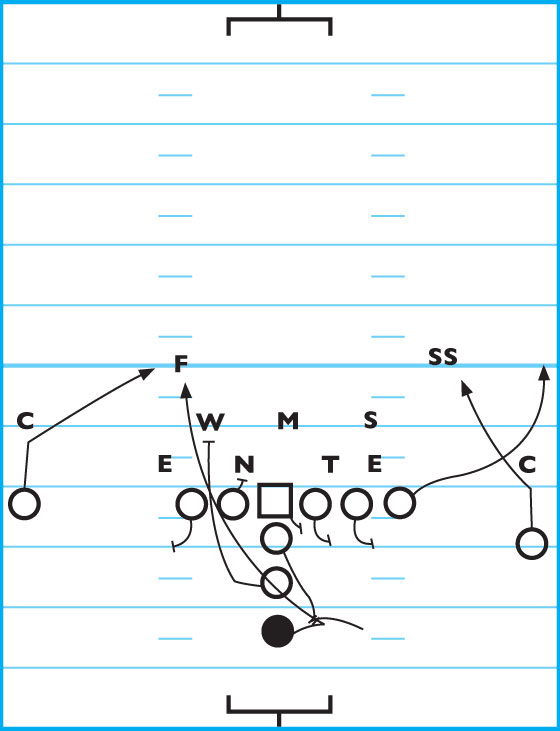
The jab play can be just as effective from a two-back set as from a one-back set. Using the fullback to lead up on the LB at the point of attack is a simple alternative that requires no other offensive player to change his assignment.
DIAGRAM 2: Jab-Draw From Two-Back Set. The ball carrier still initiates the play with counter steps before changing direction at the mesh point.
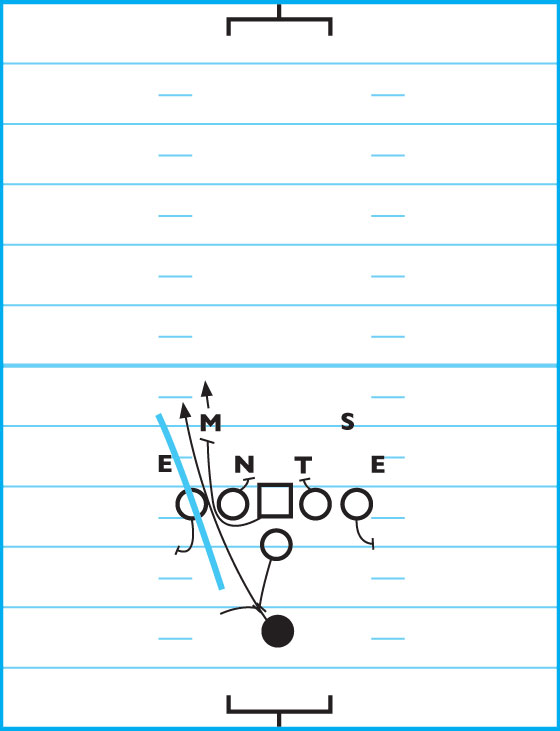
2. Fold The Center
DIAGRAM 3: Jab-Draw With Fold Technique At The Point Of Attack. From a one-back set, you can change the look of your jab play by “wrapping the center” around the fold block of the play-side OG. This is a very common adjustment and can be made at the line of scrimmage by your offensive linemen.
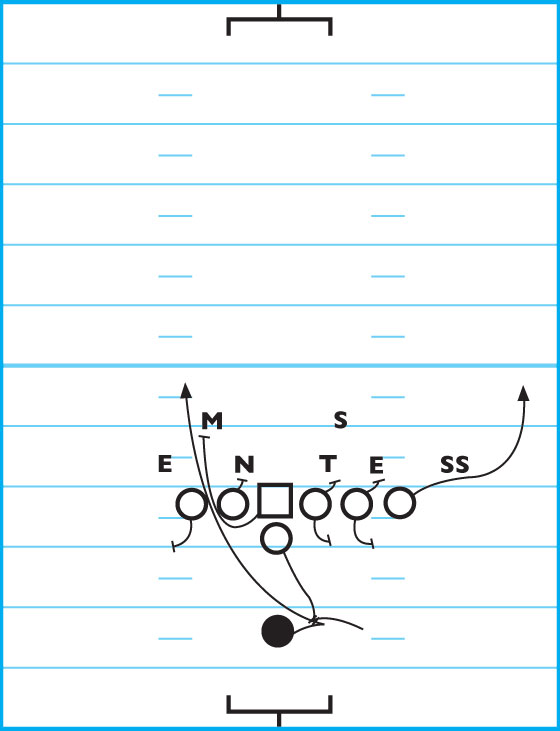
You want your interior linemen to take the quickest path to the LB, which may require checking the blocking scheme at the line.
3. Lead Block With Slot Receiver
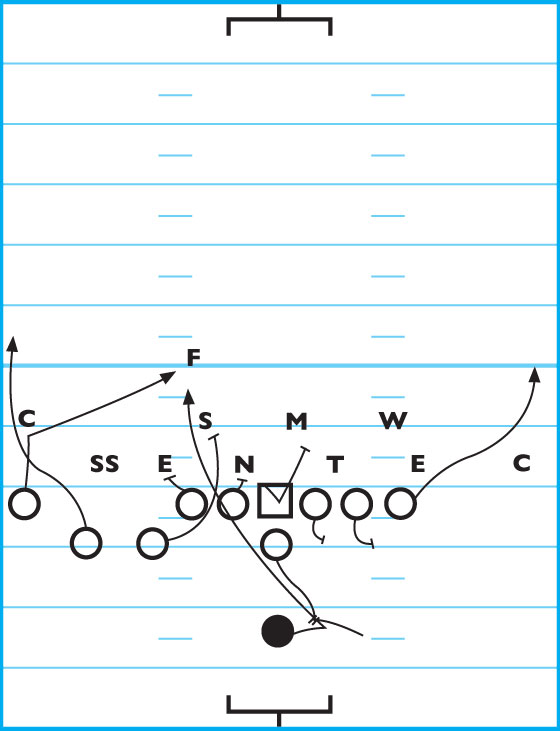
Through the utilization of quick motion or setting the receiver tighter to the core of the formation, we can use an inside receiver to lead block on the LB at the point of attack.
DIAGRAM 4: Jab-Draw With Slot Receiver As The Lead Blocker. With this adaptation to the jab scheme, the play-side OT will be more aggressive with his block vs. the end man on the LOS.
4. Pull Backside Guard
When your personnel dictates the opportunity to pull your backside OG to strengthen numbers at the point of attack, there are two variations of the scheme you can employ:
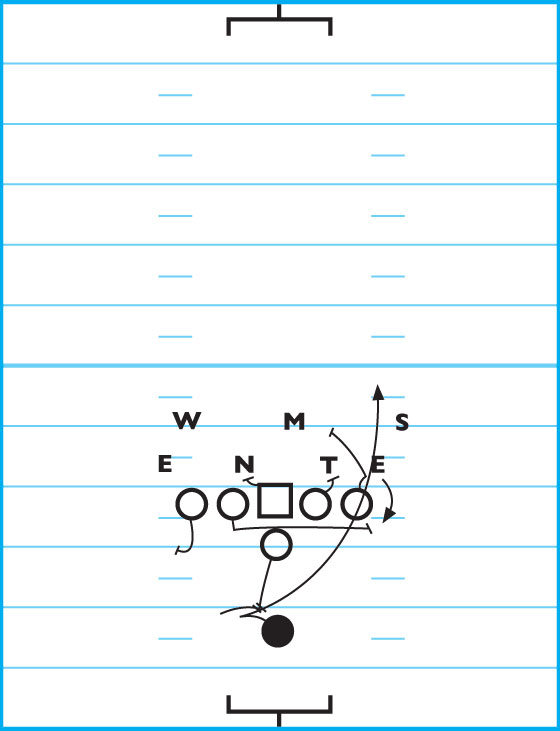
- On the base Jab-G where we pull the backside OG, the pulling OG will “kick out” the end man on the LOS as the play-side OT rubs the end man on the LOS and checks to the LB at the second level.
DIAGRAM 5: Jab-G With Backside OG Kick Out.
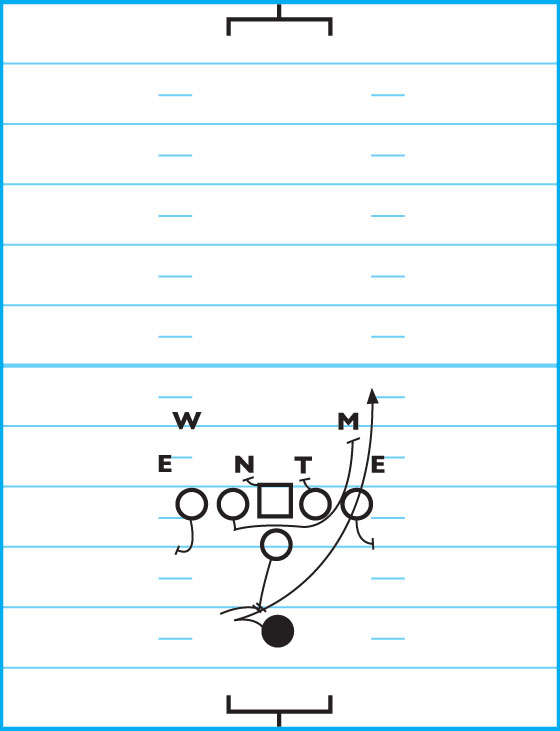
- By making a “switch” call, the pulling OG and play-side OT switch responsibilities. The play-side OT will pass set (fan protect) vs. the end man on the LOS and the pulling OG will lead up on the LB at the point of attack.
DIAGRAM 6: Jab-G/Switch With Backside OG Lead At The Point Of Attack.
For a team that likes to throw the ball on first down, the jab-draw is an ideal complementary play. Similarly, this can be a very effective play in third-and-medium to third-and-long situations with negative field position. In both scenarios, the offense can capitalize by showing pass action, then unexpectedly hitting the defense with the jab-draw.
Keys For Successful Execution
Offensive Line. In the base jab scheme, the five offensive linemen are responsible for the defensive down techniques and the play-side LB at the point of attack. In giving the look of a pass, OTs will pass set vs. the end man on the LOS, just as they would on a 5-step pass-protection scheme.
DIAGRAM 7: OTs “Fan Protect” To Widen Running Lane. Fan protect with your OTs in this manner to encourage an upfield rush by the end technique to widen the running lane.
As the offensive tackles create the outside edge of the running alley, the three interior linemen are accountable for the two interior down techniques and the play-side LB.
The backside OG will lock up with the defender covering him, regardless of the technique. That leaves the center and play-side OG to combo block the defensive tackle and LB on the play side. This combo block may involve a “scoop” (see
Diagram 1) or a “fold” technique (see Diagram 2).
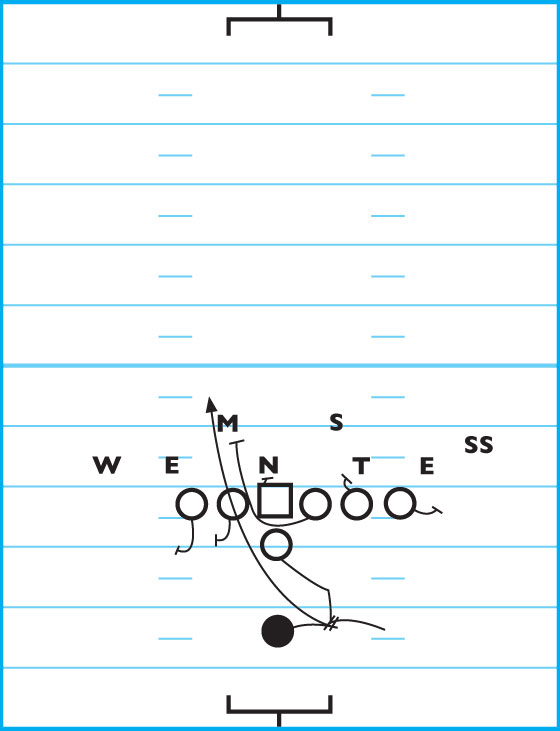
When running the jab versus an odd front, fan protect with the play-side OG and pull the backside OG on the play-side LB at the point of attack. Against this defensive look, the running alley will be more to the outside. The RB must recognize this defensive look to track the play-side hip of the pulling OG and break his path outside.
DIAGRAM 8: Jab-Draw Vs. Odd Front. In this scenario, the play-side OG will execute with the same principles as the play-side OTs to invite an upfield rush from the defensive down technique.
Quarterback. The QB must set up the jab before selling the pass action of the 5-step drop. As the QB rolls away from the hole, he must “look off” the backside LB. You won’t have to physically account for this player in your blocking scheme, so the QB must “influence” the defender’s movement.
When the QB can draw the play-side LB out of his normal pass-drop zone, he’ll have drawn him into the “window” to make the combo block by your play-side OG and center easier (refer to Diagram 1). Teach your QB to show pass on the first two steps of his simulated 5-step drop, find the ball carrier on the third step and sell the naked fake after the mesh.
As with all run plays, the timing of the QB and RB exchange is critical to the play’s success.
Running Backs. Obviously the key player in the jab, the RB, must set the play up for himself. As the offense gives the appearance of a 5-step pass, the RB will take two “shuffle hops” away from the point of attack prior to receiving the ball behind the QB at the mesh point.
Just like the QB, you want your RB to “look off” the second-level defenders. On the second step of his shuffle hop, the RB takes a sharp change-of-direction step and accelerates into the running alley. It’s imperative that the RB understands the blocking scheme that’s being used and the defensive front you’re facing. This allows the RB to anticipate where his crease will be.
From the mesh point, the RB must accelerate into the crease. Anytime you rely on an “influence block” to account for defenders in the box, acceleration from the ball carrier is critical.
Receivers. In all phases of your running game, your receiving corps needs to take blocking very seriously. But it should be understood that successful blocks don’t necessarily equate to putting defensive players on their backs.
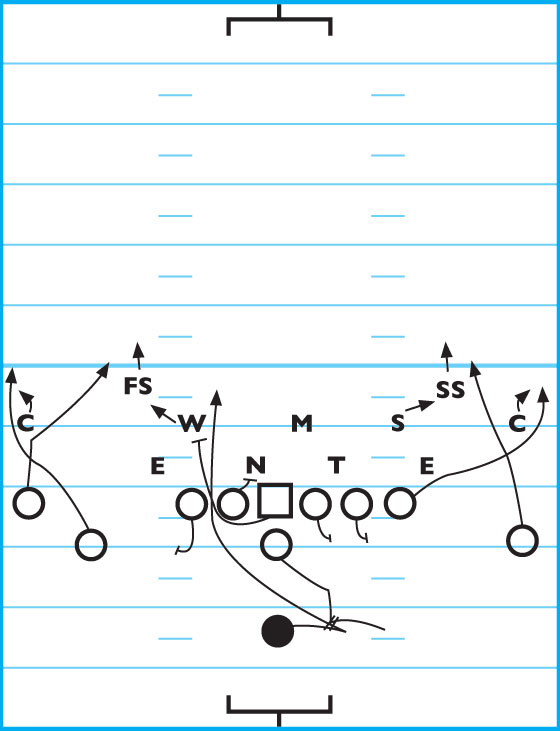
On the jab-draw, you’re trying to give the perception of a pass with all offensive players. Consequently, your receivers are all running deep vertical routes to draw secondary coverage.
DIAGRAM 9: Receiver Vertical Routes To Draw Secondary Coverage. This philosophy helps to create wide run lanes for the RB, as the secondary coverage is triggered into pass drops.
Simply Effective
As simplistic as the jab-draw scheme may appear, and in reality may be, it has proven to be a very effective part of any offensive package. It’s an ideal complement to a 5-step passing game and it can easily turn into one of the big-play threats of your offensive scheme.
The versatility of the scheme allows us to maintain this threat from all of our offensive sets. With teams that have a tendency to throw the ball frequently, the jab draw keeps the defense off balance. For these reasons, the jab is a valuable weapon that will establish your ability to run the football effectively.