We run a spread offense that relies on the receivers to make big plays in the passing game. We expect our receivers to make similar big play contributions in the run game as well. They are required to execute all the blocks with the same enthusiasm they have for catching the football. Here are drills our offensive staff believes make our athletes successful. Before any drill starts, however, we must develop a mindset.
Mindset
Receiver is a glamorous position. Most players have pre-conceived notions about a lack of physicality that comes with playing receiver. At Lindsey Wilson, we look to change that mentality, and our coaches demand they become more physical and take pride in blocking. Instill in your players minds that they are the difference between an average run and a big play.
We require the receivers to have their chinstraps buttoned in every drill of every practice. This is a small detail, but we believe this sets a precedent for your position group that they will be involved in physical drills. We have a blocking progression during practice to enhance technique and physicality.
Blocking Assignments
There are multiple blocks that our receivers are asked to execute throughout practice and, eventually, in a game. We differentiate blocks by “Point of Attack” or “Downfield”.
Point of attack
Stalk – Man-on-man vs. defender. Receiver must understand where the run or screen is designed to go and work to properly position their body.
Read/Crack – This block is used by outside receivers. They are pushing up the field three steps, determining who is the most dangerous man (MDM) between a safety and corner.
Downfield blocking
Release and collect – A technique for receivers seeing press man. The receiver must get a release upfield stressing the defender vertically. Once the defender is hip-to-hip with the receiver, he must push him by with his inside arm and collect him.
Backside cutoff – This is an assignment for the backside of any run or screen. The goal is to get to the frontside of the play and cut off secondary support. Receivers must give a great effort on these blocks.
Drills
Mirror Drill/Shoot and Chase
(See Diagram 1)
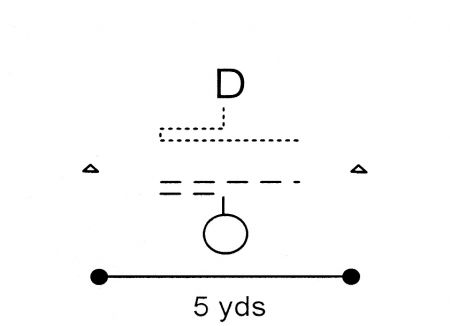
These two drills are put together during the individual period to teach a progression of the stalk block. The “Mirror Drill” focuses on footwork and can help build football endurance. Place two cones five yards apart. The receivers will work to keep a good base and hips sunk. The defender is working from cone-to-cone to gain separation from the receiver.
“Shoot and Chase” is taking the mirror drill and applying a hand strike. At the start of the drill, the receiver’s feet are buzzing. When the defender steps forward, the receiver strikes him with his thumbs up and elbows in tight. As the defender works to gain separation, the receiver will shuffle his feet. We use the phrase “chase your hands with your feet”, meaning that if your hands are getting outside your body, shuffle your feet to get square. The receiver’s feet should constantly be working in this drill. This drill is full speed and physical.
Five Yard Drill
(See Diagram 2)
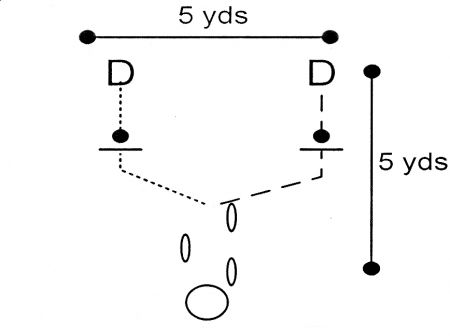
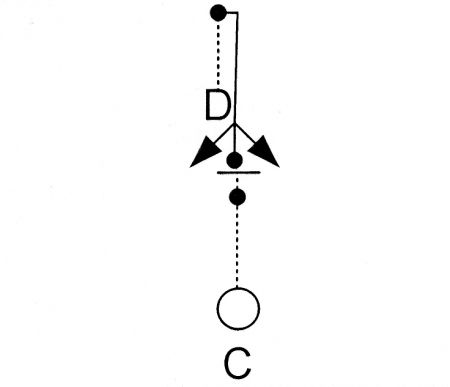
For the “Five Yard” drill, align two defenders within five yards from the receiver. The coach selects which defender will come up for run support at his whistle. Have the receiver take three steps with eyes upfield. Once the defender presents himself as the force player, the receiver will work to the block. The receiver must sink his hips, shoot his hands, and keep his feet alive until the drill is over. This drill is also applicable to inside receivers for determining the MDM in the screen game. This drill is full speed and physical.
Read/Crack
(See Diagrams 3A and 3B)
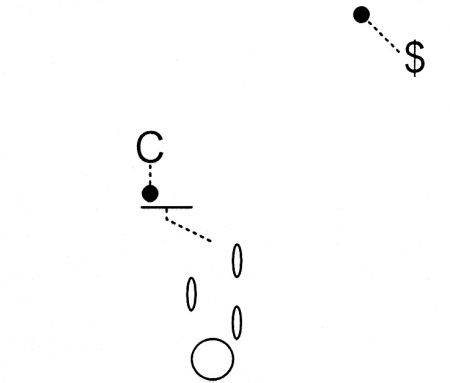
The “Read/Crack” drill entails block execution as well as understanding coverage. Align the safety and corner in different positions. Have the defense give a cover 2 look with the corner less than five yards deep with outside leverage and the safety at 12 yards. Show a cover 3 look where the safety is spinning down and the corner is bailing. Be sure to disguise coverages, and make the receiver identify the coverage post-snap. The variation should depend on the coverages your upcoming opponent uses. The receiver must identify the coverage and execute his blocking assignment. He should have a pre-snap idea of the coverage and his responsibility, but as he takes three steps upfield, he will recognize the MDM. This drill is full speed and physical.
Towel Drill
(See Diagram 4)
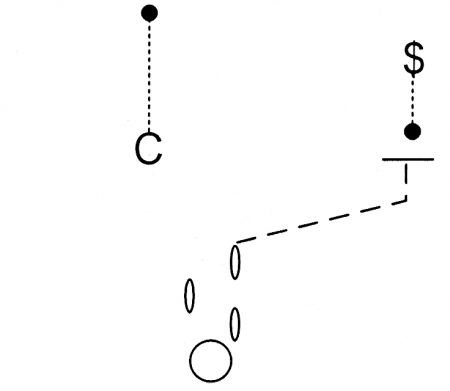
The “Towel Drill” is designed to put the receiver in the worst position possible. The defender is aligned at six yards, backpedaling and then breaking full speed with a two way to go option. A coach stands behind the receiver with a towel raised up in the air. On the cadence that is determined, the receiver climbs upfield as the defensive back backpedals. Once the coach drops the towel behind the receiver, simulating a ball carrier running in that direction, the defensive back breaks.
When the defender breaks down, the WR will break down. The receiver must work to get in front, sink his hips, shoot his hands, and chase his hands with his feet. If the WR gets his hands outside the framework of his body, a referee will more than likely call holding. In the attempt to eliminate a holding call, the WR must keep his feet moving, constantly shuffling to get in front of the defender. The goal is to not let the defensive back get to the towel. This drill is full speed and physical.
Backside Cut-off
(See Diagram 5)
Our players understand that a “Backside Cut off” block is all about effort. We often have two receivers on the backside of a run or a screen. We demand that they get to the front-side of the play to cut off secondary support. Versus a two-safety look, the inside WR is looking to cut off the furthest safety at eight yards depth. We give him a landmark, eight yards, so that he will work flat and can always adjust upfield. The outside WR against a two-safety look will work to a depth of 12 yards to cut off the near safety. Against a single high look, the inside receiver will work to the safety and the outside receiver will work to cut-off the backside corner. Both receivers will adjust their assignment if the defense rolls the coverage.
Have two lines for both inside and outside receivers. Set cones at the specific landmarks (8 and 12 yards opposite the hash). The receivers work to their respective cones and block defenders. They must work to square the defender up. If the defender is past the cone, then get on the backside shoulder plate and run the defender to the sideline.
These drills are just a few of the drills we work on throughout the year. The main purpose of these drills is increasing fundamentals and intensity. If the receiving corps can become excellent blockers on the perimeter, your offense will improve drastically.