COACHING 8-MAN football is a much different beast than heading an 11-man squad. However, some of the principles, philosophies and strategies used in 11-man can be shifted to fit into your 8-man football team.
An option-based package as the base offense is possible in 8-man football. This package should consist of the midline, inside and outside veer. The base formation is an unbalanced formation to the right and left.
DIAGRAM 1: Unbalanced Right.
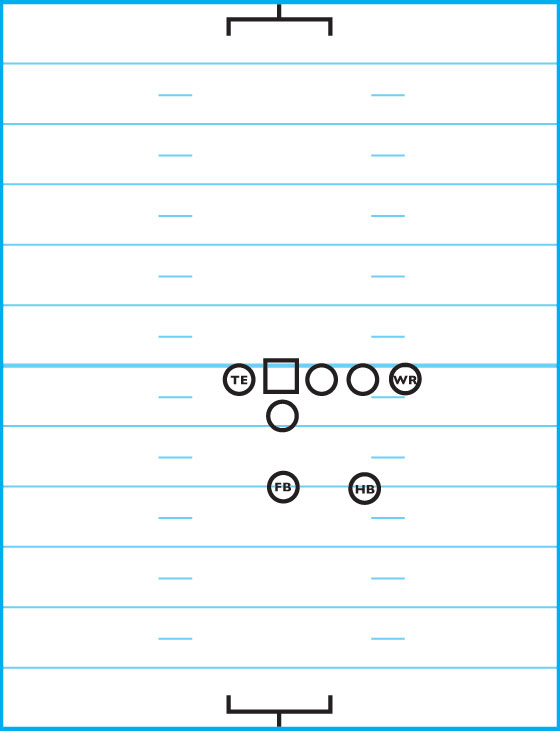
DIAGRAM 2: Unbalanced Left. To use the split-back formation, the fullback must be lined up behind the center and quarterback. This puts you into an off-set split-back backfield, which is shown in the base diagrams, Diagram 1 and 2.
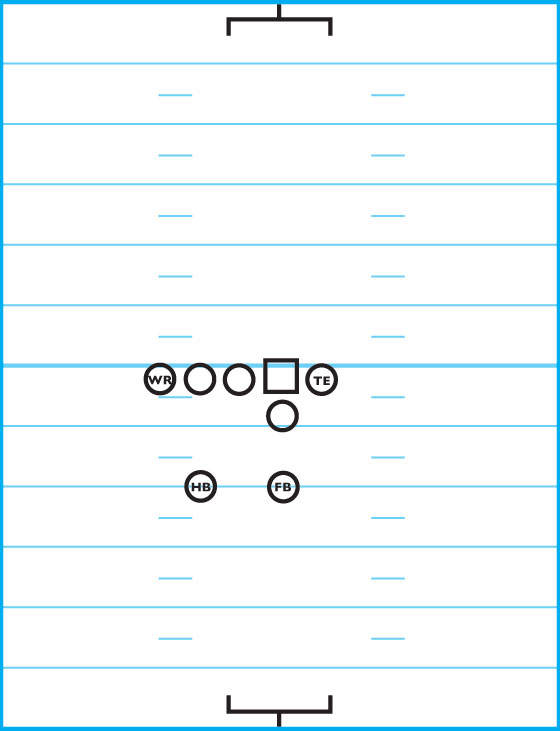
The linemen are given a designated position. The tight end goes away from the call and is the lineman on the short side of the offense.
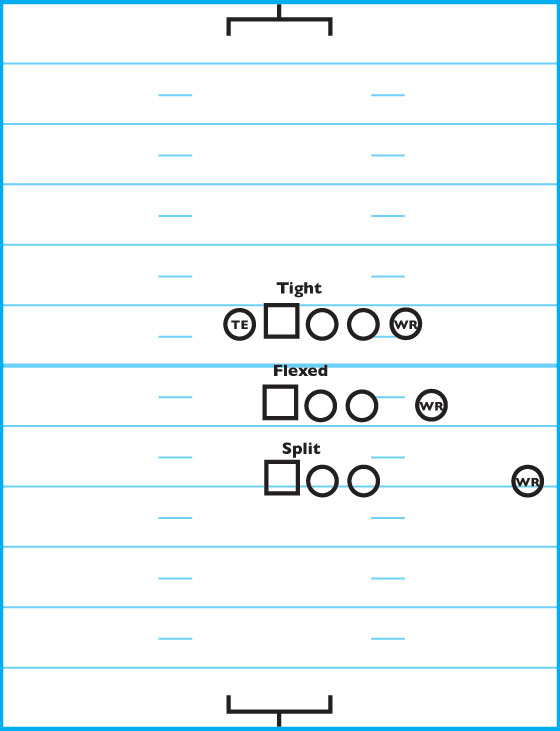
This leaves a center, guard, tackle and wide receiver. The WR can be in a tight position, flexed or split out from the formation, as shown in Diagram 3.
DIAGRAM 3: WR Positioning. When the WR is tight, he’s side by side with the line. When he is flexed, he is 4 yards separated from the line and when he is split out, he is 12-15 yards from the line.
The offensive line has 2 1/2-feet splits with the WR having a 3 1/2-feet split. The linemen align with their helmets on the hip of the center, which gives them good angles for downblocking, pulling and drive blocking.
DIAGRAM 4: Paths For Dive Backs. This diagram shows a right formation and the paths the dive backs take for the midline, inside veer and outside veer.
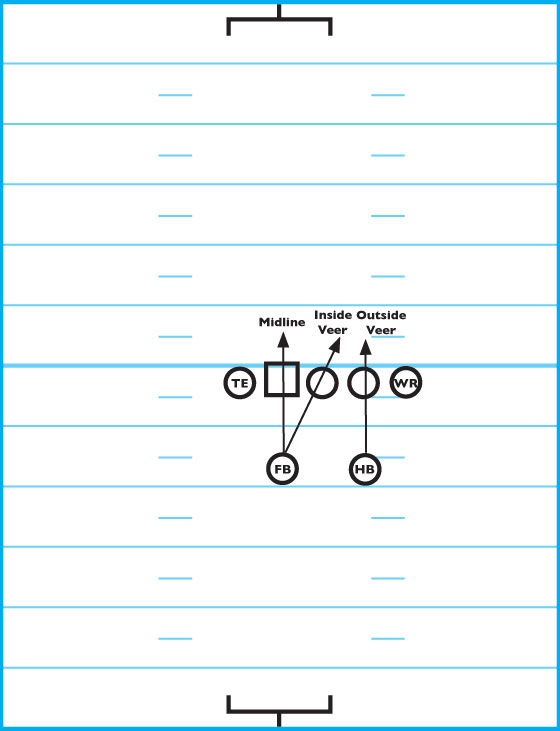
Aim the dive back at the middle of the backside of the lineman in the dive path. The midline path puts the FB diving straight ahead at the center. If the midline is going to the right, then the back steps with his right foot first. His inside arm is up to his chin and the right arm is down with the palm up at the level of his belt. His eyes are straight ahead and focused on any linebackers who may fill the hole, if he is given the ball.
midline responsibilities
The blocking scheme for the midline option is simple but handles all defenses.
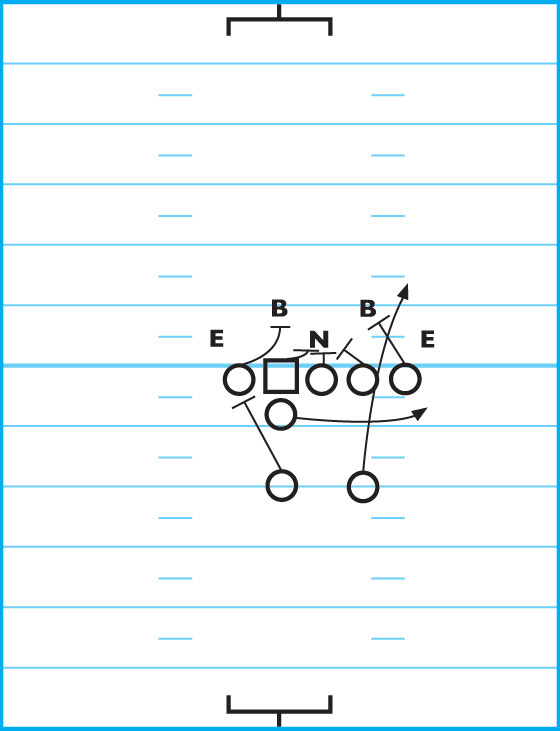
DIAGRAM 5: TE Odd-Front Blocking. The TE hinge-blocks on an odd front defense.
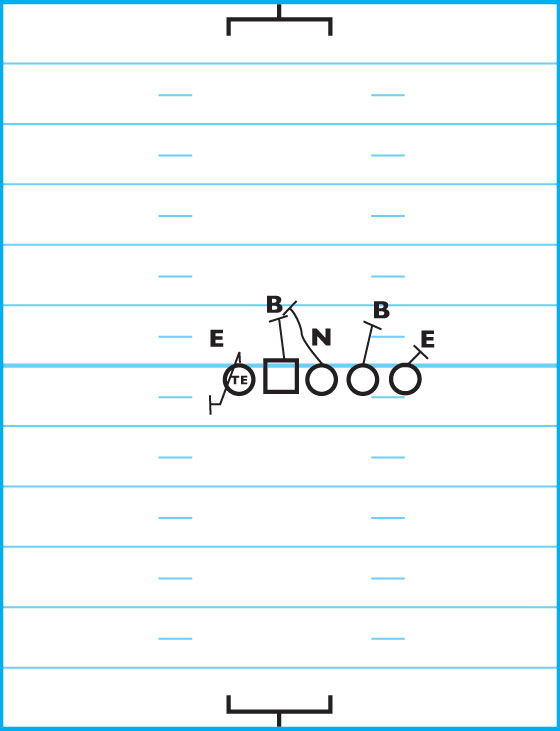
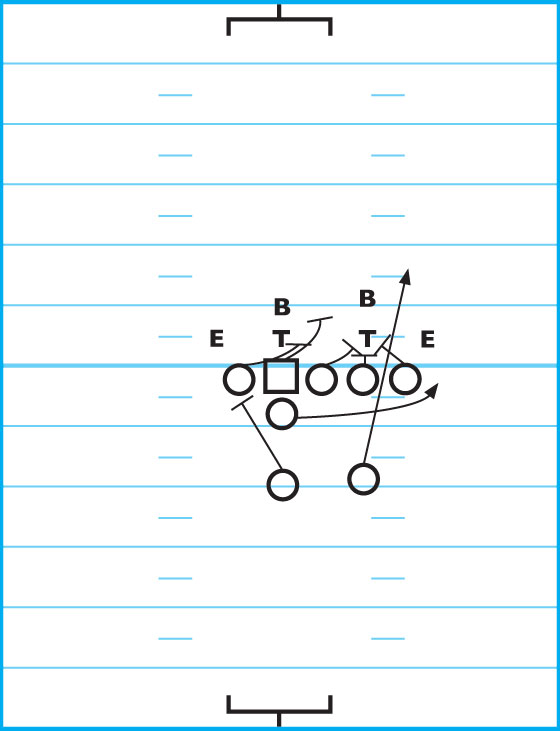
DIAGRAM 6: TE Even-Front Blocking. The TE double-team blocks with the center against an even front. You want to double-team at the hole behind the play. Even against unusual defensive fronts, your players are prepared as long as they adhere to all of the rules.
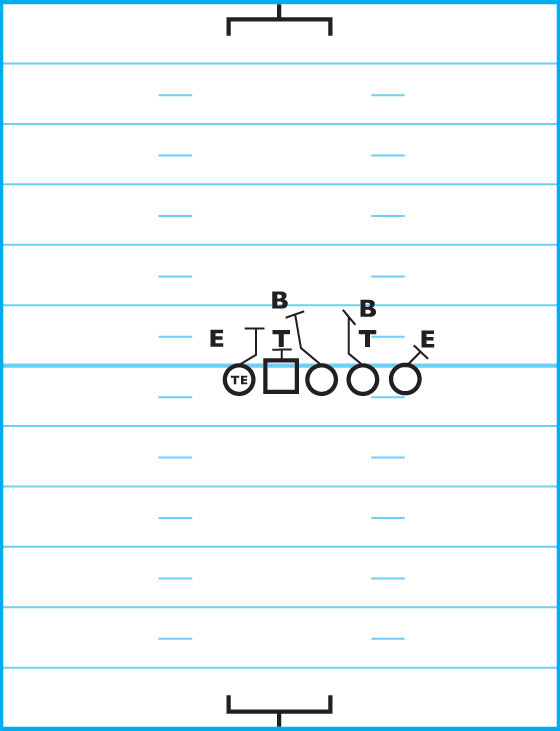
DIAGRAM 7: Read The Defender. The next blocking rule for the midline play is to read the defender that is head up or outside the guard.
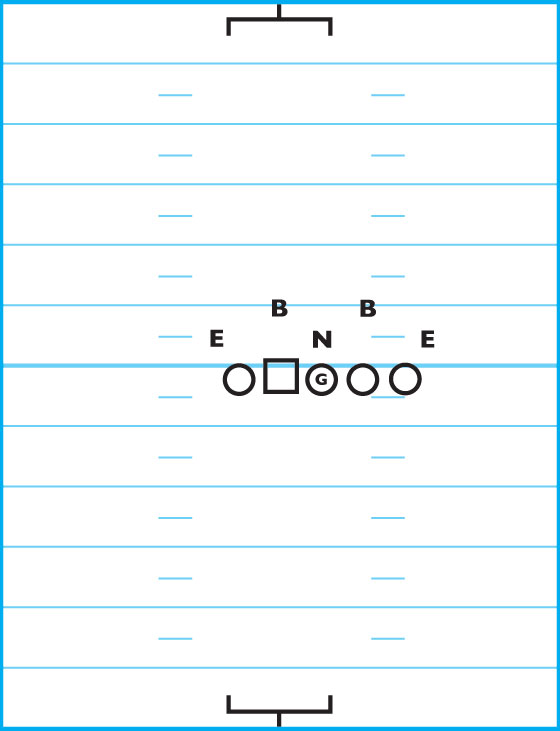
DIAGRAM 8: Guard Vs. Inside Defender. If the guard has a defender inside of him, wash that defender down inside.
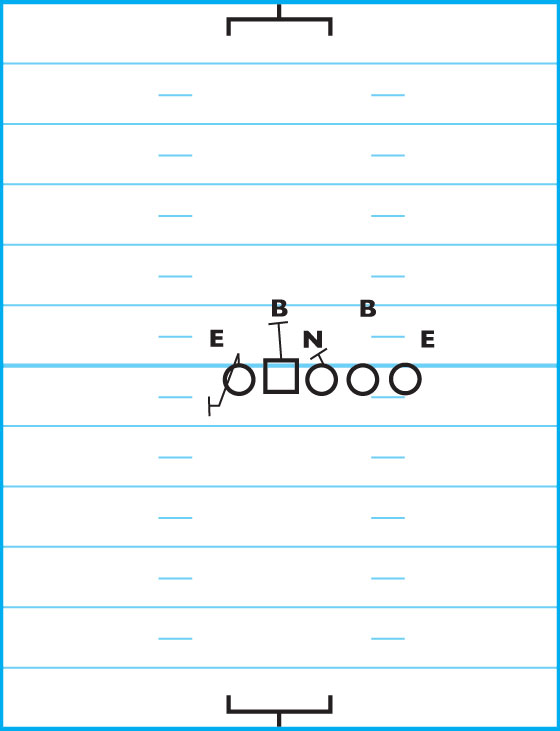
DIAGRAM 9: You Vs. Me Call. The next blocking step is for the WR or the tackle to call “you/me,” which signals who has the block on the edge defender.
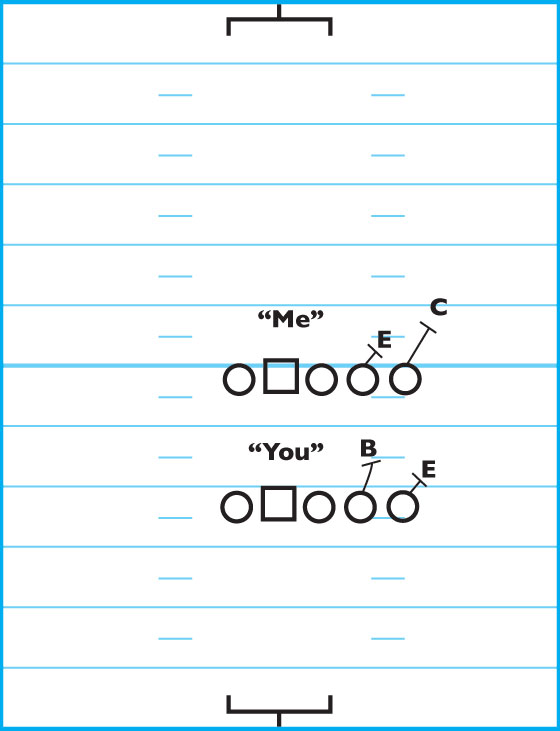
The QB reads the first man that is head up/outside the guard. The QB always gives the ball to the FB, unless he sees the eyes of the read man coming to him.
If it is a pull read, the FB continues his path and tries to seal the backside LB or go to the third level to block a defensive back. The HB leads into the hole and seals the play-side LB. Being short a back in 8-man football, there is no pitch for this play — so it is either a give or a keep.
DIAGRAM 10: QB Keeper. The QB keeps the ball and goes through the gap opened by the back and the tackle/WR. The QB must plan and push off his right foot so both feet are parallel when he rides the FB.
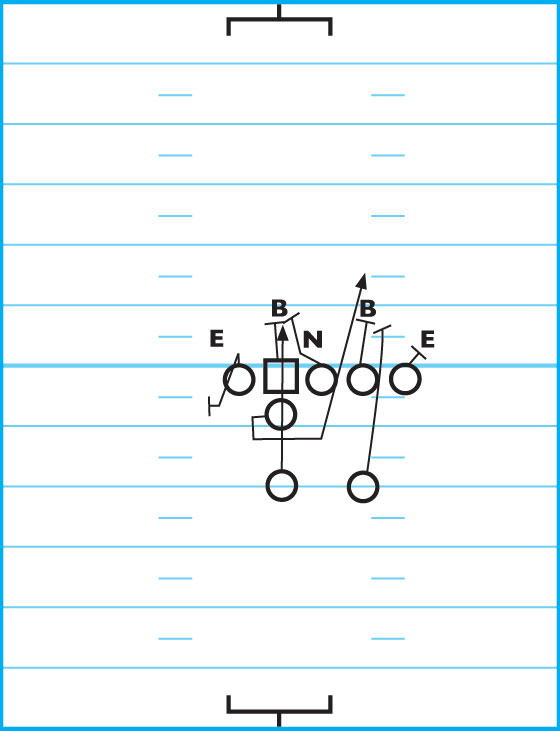
If the read is a pull, the QB must take a clearing step, which is back at the 6 o’clock position. This gets him away from the collision of the FB and the tackler, plus the QB has a downhill attack at the C-gap area.
inside-veer responsibilities
The inside veer is a triple-option offense. The FB could get the drive (most frequent result of the play), the QB could keep the ball and
the HB could get the pitch.
When the play is run to the right, the FB aims at the middle of the backside of the OG. He steps with his right foot and has his left arm up to his chin and the right arm down at his belt buckle. He does not veer from his path until he is given the ball. He must have his eyes up and be ready to cut if he is given the ball.
The QB is facing 12 o’clock and steps at 4 o’clock with his right foot. The second and third steps are the ride steps of the QB. The QB rides the FB until he gets a read.
DIAGRAM 11: QB No Read On Dive. If the QB is into the line and still doesn’t have a read on the dive key, he follows the FB into the hole.
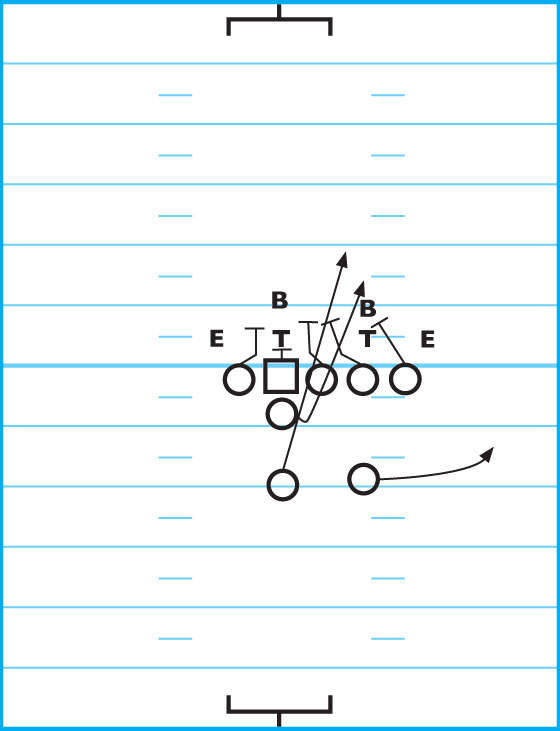
In most instances, except for the one just mentioned, the QB gives the ball to the FB, except when he sees the eyes of the dive read coming at him. In this instance, the HB hesitates and turns his body to get ready to take off to get to his pitch path. If the dive read takes the FB, then the play heads to the next level to see what the DB is going to do. The QB keeps the ball unless the DB’s eyes come at him, then he pitches the ball to the HB. The HB is on a 5-yard-by-1-yard pitch path for the pitch.
As for the blocking rules for the inside veer, they aren’t complicated but must be applied for success.
If a defensive player is head up or outside, the OT lets go. If someone is inside of the OT, he washes him down.
DIAGRAM 12: Two Defenders Outside OT. If there are two players lined up outside the OT, the WR blocks one of them, as shown.
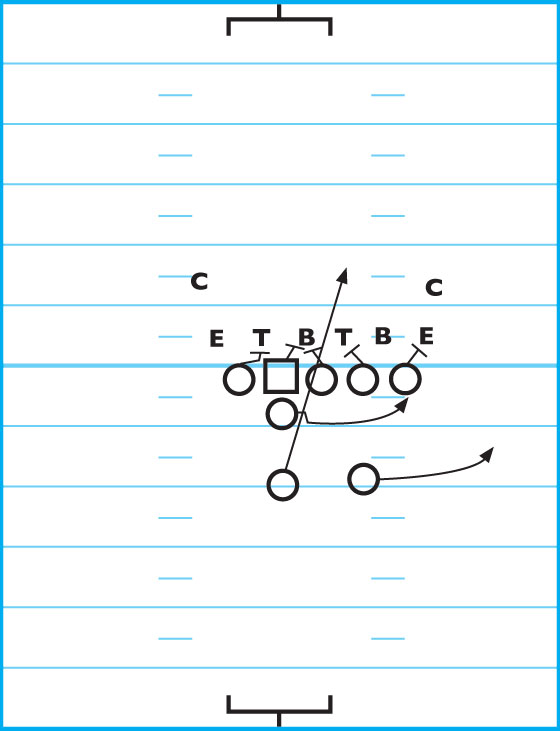
DIAGRAM 13: Double-Team Blocking. The double-team rule applies in all plays — you want your players to double at the hole behind the attack. The double-team precedent is from the inside to the outside.
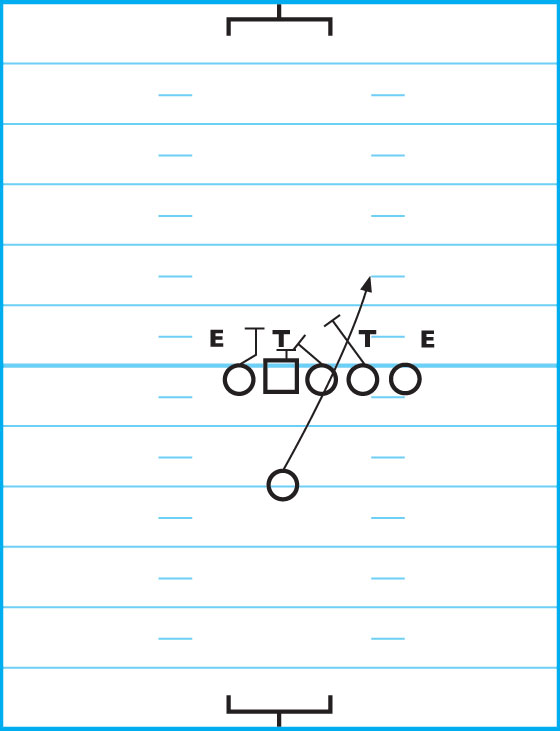
DIAGRAM 14: Inside Double-Team. The precedent is for the double-team to hit an inside block over an outside block, which is shown in this diagram. Pictured here is the double-team of the center and OG taking precedence over the potential double-team block from the OG and OT.
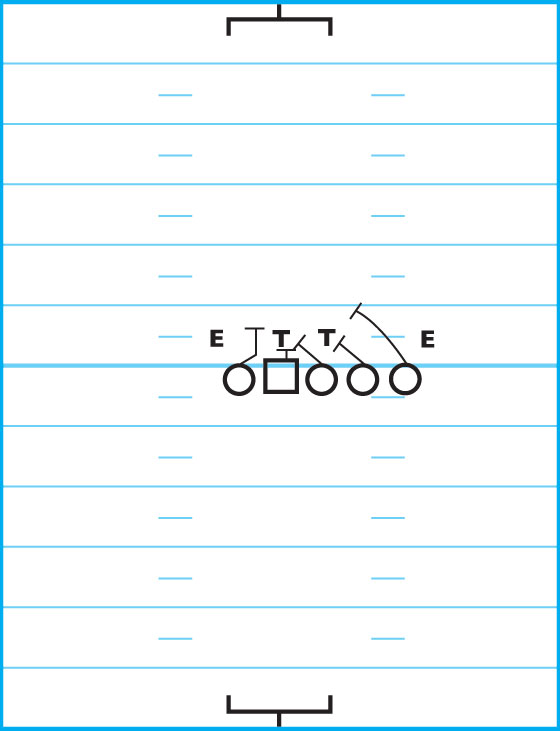
Another rule of blocking to consider for the inside-veer play is something called the three-on-two. This rule deals with the defensive lineman playing a 2-technique.
DIAGRAM 15: 3-On-2 Rule. With this rule, your team covers the two gaps where the DT could go since the DT is head-up and you are unsure where he is going on the snap of the football. Stack teams especially like to line their DTs head-up and slant them all over the place.
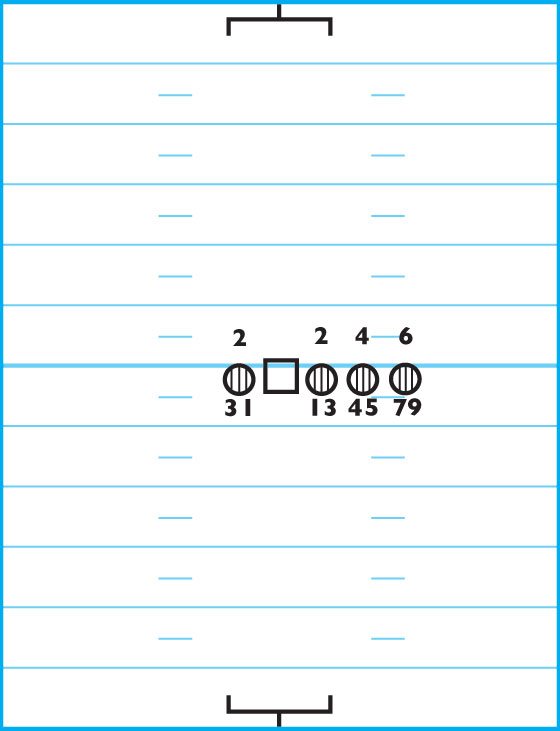
DIAGRAM 16: 3-On-2 Combo Block. Take care of stack teams using a 3-on-2 combo block as shown.
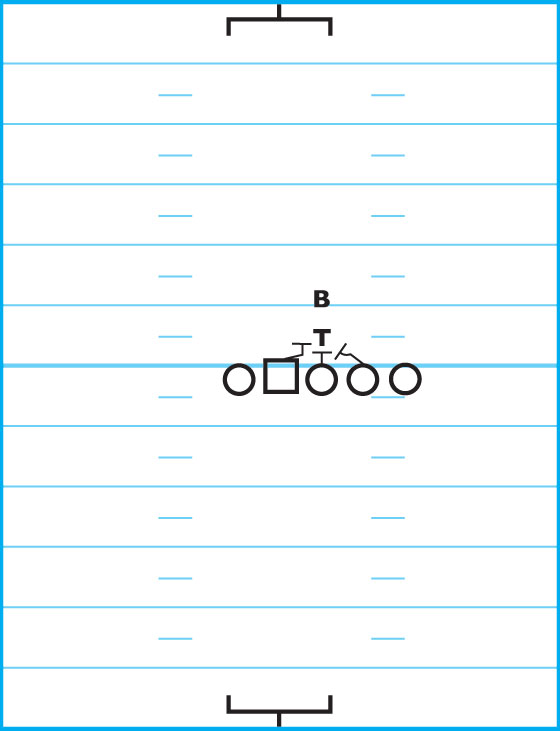
outside-veer responsibilities
The last play in the straight-option package is the outside veer (sometimes called a Houston veer). This is a great off-tackle play, which potentially goes for big yards, especially in 8-man football.
While all coaches have their own variations to the outside veer, what works best for us is using the FB as a false read.
The HB aims at the middle of the backside of the OT. The HB steps with the play-side foot first, his inside arm up to his chin and his outside arm around close to his belt buckle.
DIAGRAM 17: HB Stays On Crease. The HB must stay on his crease through the second level. Watch for younger HBs bending the play back inside, which puts him into harm’s way.
The FB drives to the inside leg of the DE opposite the play. Teams reading the FB get the false read, which gives your offense an additional step on the defense.
The outside veer serves as a double option for your team as well. The ball is given to the HB or the QB keeps it and goes around the end. The QB steps at 3 o’clock with his play-side foot, Tell the QB and the FB that this is a race to the OT. They should meet at the spot
at the same time going full speed.
An important read is the first defender on the line outside the WR. The WR washes any defender that is inside of him.
DIAGRAM 18: Line Scoops To Play Side. The line scoops to the play side and all double team rules mentioned earlier apply to the outside veer.
Since the last man on the line of scrimmage outside the WR is optioned, the outside veer is one of the easiest plays to block in the option game.
The timing of the mesh has to be handled and adjusted so the play runs smoothly.
If either of the backs gets there too early, there is going to be a big collision.