WHEN ALL ELSE FAILS, our offense turns to the “Go Sweep.” This play can be devastating to defenses at any level of competition.
The “Go Sweep” evolved from our toss sweep with the play-side guard and fullback switching responsibilities. The term “Go” designates “guard-on force.” We run a Pro-I offensive scheme and get into a one-back set for this base play.
It is designed to utilize the speed of our offense to get to the perimeter and outrun the defense. Even if speed is not one of your team’s strong points, through execution and technique this play can be successful.
Our favorite set to run the “Go Sweep” out of is twins set with the FB in a wing set to the tight-end side. This allows you to pull the strong safety to the twins side and force a cornerback to the play-side. Against a balanced defense, we’ll use the pro set with the FB in the wing set to get an extra man at the point of attack.
Combo Blocks Are Key
The OG position should be filled with quick, strong, mobile kids. The key to this play is the combo block of the TE and FB. The TE takes a play-side zone step at the outside “V” of the defensive end. At the same time, the FB takes a play-side zone step at the DE and executes a half-press (one hand) technique with the inside arm turning the DE’s shoulders. Their first objective is to get movement off the line of scrimmage to seal the DE and create a corner.
Both players spy the nearest linebacker inside or stacked on the DE. If the LB tries to scrape over the top, the TE wheels his butt around the DE (as in most zone techniques) and pushes the FB up to engage the LB to seal him off. If the LB comes downhill off tackle (C-gap), then the TE will come off the DE and pick him up as the FB executes a full press technique (with both hands) to seal off the DE.
The major coaching point is to teach both players to keep their eyes on the LB and their hands on the DE when executing this combo scheme.
The play-side offensive tackle’s job is to fill for the pulling OG who is blocking the nearest down lineman. Emphasize that the OT not allow penetration that will cut off the OG. The play-side OT’s rule on point is to “earhole a penetrator and armpit a reader.”
Dealing With
The Force Defender
The next key is the execution of the pulling OG’s technique. At the snap, the OG throws his right wrist open, takes a 5 o’clock step with his play-side foot and pulls down the line making sure he is on a downhill path to the DE’s inside shoulder. Make sure he goes downhill and stays on this track. If he bows upfield, the force defender has an easier time getting underneath the block to make the play. You want him to kick the force defender out. If the force defender gets too far upfield, you want your pulling OG to half press the defender’s inside shoulder, then continue upfield.
If the force defender comes at an angle to where the OG can’t get a kick, then he must log him (a technique where the lineman attacks the defender’s outside shoulder and works his feet around so he can seal him off).
Where To Run
The tailback’s first 2 steps are parallel to the LOS to give him time to catch the pitch and get a quick read on the OG’s block. The ball carrier hugs his OG’s outside shoulder to set up the kick-out block on the force defender. Once he feels he has the force defender set up, he dips back under the kick-out block and bounces back to the sideline using his speed to outrun pursuit. If he gets a log block from the OG, he simply outruns pursuit to the sideline.
|
|
1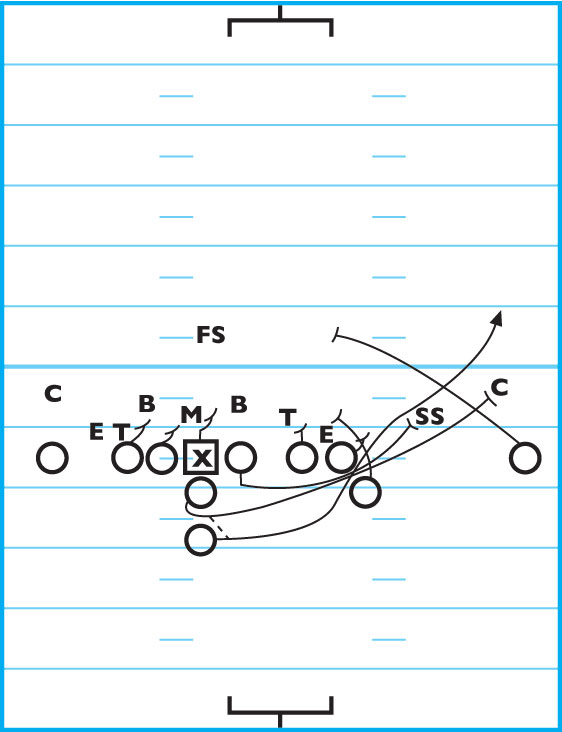
|
|
2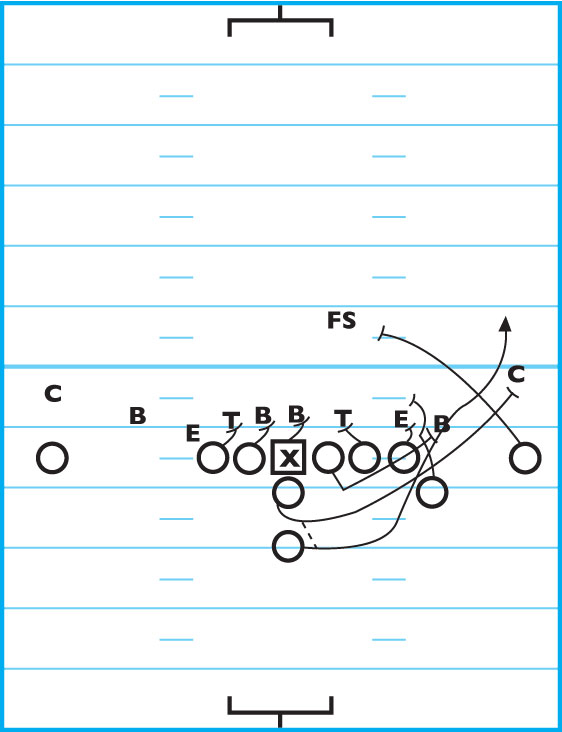
|
|
3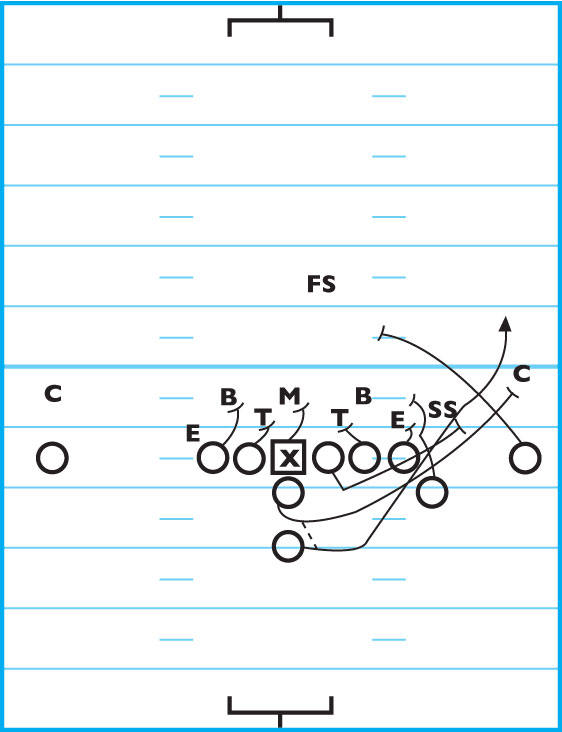
|
|
4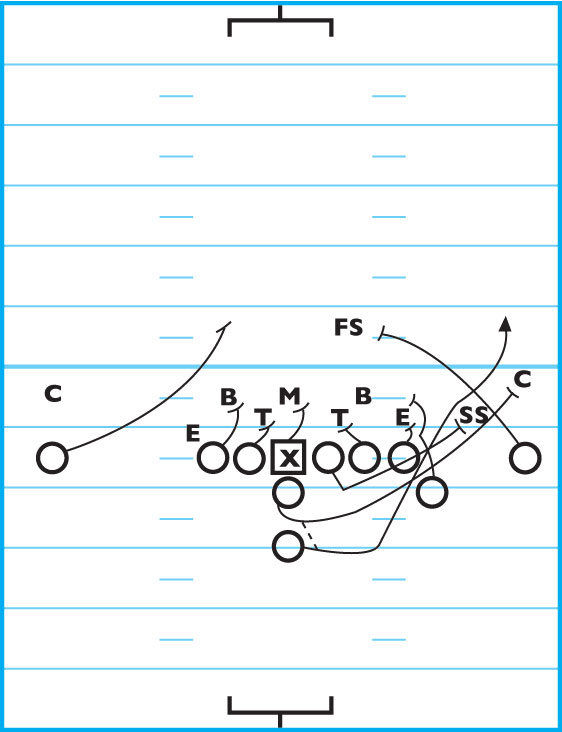
Quarterback Responsibility
The quarterback is also a key to the success of this play. You need to have a QB who isn’t afraid to throw a block. We have even had our QB make the “Big Block Board” quite a few times (this is an award given each week to the player with the best block in each game).
The QB will reverse out and make a quick, crisp pitch to the tailback staying tight to the LOS so he does not interfere with the ball carrier’s path. He needs to turn upfield as soon as he can and is responsible for either the CB or the S depending on the defensive set.
The center and the backside OG are responsible for the nearest defensive linemen and the backside LB. Use either a combo block or a slip-and-cut (zone). In the slip-and-cut technique, the OG cuts the play-side leg of the nearest defensive linemen.
The center takes a play-side zone step, not cutting the defender (to avoid a chop block penalty), and works up to the backside LB to seal him off.
The backside OT (and TE if applicable) will zone the remaining backside defenders.
DRILLS
Pursuit with a Purpose
The 2 Whistle Drill
THE BEST WAY that I’ve found to get a lot of my players around the football is to use the “2 Whistle Drill.” This simple drill will get your players used to gang-tackling.
11 players line up in at their normal positions. A coach will randomly throw the ball to an area.
On the first blow of the whistle the players will scramble towards the ball. By the time the second whistle blows— any player not within 5-yards of the football will do five up-downs.
In a short period of time, you will have 11 players sprinting to the ball.
—Butch Jacobs, Head Coach, Bamberg Ehrhardt High School,
Bamberg, S.C.
Teach Importance of Leverage
ONE OF THE MOST difficult concepts to teach players is understanding leverage. The following drill gets the job done.
Start out with one offensive player who assumes a position of already having hooked or reached a defensive player. He should grab the defender’s chest plate and sit his hips down in a good football position.
Push, Pull
On the command “set go,” the defensive player pushes with his outside hand and pulls with the inside hand to try to square up the offensive player’s shoulders. Stress keeping hips and pad-level down. Tell them to keep throwing their hips outside.
Once the defender achieves a stalemate, completely squares the offensive player’s shoulder or beats him, the defender should shuck the offensive player away and make a form tackle on a player or coach who is simulating a ball carrier.
Playing Off Block
As they gain experience with this drill, you can have the offensive player put his hands on the defender’s chest plates in a hooked or reached position, while the defender keeps his hands by his sides. On the “set go” command, the defensive player shoots his hands into the offensive player’s chest and carries out the drill the same way as before.
This is an excellent way to teach players leverage and how to play off a block. It teaches a defender how to work their hands inside on the offensive player’s chest plates and how to gain proper leverage on an opponent.
—Mark D. Johnson,
Linebackers/Special Teams Coach,
University of Nevada—Reno, Reno, Nev.