THE ‘GANGSTER’ is a pass-run option that provides the offense with enough variables that it is effective against any front or coverage and in any situation.
The play has its origins from Tiger Ellison, the innovator of the Run and Shoot, as well as the late Hub Etchison, who coached Richmond, Ind., for more than 30 years. Other contributors include the passing pedigree of the late Lee Tressel (the father of Ohio State University’s head coach Jim Tressel), as well as the slide route from Mouse Davis and the work of the late “Red” Faught of Franklin College. These coaches laid the foundation for this play, which has been a mainstay in our offense for more than 20 years.
Being a one-back team since the 1980s, the “Gangster” always has been there when the coaching staff needed a big play or when we needed something to hang our hat on. It has bailed us out many times.
Start the “Gangster” by looking over the defense to decide the part of this play you can use. Many variations come off this play and the “Gangster” even could be used as a base for an offense.
DIAGRAM 1: Basic Alignment. The basic alignment is the double-slot from underneath or in the shotgun. The single back lines up 5 yards behind the quarterback. The wide receivers are 15-18 yards from the tackles on the line. The slots are 1 yard from the tackles and two steps back.
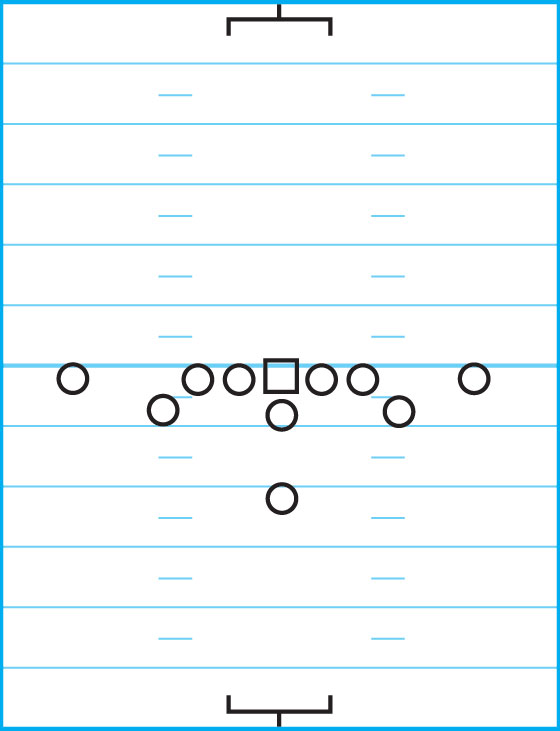
DIAGRAM 2: Gangster 1. The basic movements of the Gangster are shown in Diagram 2 with the subsequent diagrams showing variations.
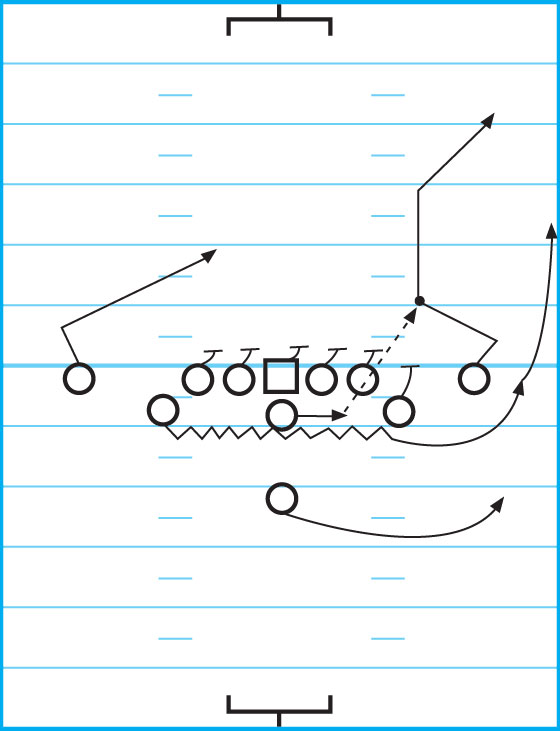
The WR on the play side releases outside for three steps, then breaks sharply at a 45-degree cut. The front-side slot blocks the end man on the line of scrimmage (EMOLS). The backside slot runs long motion and when he gets to where the front-side slot is, he starts to bubble and ends up where the front-side WR’s feet were. The backside WR runs a get-open over the middle but is tagged in a variety of ways.
Typically, the backside WR mirrors the front-side WR’s route by running outside for three steps, then using a diagonal cut.
The RB takes an open and crossover step. He loses some ground but stays in a pitch relationship with the QB.
The QB is the trigger man who makes this play go. He starts down the line of scrimmage for three steps. If he sees a window to through the quick slant, he fires it in there (as depicted in Diagram 2). If there is no window or if it’s not a clear shot, he comes off the LOS on his fourth step and loses ground while looking for the “bubble” route of the backside slot. As the QB is on the run, the defenders have to commit to either the pass option or the run option of this play. The flat defender usually guesses incorrectly, allowing your offense to pick up some good yardage.
As depicted in the subsequent diagrams, when defenses start to roll up or run to all the front-side motion, go to the backside WR on the slant. Or, tag him for a post corner or run a dig and drag pattern.
The last part of the Gangster has to do with the running portion of the play. If the defense stays back on the pass to the front side, the action in the backfield turns into the speed option. An option off the last phase after the RB gets the ball is that he could throw it as well.
DIAGRAM 3: Gangster 2. In this variation from the basic movements, the backside WR gets open by running a corner, post or dig route. The backside slot continues through the flat and runs a route up the sideline where the QB could hit him with a pass after just 5 or 6 yards of depth. The front-side WR sits down in his route after his initial movements.
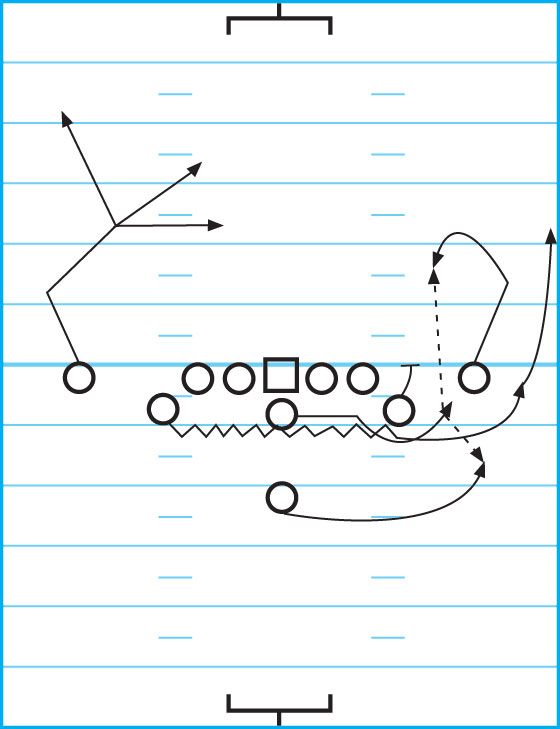
The QB now has three options:
1. Pass to the front-side WR sitting in his route about 8 yards down the field.
2. Pass to the backside slot 5-6 yards up the sideline.
3. Pitch to the RB in the backfield.
DIAGRAM 4: Gangster 3. This variation offers the QB several options. The backside WR starts by going his typical three steps to the outside. Instead of cutting at a 45-degree angle at that point, he continues up the field for another 5-6 yards. He then runs a drag pattern toward the middle of the field.
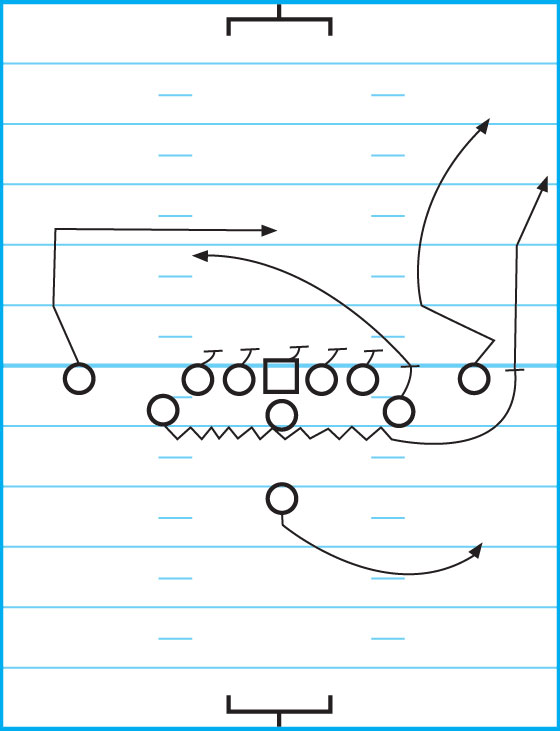
The front-side WR runs his three steps outside, breaks inside at a 45-degree angle, then runs vertical and finishes with a corner route if the QB can’t hit him early in the pattern like in Diagram 2.
The backside slot comes in motion, bubbles, then sets a block near the LOS. After the block, he releases on a vertical pattern that moves toward the corner.
The front-side slot sets his block for a two-count, then runs a 5- to 8-yard drag pattern underneath the pattern of the backside WR.
DIAGRAM 5: Gangster 4. When the linebackers start bumping over to cover the flats and the front-side motion, running a trap is the best option.
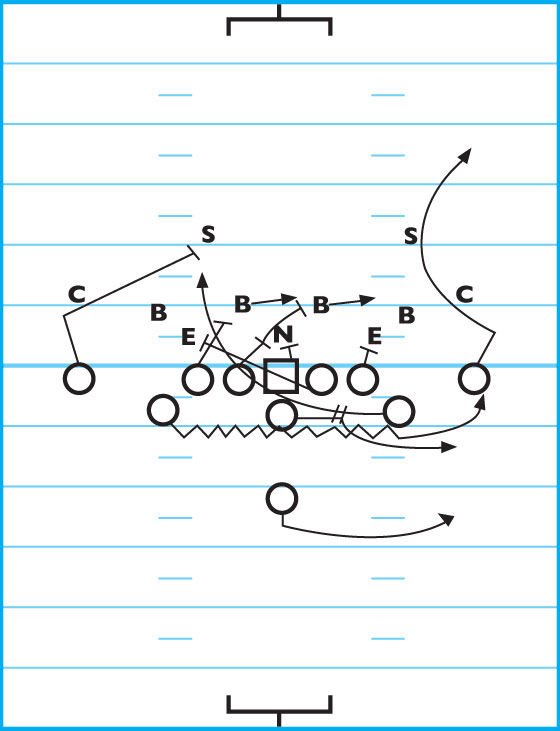
The backside WR runs his typical pattern but eventually sets up to block for the trap play. The front-side WR runs his route. With the LBs bumping over, he’s more than likely not open, which means he breaks down the field (there is an outside chance he could be open for a home run pass for a score). The backside slot goes in motion, bubbles and ends up where the feet of the front-side WR once were. The front-side slot, instead of coming up to set a block, cuts inside, receives a handoff from the QB and runs a trap through the hole.
This hole is created by the front-side offensive guard pulling to hit the backside defensive end while the backside OG comes across to hit the nose tackle.
DIAGRAM 6: Gangster 5. This play centers on the ability of your RB. If this player is a decent passer, you have some outstanding possibilities here to fool the defense.
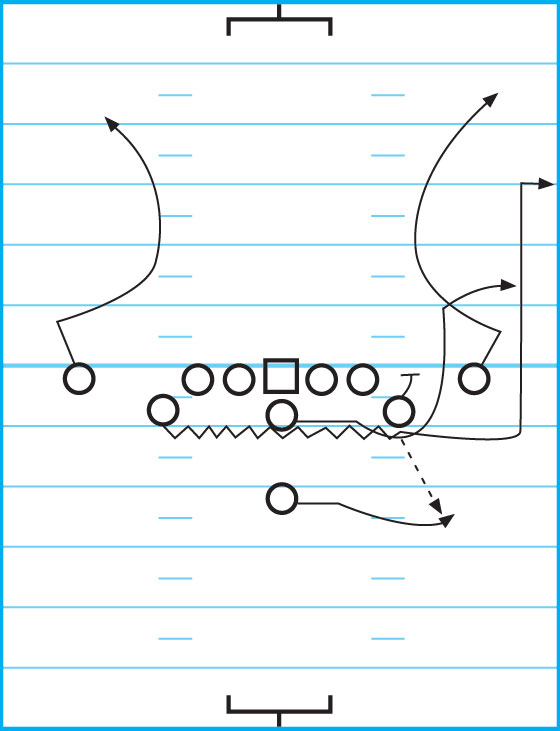
Or, you could send in your second-string QB to man the role of RB in this play. In that case, you have a bonafide passer lined up in the backfield and the defense may not be aware of it. Once again, the defense won’t have time to react, even if they do happen to catch onto what you are doing.
The two WRs run their typical routes with three steps to the outside, then cutting inside at a 45-degree angle. If neither is open, then both go vertical and eventually end up running corner patterns on their respective sides of the field.
The backside slot once again comes in motion, bubbles and heads up the right sideline.
The QB steps to the right and on his fourth step pitches to the RB. The QB then runs a route about 7 yards down the field toward the sideline to give the RB another passing option.