IF YOU WATCH kids playing pick-up football, you see that the most popular pass route is the “fade,” straight down the field going deep. Why? A well-thrown ball and decent catching ability can provide that quick-strike TD payoff.
While the fade is a staple of most any offense, it isn’t typically coached well. How many times have you watched a wide receiver get a great release, get slightly on top of the defender, and then run straight to the sideline? When that occurs, the WR becomes sandwiched by the sideline and a defender. For a completion in such a route, you need an extremely accurate passer and a great WR.
There are things you can do as a coach, however, to help even your average WRs get open on this route.
Alignment, Stance
Our base offense is a 2 by 2 (4 WR formation) with 1 back. Regardless of how many WRs are positioned to a side, the rule is that the outside WR aligns himself just inside the numbers on the field (about 9 yards in on our field).
This set alignment cuts down on showing any tendencies to the defense.
The WR stance is always with the inside foot up and the outside foot back. Hands are always in the “ready” position, meaning the WR holds them up at about chest height.
Release Vs. Zone
Regardless of whether a 3- or 5-step drop is called, the WR always takes two hard steps toward the inside of the defender. This helps turn the defender’s hips inward. On his second step, the WR pushes off his inside foot and gets outside of the defender (a head-and-shoulder hint move increases the odds of gaining good separation).
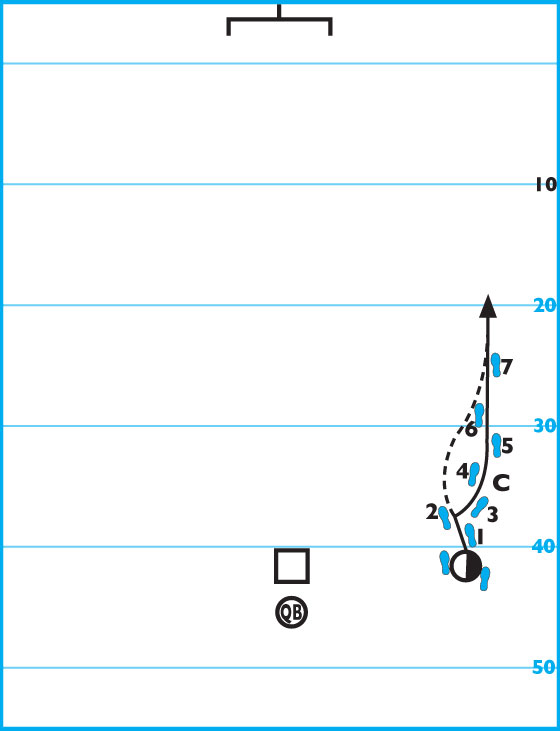
DIAGRAM 1: Release Vs. Zone. If the WR has trouble getting back outside of the defender in zone coverage (which can happen in a Cover-2 look) he may continue on a path slightly inside of the defender and returns to the route’s vertical landmarks once he has gotten on top of the defender.
Release Vs. Man
Because the defender is usually in an inside shade and pressing in a man defense, the WR takes one hard step in and slightly up with his inside foot.
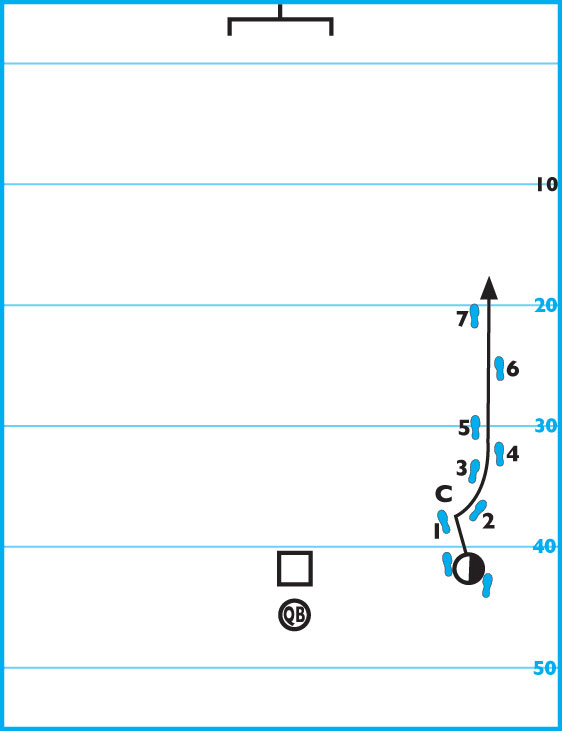
DIAGRAM 2: Release Vs. Man. The “hands ready” position is important in man coverage as the WR must have quick hands to get the defender’s hands off him on that first step. The WR head-fakes, and then gets outside of the defender, again running inside the field numbers.
After The Release
In either release, the WR continues to run the route “just inside the numbers.” In man coverage, the defender will try to push the WR to the sideline. The WR must combat this by “leaning” on the defender while running the fade.
This also creates some question in the defender’s mind as to which way the WR is trying to run.
“Window” For Fade Vs. Man Coverage
If the WR has a good release and is on top of the defender with no safety help over the top, the quarterback should throw the ball high and to the WR’s outside shoulder. (Teach the QB to “drop it down the chimney.”) At the last moment, the WR should adjust and catch the ball over his outside shoulder.
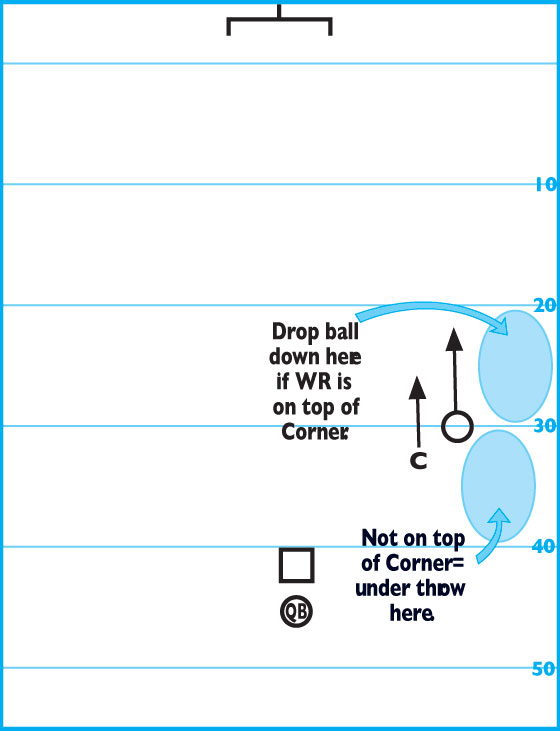
DIAGRAM 3: “Window”
for Fade Vs. Man. Because of the landmarked route, the QB has a much easier throw, as there is ample room between the sideline and the defender.
If the WR hasn’t gotten on top of the defender, then the QB underthrows to the WR (throwing the ball short and to the outside, behind the WR).
“Window” For Fade Vs. Zone Coverage (Cover 2)
In a Cover-2 look, the corner usually sits in an outside shade of the WR with a cushion of about 5 yards. After a “hint” move or running inside and then getting on top of the defender and back on the landmarks, the WR should turn and look for the ball. In a 3-step drop, the ball is thrown “on time” in the window between the corner and the safety playing over the top in his half of the field. This ball is thrown “on a rope” directly into the window.
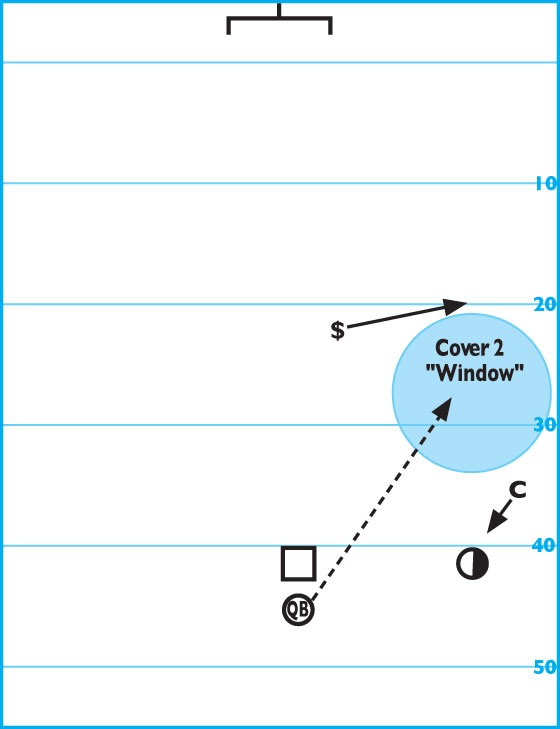
DIAGRAM 4: “Window” For Fade Vs. Cover 2. In a 5-step drop, the ball is usually underthrown (throwing slightly behind the WR) to allow the WR to catch it in front of the safety. The trajectory of the pass varies depending on the situation.
”Window” For Fade Vs. Zone Coverage (Cover 3 or 4)
In a Cover-3 or 4 look, the corner usually sits in an outside shade of the WR with a softer cushion of about 10 yards. In this case, the WR may take more than his usual two-step lean for a more vertical release. In a 3-step drop, the ball is usually underthrown between the corner and the “cover down” defender. In a 5-step drop, the rules are similar to that of man coverage.
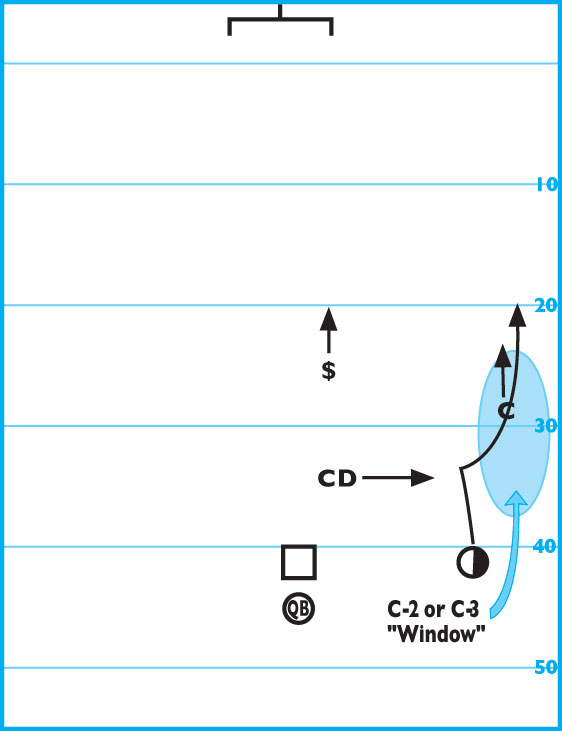
DIAGRAM 5: “Window for Fade Vs. Cover 3 or 4.
If the WR is on top of the defender, the ball is thrown downfield to the WR’s outside shoulder. If the WR hasn’t beaten the defender, then the QB underthrows the ball. Again, the trajectory varies depending on the situation.
Release Drills
The following are effective drills that can be used to teach your WRs solid release techniques. Each can be run with WRs alternating as defenders.
Vs. Zone. Facing a defender aligned in a soft outside shade, the WR works his inside lean with a head-and-shoulder fake on the second step and then works to get back outside of the defender while looking for the ball. You can use another defender to force the WR inside so he can practice returning to the landmarks.
Vs. Man. Against a pressing defender in an inside shade position, instruct the WR to make a hint move inside with his inside foot. After a head-and-shoulder fake, the WR pushes off his inside foot and uses his hands to shake the defender’s hands off him while continuing to run the route.
“Quick Hand” Drill. This is a great drill to develop a WR’s important hands skills when facing a pressing defender. The defender lines up 1 yard away from the WR. On the start, the defender shoots his hands straight out at the WR’s chest and continues shooting and recoiling them. While keeping his feet planted, the WR rips or swims the defender’s hands. Instruct the WR to alternately lead with his right and left hand.
A few teaching points should be made in conjunction with this drill. The WR should select his lead arm based on the direction in which he intends to go (moving to the right, use the right hand). The WR should aim to make hand contact just above the defender’s wrist.
The “follow through” arm should rip or swim both of the defender’s arms. Teach players to swim only over the defender’s arms and not his entire body, as this invites the defender to jam the WR in the ribs and drive him to the sideline.
Route-Running Drills
Several route-oriented drills can help bring the timing and familiarity needed between the QB and WR.
Fade On Air. After simulating a “hint” or “stem,” the WR executes the fade route with the QB throwing on time. The WR must work to the assigned landmarks and the QB must throw a good lead ball with enough air to drop it down on the outside shoulder of the running WR. As with any pass, the key is the WR-QB relationship. Drilling your top routes daily helps speed up the process of the two positions becoming comfortable with each other.
Fade Route Drill With Defender. The WR runs a fade route while the defender runs alongside at his inside hip. The QB throws the ball and, at the last minute, the WR leaves his landmark to “lean” over to the ball, catching it over his outside shoulder.
Underthrows Drill With Defender. In this drill, the QB underthrows the ball and the WR must plant, stop and reach for the ball, catching it at its highest possible point.
“Window” Fade Throws. With a corner and safety positioned as directed by the coach, the QB reads the coverage and the WR runs the fade. This drill helps the QB practice the proper fade pass and helps both positions in their coverage reading ability.
Coaching Points For Fade Success
A few coaching points for fade routes include:
- Finishing Routes. Instruct your WR to “finish” all routes by sprinting 10 yards upfield after each catch is secured.
- Off-The-Field Teaching. Teach coverages before taking the field. Note the coverages you expect to see throughout the season and teach them on the chalkboard and on film, and then ask your QBs and WRs to draw it on the board. Make sure they understand the strengths and weaknesses of each coverage.
- Catching, Securing The Ball. Teach your WRs proper catching and ball-securing techniques. Too many WRs “trap” the ball into their body. The hands of the WR should “absorb” the ball as it hits them. They should always keep their hands on the same level plane. Finally, each WR should be taught to “see the ball in” and follow it with their eyes until the ball is secured.
- Stance. Always have WR line up in a proper stance, pushing off the back foot and rolling off the front foot. (If the defender is pressing, you can allow a “hint” move with the lead foot.) This routine eliminates any nonproductive steps and gets the WR upfield as quickly as possible.
- Drill Your Landmarks. The landmark in the fade route is critical to success. Emphasizing the landmarks in practice and insisting they are run with perfection will take great pressure off the QB in game situations.