THE PHILOSOPHY OF the empty backfield formation is to spread the offense and opposing defense from sideline to sideline.
Once the defense has been spread out, you can read its alignment and attack any mismatch that can be found by either running or passing the ball.
Quarterback Traits
This offense places a heavy burden on the QB. To execute this offense to its fullest potential, your QB must have the following traits:
- Intelligence. Your QB must read the defense at the line of scrimmage and audible to a play that will take full advantage of the defense.
- Running Ability. Your QB must be able to escape a pass rush and perform the same duties as a running back.
- Passing Ability. Your QB will not only be required to throw short and deep passes accurately, but must do it on the run.
DIAGRAM 1: Basic Formation. In this formation, one receiver is split 15 to 20 yards outside the left tight end. This varies with the position of the ball in relation to the hash marks.
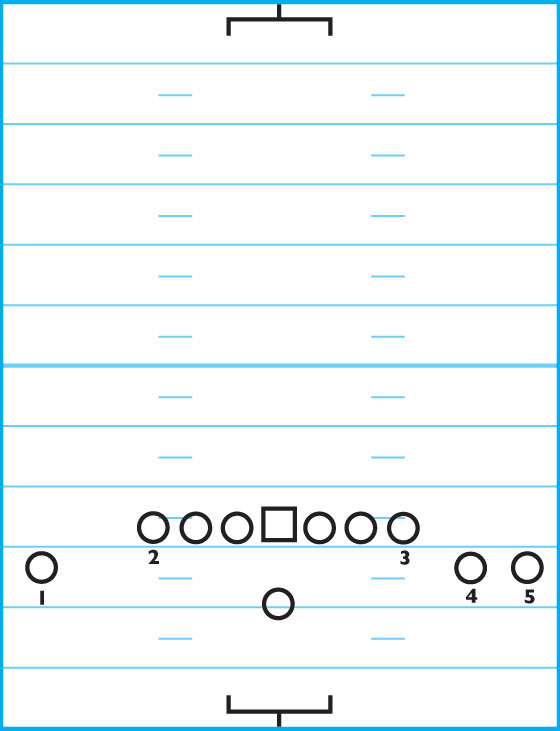
Two TEs are flexed 2 yards outside the guards. This is done to stretch the defensive front and will widen the perimeter running lanes and give the QB more time to throw.
The slot receiver is positioned 10 yards outside the right TE. The last receiver in this formation is positioned 3 yards off the right sideline. Receivers are numbered 1 to 5, going left to right
The offense is balanced with 18-inch splits and the QB is 5 yards deep in the shotgun formation.
Calling The Play
In our offensive package, the empty backfield formation is called “Black.” One season we decided to have a little fun and let our players pick out names for the four pass plays (Of course, they named them after some girls in our school).
The running plays are called Right, Left and Middle. Left holes are odd numbered and the holes to the right are even numbered.
The QB shouts out the play and a 3-digit number at the LOS. For example, prior to the snap, our QB might approach the LOS, read the defense and shout out “Susan 789” which means that the play will be run in the 7 hole. To keep the defense from guessing whether we’ll run or throw, the QB is coached to shout out a girl’s name that is not the name of one of our pass plays, meaning the play will be a running play.
Audibles
When your QB sees an uncovered receiver, he will shout the name of one of your pass plays and the number is the hot receiver.
Teach your receivers that if they’re the hot receiver on any given play, they should run their pattern, but be ready to receive a pass at any time.
If your QB reads the defense and finds a running play would be more effective for the situation, he may audible.
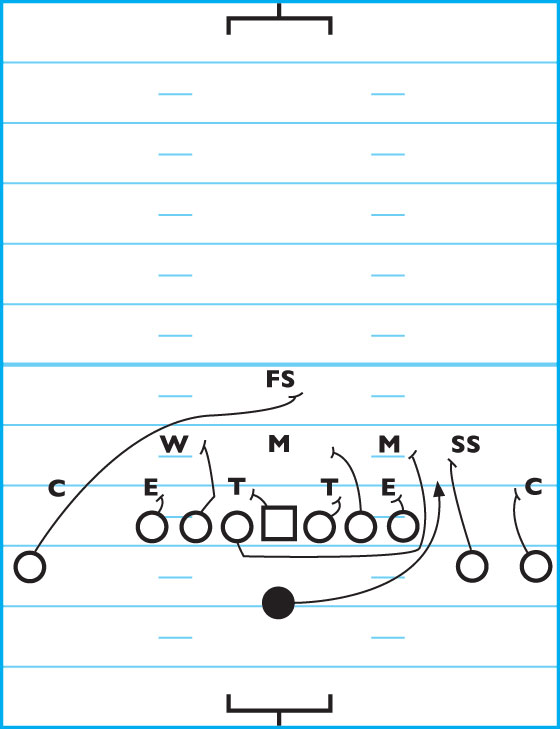
DIAGRAM 6: Susan 273. This audible running play was called because the right defensive end lined up too far inside of the TE.
A major key to calling successful audibles is having complete confidence in your QB.
The QB must be able to read defenses and have complete recognition of secondary and front alignments. Once they are able to to do this, finding the hot receiver will become second nature.
This skill takes time to learn. You must be patient with your QB while he’s experiencing growing pains.