EACH OFF-SEASON, teams at all levels across the country make modifications and adapt their style of offense to the type of talent that they’ll have when fall camp arrives.
In our program, it’s not uncommon that we’ll have a pure drop-back passer at quarterback one season and then a true option QB the next. Or we may have great speed at wide receiver or tremendous power at running back. It’s wise to design an offensive package that plays up to those strengths.
It changes every season and you must mold your offense around those types of players who best give your team a chance to win a championship.
One way to have a better chance at that championship is to put the ball in the hands of players who have the ability to score each time they touch the football. For our team, a large part of doing so involves the passing game — or more specifically — throwing to our RBs (our most-talented players).
At the high school level, more often than not, the RBs are usually the team’s best player. Or at least they are usually the physically most-explosive player on the team.
In our league, we don’t see a variety of defenses among the teams we play, let alone do we see different defensive looks from an individual opponent. Because our opponents are so limited and deliberate defensively, one method that has been extremely successful with is to create a mismatch and throw to a RB (who is more often than not, covered by a linebacker).
Dodge Route
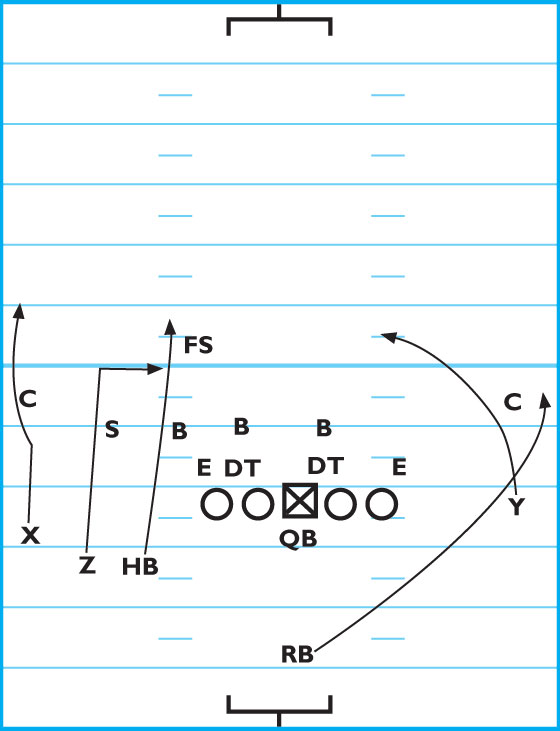
The “Dodge Route” is one of our favorite routes that’s designed to get the ball to our RBs. Run from trips, the goal is to influence deep defenders and sneak a RB into an area where, if he makes a catch, he can make a big play. More often than not, we’ll flex the tight end (Who, this past season, was our best receiver.) and the defense immediately thinks we’re passing.
DIAGRAM 1: “Dodge Route.” Our team faces Cover-3 more than anything else, so our goal becomes to influence the deep-third defender inside and run the RB into the vacated area. It’s the RB’s job to beat the underneath defender. The QB can help himself by looking off and influencing the deep-third defender and then throw to the RB on the Dodge Route.
Circle Route
Another way to use the RB in the passing game is to utilize the “Circle Route.”
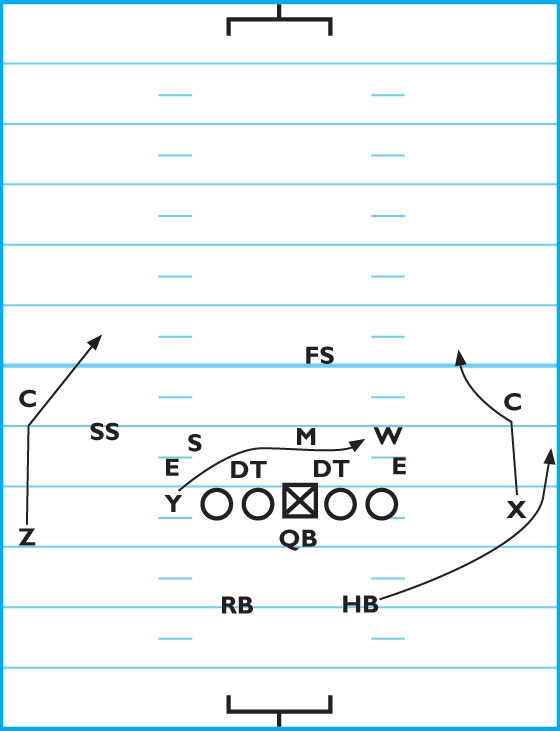
We like to use a quick passing game and slant routs. We also go to a 5-step drop passing game and run mirrored posts. Run from a 2-back set, the addition of the Circle Route to the post by the WR creates a situation for a potential big play.
DIAGRAM 2: Circle Route (Vs. Cover-3). The post route run by the WR influences the deep-third defender to the inside. The RB must outflank any underneath defender as he runs his circle route. The QB takes a 5-step drop, hitches and then delivers the ball over the outside shoulder of the RB. The timing and execution for this play works much better by using a 5-step drop than it does with a 3-step drop.
Boot Swing
Another way to get the ball to the RB is to use a play-action pass where the RB runs a route after selling the run-action. This play, which has been one of our most successful plays is called the “Boot Swing.”
The Boot Swing is versatile enough to be run from several different sets, but we prefer to run it from a 2-back, I-formation.
One of our favorite and most used running plays is the “Toss Sweep.” With the opposing defenses expecting the Toss Sweep from us — and by using sweep action — we can boot away from the run and find open receivers. The potential for a big play comes after your opponents have seen the boot run repeatedly.
DIAGRAM 3: Boot Swing (Vs. Cover-3). Shown against a Cover-3 (which is the coverage we face most often), the toss is faked to the right and the RB boot routes across the formation. The RB must “get lost” and then outflank any defenders and swing up the field.
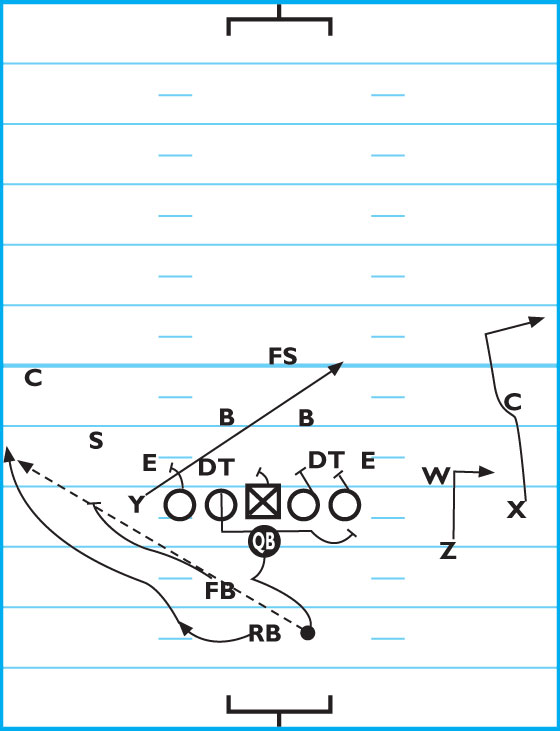
The QB must carry out a great toss fake, sell the boot and then pull up and check the status of the RB. He then throws a deep ball to the outside of the RB’s shoulder and the potential for a big play should be there.