DEFENSES ATTEMPT TO be comfortable with the formations and plays that an opponent may throw at them in any given situation.
Defensive coordinators relentlessly study game film and opponent tendencies to ensure that their units are prepared for any situation. It’s especially critical that they feel comfortable and prepared for situations where they are forced to defend the goal-line.
Our team likes to throw a defense’s comfort level off by doing a few things that harken back to the leather-helmet era of football. We use an unbalanced-stack formation and then attack the defense using the
Double-Dive Series.
Why It Works
The Double-Dive Series utilizes the same “guessing-game” feel that the Wing-T gives defenses. But our offense is an I-formation team and we don’t like to move away from it too often. This series, however, gives us a chance to find the holes in the defense and aggressively tries to exploit them.
There are two reasons that this series is one of our most productive offensive threats.
1. Unusual Look. The formation is different and forces defensive coordinators to spend major amounts of time developing a plan to stop it.
2. Forces Responsibility. This series takes advantage of undisciplined players and forces the secondary to become run-stoppers — a role most defensive backs aren’t used to performing.
Double-Dive Plays
The Double-Dive Series has three main plays: the Dive-1 Play, the Dive-2 Play and the QB Keep.
The beauty of this series is that all three plays look exactly alike.
The key play in the Double-Dive Series series is the Wedge Play.
DIAGRAM 1: Stack Rip 2 (Dive 1). In the stack-formation double-dive series, the first back always goes to kick out the last defender to the play-side on the line of scrimmage.
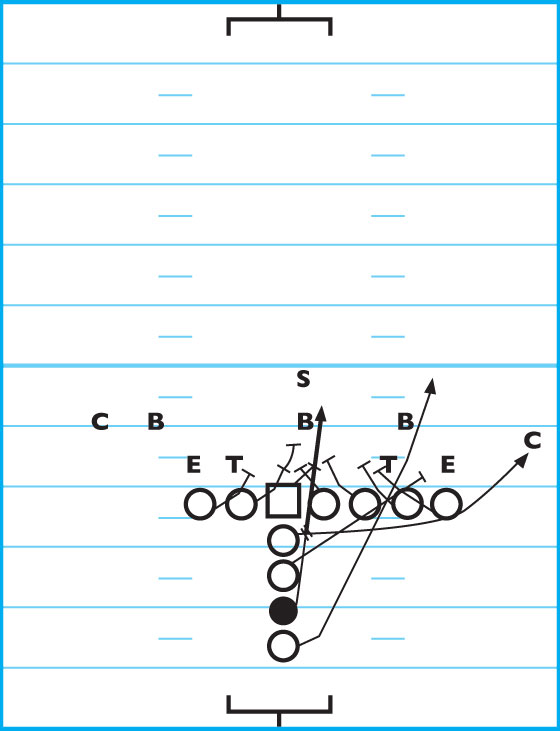
The second back gets the dive and the third back fakes his dive toward the off-tackle hole.
The offensive line simply uses wedge-blocking technique. The formation-side guard sets the wedge. He is the apex, and everyone moves violently inward toward him.
If you can run this play, the rest of the series will be no doubt successful.
DIAGRAM 2: Stack Rip 4 (Dive 2).
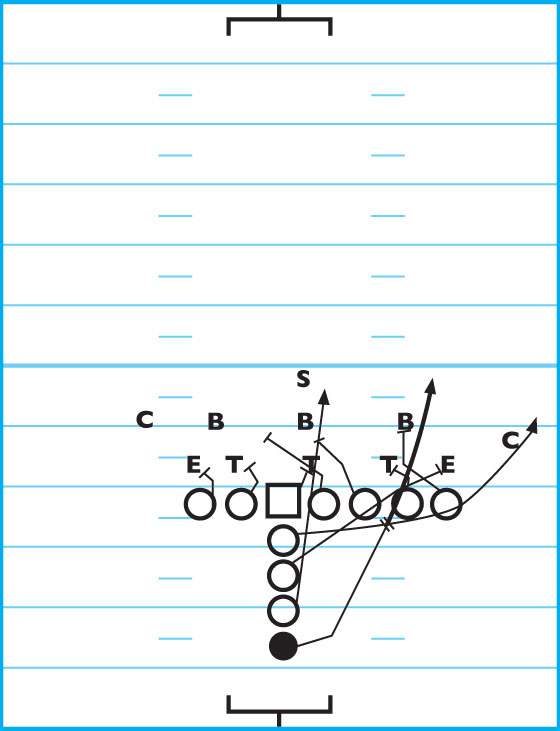
DIAGRAM 3: Stack Rip 4 (Vs. Cover-2 Look). The QB’s steps and the manner in which he carries out ball fakes in this series are critical to the success of the play.
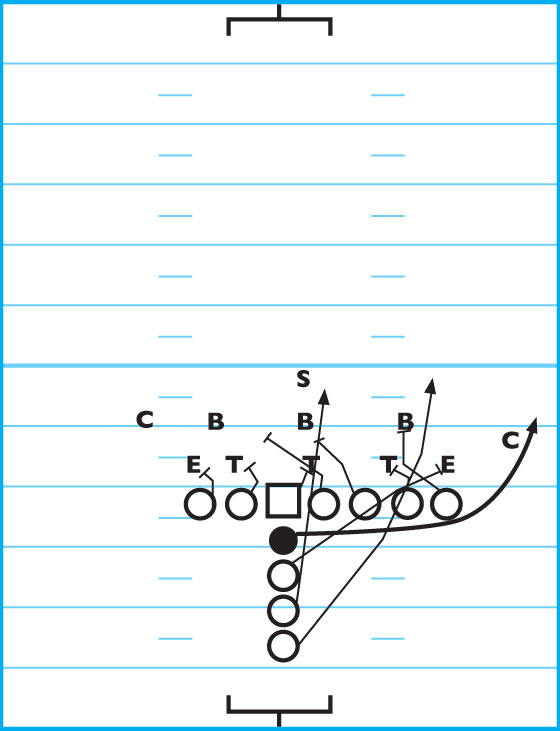
Opening up flat to the play side, the QB must stick the ball directly into the belly of the dive back getting the call and then ride it — option style — up into the hole.
The QB then stays flat down the line and meshes with the second dive back at the off-tackle hole. He will repeat, stick the ball in, step through the ride and carry out down the line.
The QB then proceeds to hide his hands (as if handling the ball), carrying out a good fake downfield.
DIAGRAM 4: Stack Rip 8 (QB Keep). This is an effective play when set up correctly. If called at the right time and set up properly, your QB could end up walking into the end zone while the cornerback is tackling the Dive-2 back.
Coaching Point: On every play, all three backs must carry out their fakes the same (as if they have the ball). They must carry out their fakes at full speed or the play won’t confuse the defense.
The blocking changes to a full-down scheme when the ball is handed off to the Dive-2 back, it stays the same with the QB Keep, except that the blocking back attempts to log block the end man on the LOS, rather than kick him out, as in the Dive calls.
The brilliance of the series is that all three plays look exactly the same, and the defenders are left guessing as to which back has the ball.
Double-Dive:
Play-Action
The Double-Dive Series features several great play-action passes, but our team’s favorite is the swing pass.
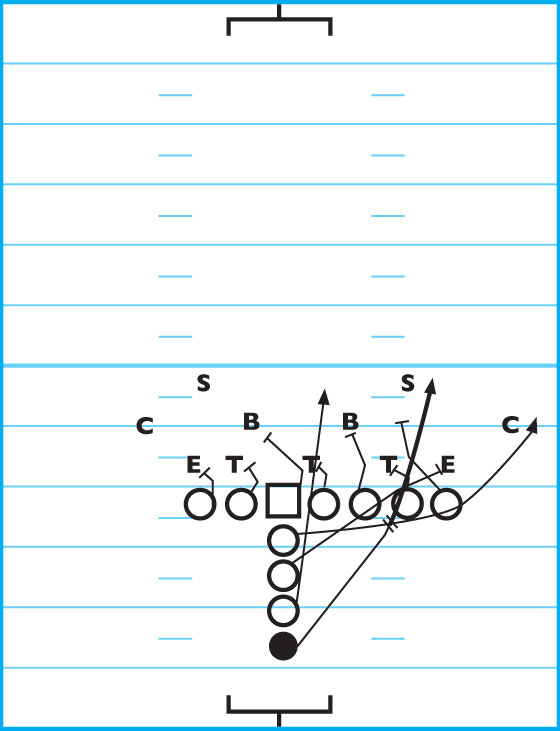
DIAGRAM 5: Stack Rip 2 Swing.
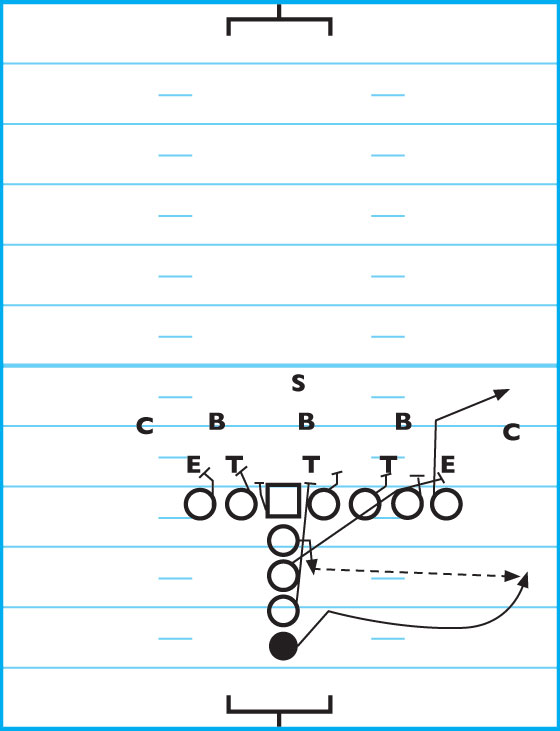
The QB opens to the Dive-1 back, ride and then takes two quick steps back. The Dive-2 back takes two hard steps at the off-tackle hole, then bellies back and runs a swing pattern.
The formation-side tight end steps down hard, gets vertical and then runs to the corner. The idea is to “high-low” the cornerback and force him to make a tough decision on who to cover.
We’ll also run the swing to the short side of the formation as well.
Beating Specific Defenses
We typically see two major defensive looks when using the Double-Dive Series. We see a Cover-3 look where the Safety plays like a “bubble” player and is free to roam and make tackles.
Or, we’ll see a Cover-2 look, which is more effective against the pass and the Double-Dive, but is much weaker against the power off-tackle play.
DIAGRAM 6: Stack Rip Power Off-Tackle Play. In this play, the entire line blocks using a down-blocking scheme. The first back kicks out the defensive end, the second back lead blocks and head-hunts the Safety.
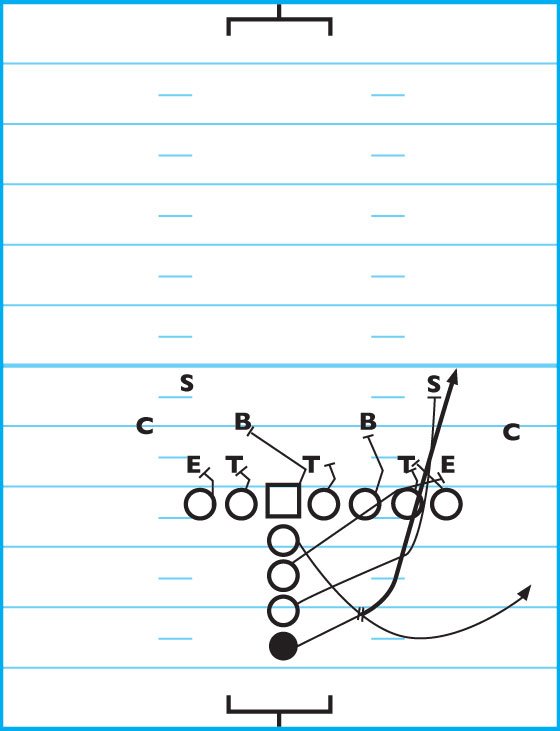
The TB secures the ball, cuts off the lead block and heads downfield.
The beauty of using this play against this type of defense is that the only player who is potentially left unblocked is the CB.
To eliminate the CB from disrupting the play and making the tackle, the QB must sell the fake hard and roll out after the handoff. The possibility for a “QB keeper” is enough to keep the play-side CB honest and make him stay at home.
Short-Side Possibilities
The Double-Dive Series and Power Off-Tackle Play are our main plays to the formation side. But the potential for plays to the short side of the field are endless.
To the short side of the field, we’ve effectively run the Off-Tackle Series, Belly Series, Iso Series, Option
Series and the Toss Series.
But with all the plays you can run to the short side, the series that defenses will fear the most is the Double-Dive Series — because it is the one series that has the potential to break the defense’s back on any given snap.
Most Effective Play In The Series
In reviewing our offense, which has heavily depended on the Double-Dive Series of plays over the last two seasons, the most effective play in our offense has been the Dive-2 play.
Run 154 times over the course of 21 games, the Dive-2 play has gained an average of 5.8 yards per carry. It has also been our most explosive running play, going for TD runs of more than 20 yards on 11 occasions over the last two seasons.