Today’s offenses are becoming more sophisticated with every passing year. The old cliché of three yards and a cloud of dust is almost becoming non-existent. Many of the advanced offenses today are reading defenses prior to the snap and calling or checking the play at the line of scrimmage. We adopted the philosophy several years ago that we were going to move and disguise the fronts, blitzes, and coverages as much as possible. We call this “prowling”.
Advantages of disguising are numerous, but the main advantage we are looking for is to remove a little of the offense’s aggressiveness in the pre-snap phase. In my opinion, the conventional way of just lining up in a technique and staying there until the ball is snapped allows the offensive lineman to be more aggressive. He has time to think…. “ok, I have a 3 technique on me….the play is a zone to the right……ok, I am going to overtake this guy and go to linebacker……what was that snap count again?....oh yea, it was on two.” However, through disguising, we eliminate how much time the offense has to think. We drew an average of three false start penalties per game out of the opposition last year and I honestly feel that was due to pre-snap disguise.
One of the essential steps in disguising, bluffing, and prowling the defense pre-snap is scouting the opponent’s cadence. If a team huddles, we put a stop watch on the average time that it takes them from breaking the huddle until the ball is actually snapped. If a team does not huddle, we look for the system that they use to get their play in to determine how much time we have to disguise. You will find through film study, that every team you encounter has some form of predictable cue that will tip you off as to when you can break your disguise. We feel that if we can break the disguise within 1.5 seconds of the snap, we will have enough time to quickly get into our alignments without the offense getting a long look us. Many coaches try to combat this by going on a quick count. However, if snapping on a quick count is not something they have been practicing regularly, then they will only wind up hurting themselves trying to do it. If we have a team trying to do something that they don’t normally do, then we already have an advantage.
On Mondays during the season, the first thing we do with the defense is to go through a recognition period. We use this time period to introduce not only the opponent’s best plays, but also the cue we will use that week to break our disguise and get into our alignment.
Defensive Line
Defensive linemen serve as an important part of disguising the front. Again, we do not want to allow an offensive lineman ample time to know who he has to block and have time to focus solely on his block. One important key to allowing these guys to stem their alignments is for them to always maintain a good football position while they are moving around. We make this a priority in the rare event that he might get caught out of position when the ball is snapped.
Prowling the defensive line will have no merit unless the defense uses multiple fronts. For example, if you are a 3-5 team and all you ever run is a 0 technique nose and 4 technique ends, it is useless to prowl linemen around if they are always going to return to that original alignment. However, if you employ shade fronts, stack fronts, 4 man fronts, then you have the ability to keep the offense guessing.
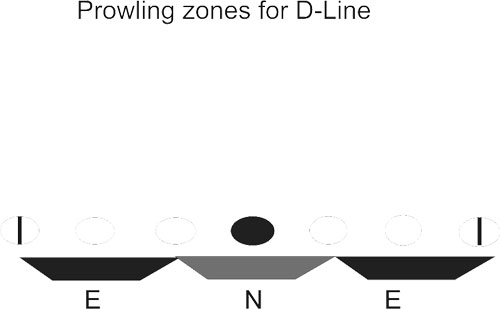
Diagram 1 shows the range of freedom that defensive linemen are allowed in our system to prowl. Generally, we do not allow these guys to prowl beyond any technique that they normally play. They must always know where to be just prior to the snap, based on the pre-determined cue of the week.
Linebackers
Linebackers in our system are expected to prowl as well. Prowling for linebackers can take on several forms. First of all, we give our linebackers the freedom on a prowl call to show blitz. This could be all three of them or just one, the choice is left purely up to our players. It is imperative that when bluffing a blitz, that a linebacker maintain the same body position as his stance. A common mistake that can occur is for the linebacker to first bluff, then turn and bail with his weight going backwards and his hips turned away from the LOS. He must keep his shoulders and hips square to the LOS and keep his balance with a slight forward lean throughout the entire bluff.
Another option we give our linebackers in prowling is to drop down into a 3 point stance on the LOS to bluff our 4 man front. Once he sees the cue that we have scouted as our signal to move into position, he will return to his correct alignment. This method is particularly valuable when disguising our front vs. offenses that are counting linemen on one side of the ball.
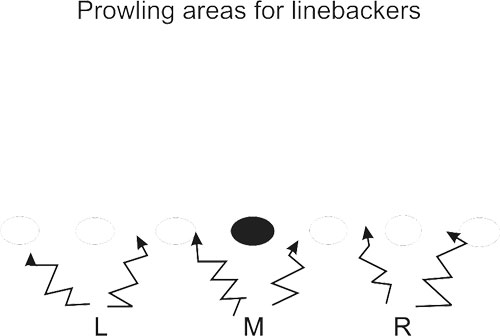
Prowling has to be practiced and coordinated between the linebackers and the defensive line. Their movements have to compliment one another in order to confuse the offense, not themselves. We start out very simple in the pre-season and tell them exactly what to do. Later on, we allow our players more freedom and also scheme what types of prowling movements we think will work the best against the opponent’s scheme. This, as with anything else, has to be practiced in order to be effective.
Defensive Backs and Spurs
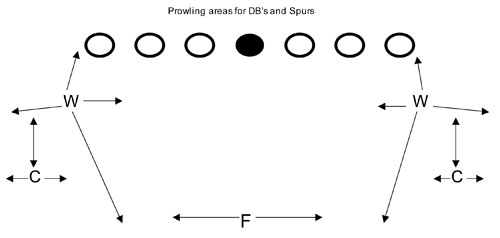
Disguising coverages is my favorite part of this concept. Especially with the “spur” type player that we may drop into coverage or blitz off the edge. We ask our corners to always play corner. We may disguise or leverage or depth, but they will always play corner. We ask our safety to disguise the 1 high or 2 high look in conjunction with our spurs. Our spurs have to be special athletes in that they have to play up in the box or also play dropped back as an additional safety. We allow them to prowl in three different ways: they can show an edge blitz, drop back to safety, or stem back into the box. Diagram 3 shows the options that each position in the secondary in which to prowl.
Disguise has become a big part of our defense. We feel that it has led to much of our success over the past several years since we started doing it. One thing that we feel makes it work is that our players truly enjoy disguise and have fun with it. Allowing them the freedom and ownership in what we do is a large part of their motivation. Our players look forward to playing defense and thoroughly enjoy hitting. I hope that you may find this concept to be as beneficial to you as it has been to us.