Long time UW-La Crosse Defensive Coordinator Roland Christensen preached the 3 P’s for many years to his defensive players: pride, poise, and pursuit. We still hold these three things in very high regard. Playing defense at UW-La Crosse is a privilege and the ability and attitude to pursue relentlessly is a requirement to play defense.
Getting Started – Pursuit Fundamentals
It is important to understand that pursuit is not simply running hard, but also the understanding of angles to the football and team defense. When we begin to teach pursuit, we begin with teaching angles to our players. More specifically, we talk about the idea that when you pursue the football, you must ‘take an angle so that the ball cannot cut across your face’.
We start this learning process with a few simple one-man and two-man pursuit drills. These drills do not require pads and can be used by the players at any time of year whether it is spring practice or the off-season.
One-man pursuit drills are run simply to teach the angle at which to pursue a ball carrier. Coaches can take time to watch and teach each player how to press the ball carrier and ‘take the air out’ between himself and the ball carrier while working at an inside/out angle that essentially ‘funnels’ the ball carrier to the force player or sideline.
Once these drills have been run at full speed with a ‘tag off’ tempo and the players understand the angle of pursuit, you can adjust the tempo to start teaching good tackling technique as well. Essentially, you are teaching an open field tackle at full speed.
One important priority is the footwork of the tackler. The tackler should be ‘long striding’ to the ball carrier while ‘taking the air out’ as he closes in. As the tackler gets closer to the ball carrier on his inside/out angle, his steps should remain narrow, but start to shorten. We tell our players to ‘step on the toes’ of the ball carrier. We do not want them breaking down with wide feet, but rather running through the ball carrier (Diagrams 1 and 2).
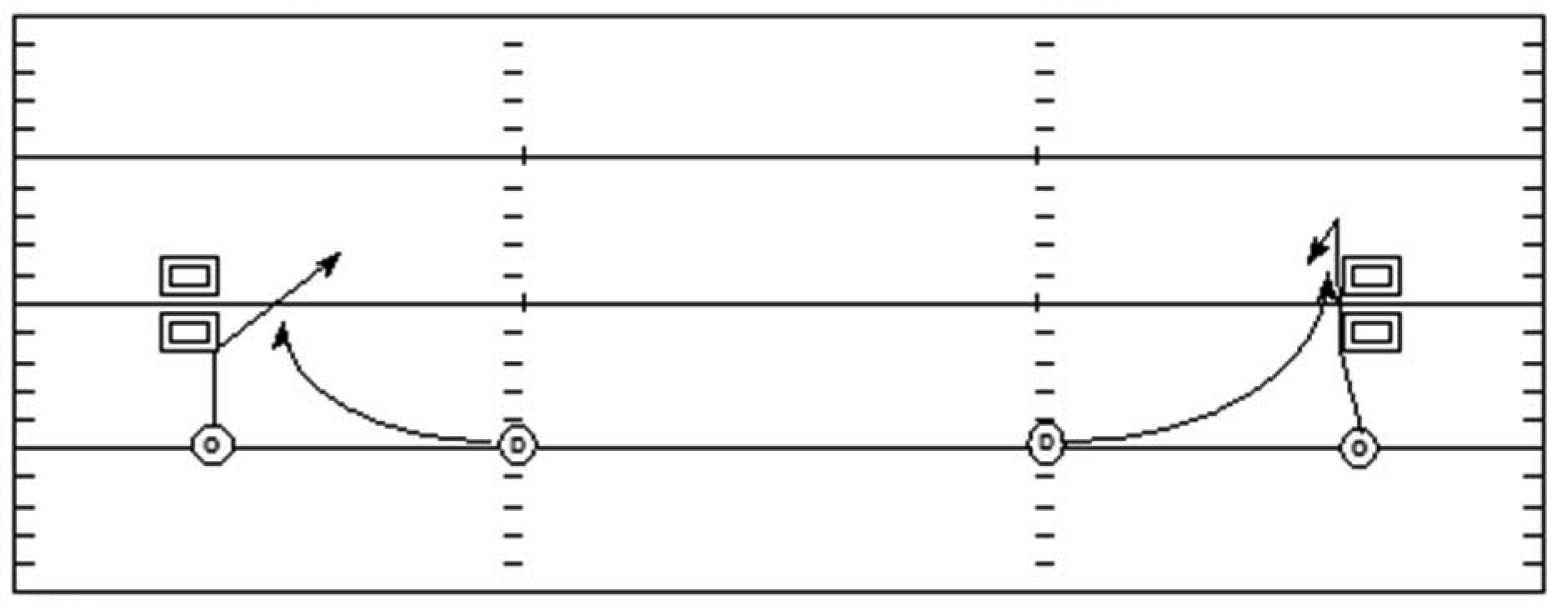
Diagram 1: One-Man Pursuit Drill – Pursuit of WR from inside leverage position
Notes:
1. O and D are 10 yards apart on the hash, O faces downfield while D faces O.
2. O runs varying pass routes (slant, hitch, curl, etc.).
3. D presses at O to ‘take air out’ and bends on ‘banana route’ to pursue and keep inside leverage.
4. We are assuming there is contain help.
5. We do not want to concede yards nor give up a cutback lane.
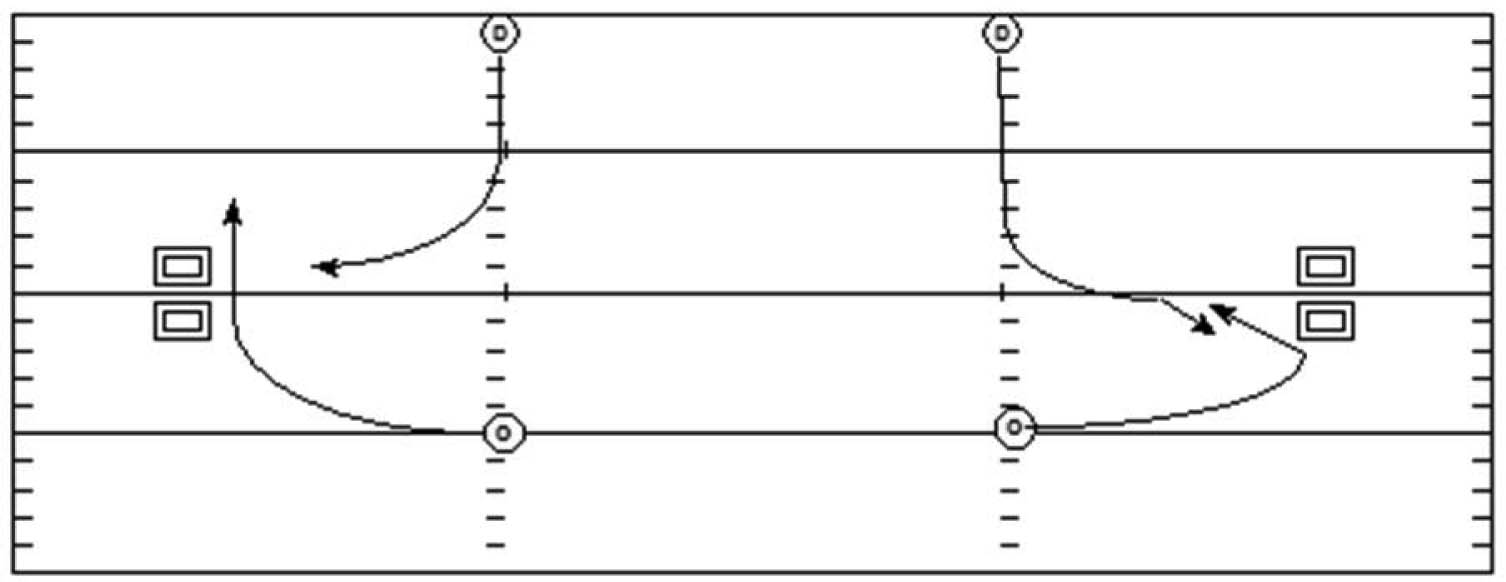
Diagram 2: One-Man Pursuit Drill – Pursuit of RB Out of the backfield
Notes:
1. O and D are 15 yards apart on the hash. O faces sideline while D faces O.
2. O sprints down line to sideline and works to run up sideline.
3. D presses O to ‘take air out’ and bends on ‘Banana Route’ to pursue and keep inside leverage.
4. We are assuming there is contain help.
5. We do not want to concede yards nor give up a cutback lane.
Once the understanding of the single-man pursuit has been accomplished, a second and third defender can be added to create a more game-like scenario. Adding ‘force’ players also teaches the players the concept of team defense and gap responsibility (Diagrams 3 and 4).
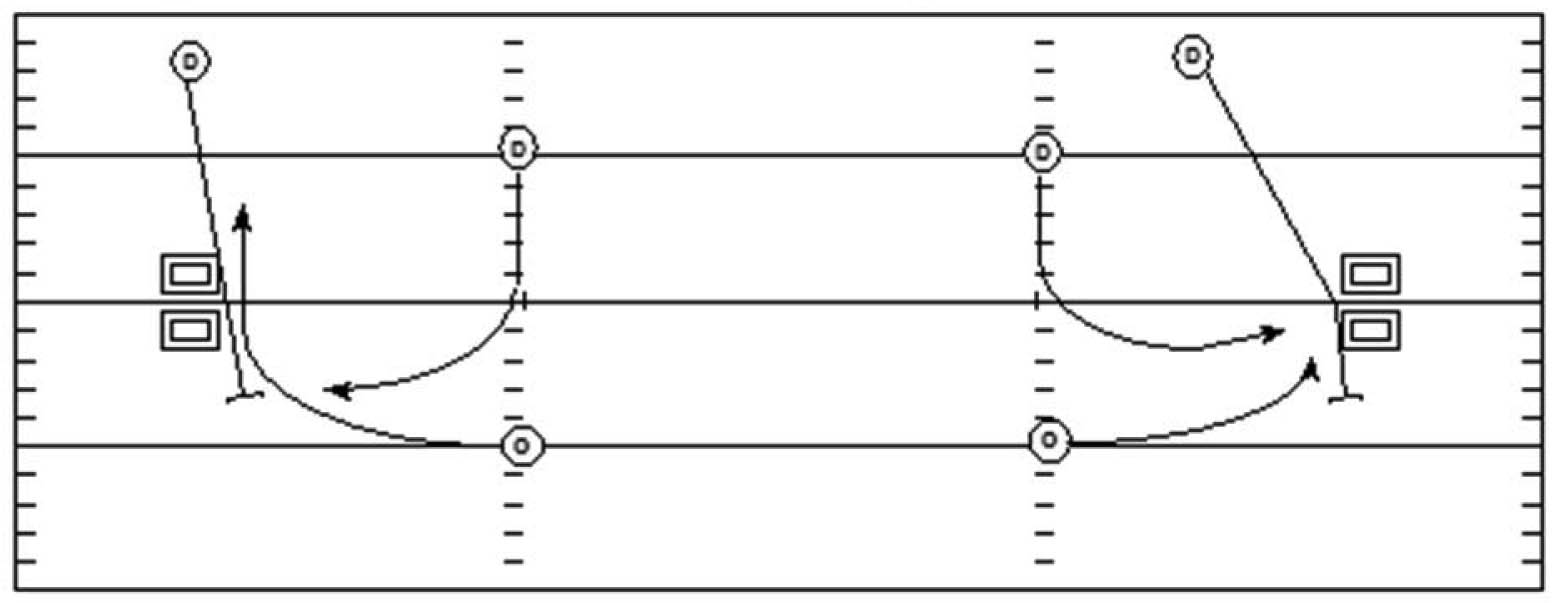
Diagram 3: Two-Man Pursuit Drill with inside and outside leverage
Notes:
1. Banana portion is the same as the one-man drill.
2. Addition of contain player – corners are the most common.
3. Contain player presses ball carrier’s outside shoulder immediately on start of drill.
4. We want to force a cutback and get that cutback prior to turning upfield.
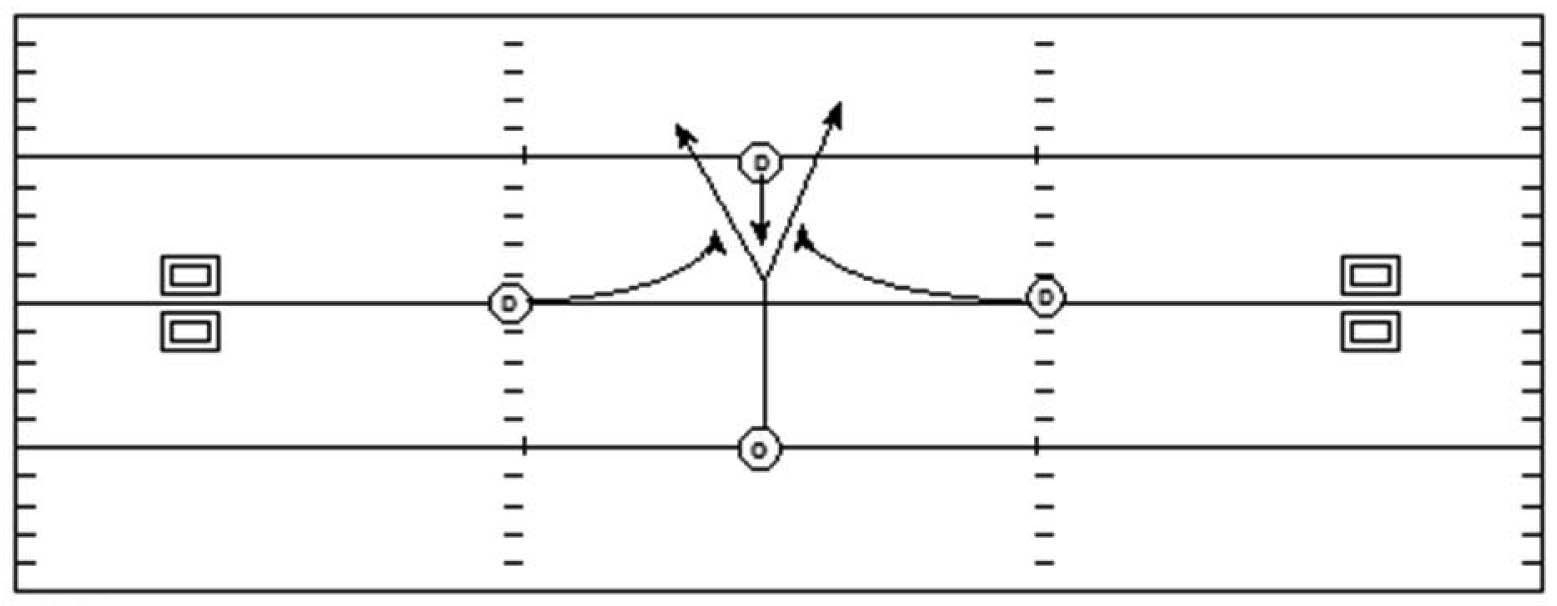
Diagram 4: Three-Man Pursuit Drill
Notes:
1. Three defensive players in triangle around RB.
2. Safety will press and force cut by RB.
3. Two other perimeter defenders press and use banana route concept to pursue.
4. Backside perimeter player continues over top in good banana pursuit.
Team Pursuit
We have tried a number of different team pursuit drills and have worked to develop multiple drills that reinforce what our individual drills have developed. The biggest challenge is developing a full defensive pursuit drill that allows the defense to run a huddle, line up, make the calls, and then pursue in a manner relevant to what they will be doing in a game.
We work the following drills with our defense:
Halfline Pursuit Drills – These drills are the next step up from the 1, 2, 3 man drills. It incorporates both inside and outside runs and the large number of players in a small space teaches the importance of run fits and team defense (Diagram 5).
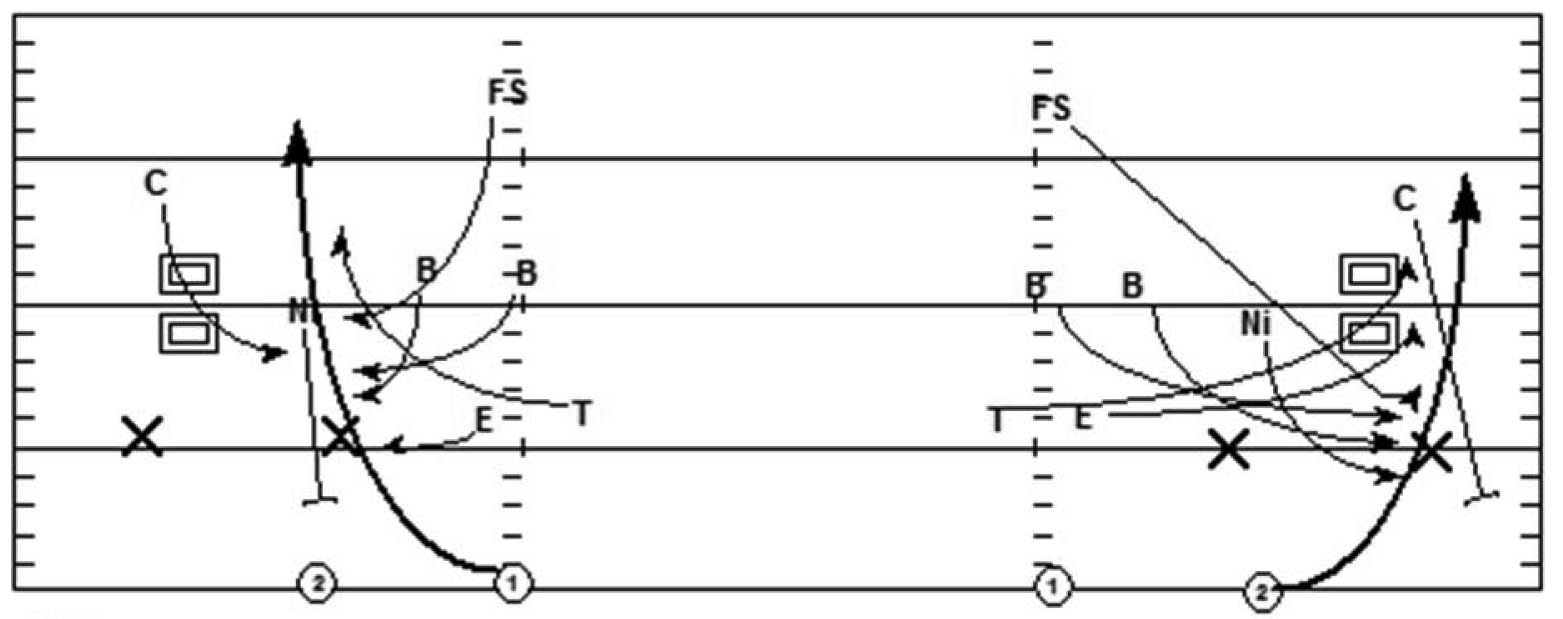
Diagram 5: Halfline All Defense
Notes:
1. Halfline defense with nickel removed – one end and one tackle.
2. ‘Rabbits’ will be at two positions and one will run on snap.
3. ‘Rabbit’ that goes will determine pursuit angles.
4. Force players need to be first and others fall in.
5. DL and backside LB will have to be biggest adjusters.
Skelly - Pass skeleton vs. your offense is the single best way to videotape and coach pursuit every day. It’s also very easy to grade and demand effort in practice as the coach is the one blowing the whistle. We run everywhere in our skelly period. We use a ‘tag’ off tempo and demand the WR/RB/TE catch and finish routes to the end zone so that our entire defense can pursue at the correct angle and with the required amount of effort (Diagram 6).
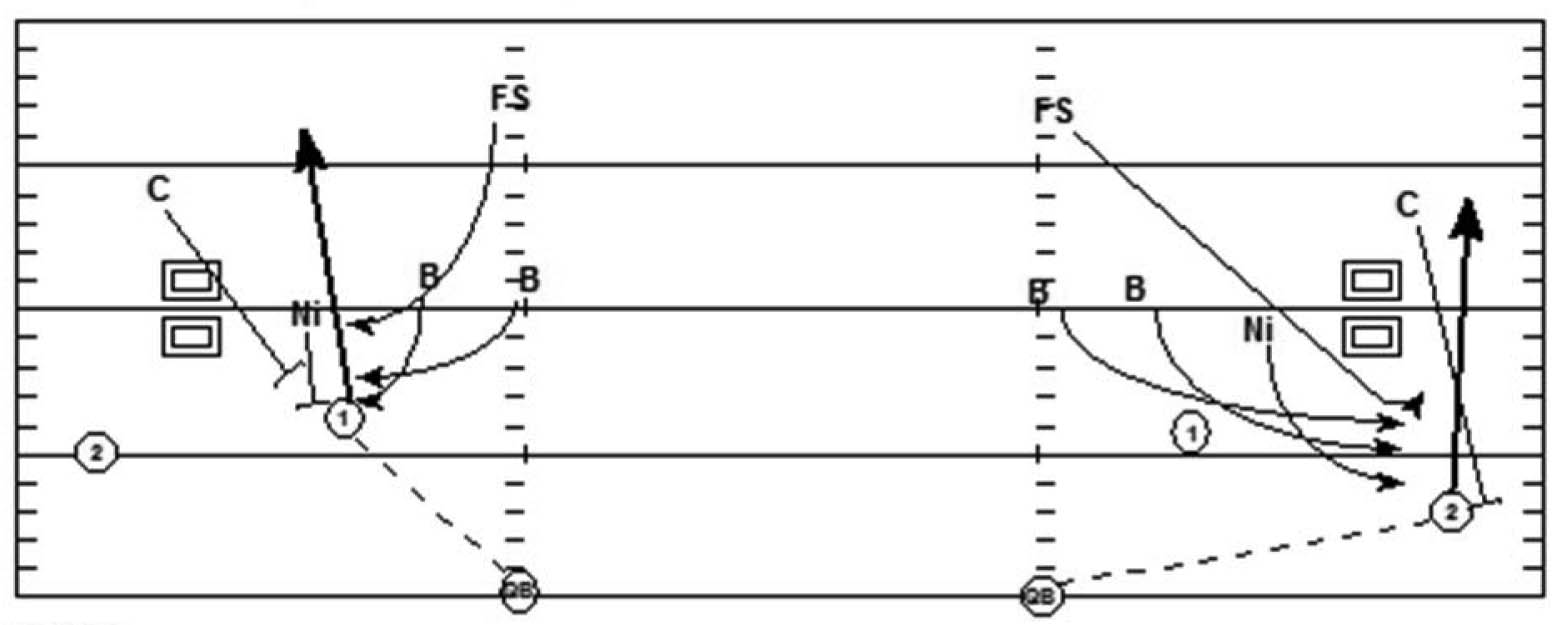
Diagram 6: Halfline Skelly – Pass Completion
Notes:
1. Halfline (or full skelly setup) with players at the depth of a normal 5-step drop.
2. ‘Rabbits’ at various route positions to catch ball.
3. QB will throw to any number of options – defense will pursue accordingly.
4. Drill can also be run with shallow crossers and the ball thrown at various locations.
Full-Team Pursuit / Sideline Pursuit – We utilize three ‘rabbits’ in our sideline pursuit drill with our entire defense. Only two of the ‘rabbits’ actually get utilized and none of them are sprinting so you don’t gas your other players. One rabbit creates the pursuit angles for your frontside players while the other two rabbits create a sideline angle for your backside players and your defensive backs. The entire drill allows your team to take their normal first steps and then pursue in a manner like they would in a game (Diagram 7).
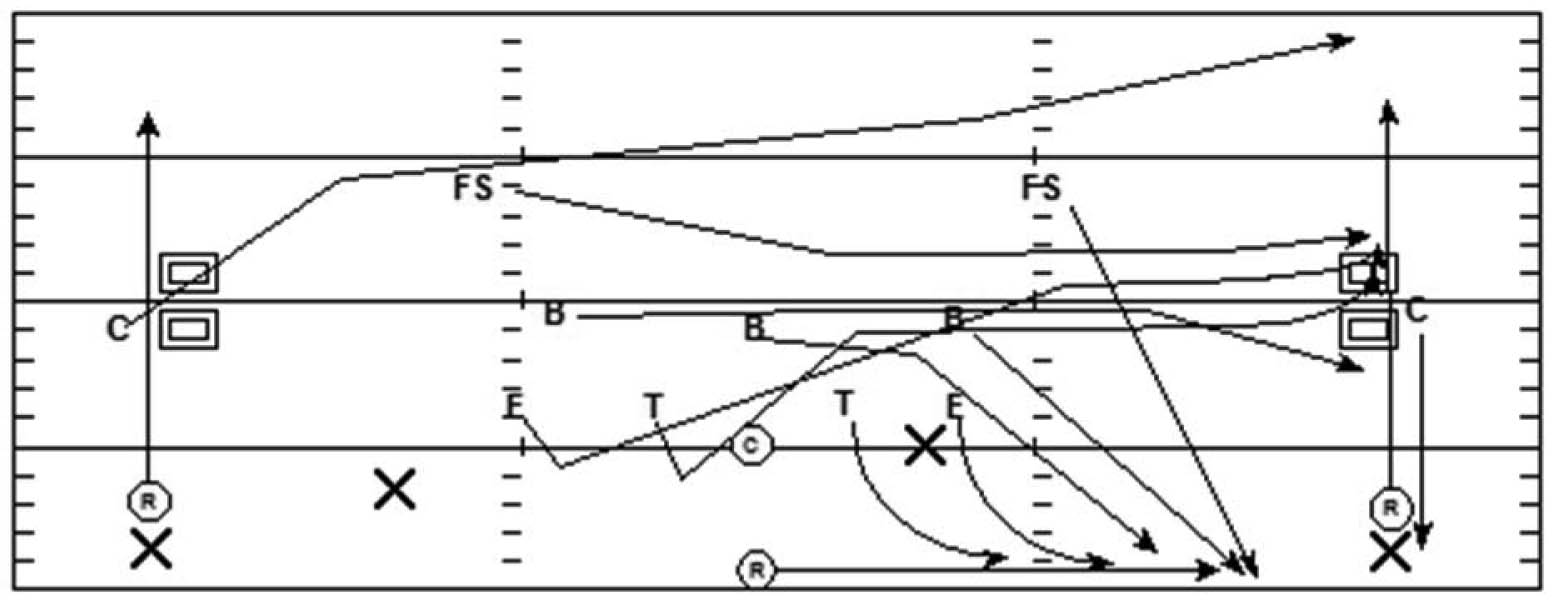
Diagram 7: Full Defense Rabbit Pursuit
Notes:
1. Coach snaps the football to start the play.
2. TB rabbit picks a direction and runs at 50% directly to the sideline.
3. WR rabbit to sideline. The TB rabbit runs at 50% down the bottom of the numbers.
4. All frontside players press and pursue TB rabbit.
5. Frontside corner presses outside shoulder of WR rabbit and then TB rabbit.
6. All backside players take normal first steps and then pursue WR rabbit at deep angle and then adjust flat.
7. Backside corner takes angle to pile on and then squeezes down to prevent cutback.
1. Coach snaps the football to start the play.
2. TB Rabbit picks a direction and runs at 50% speed directly to sideline.
3. WR Rabbit to side the TB Rabbit runs takes off at 50% speed down the bottom of numbers.
4. All frontside players press and pursue TB Rabbit.
5. Frontside corner presses outside shoulder of WR Rabbit and then TB Rabbit.
6. All backside players take normal first steps and then pursue WR Rabbit at deep angle and then adjust flat backside corner takes angle to pile-on and then squeezes down to prevent cutback.
About the Author: Joel Dettwiler begins his third season this fall as head coach and defensive coordinator at the University of Wisconsin-La Crosse. He previously was on the staff at Wartburg College from 2004-2010. Dettwiler was linebackers coach and the head strength and conditioning coach from 2004-2008 before becoming the defensive coordinator. A 1997 graduate of Wisconsin-Platteville, he served as an assistant coach and director of football operations at his alma mater from 2000-2004.