Over the past six years I have had the opportunity to coach multiple types of quarterbacks. That includes a 6’-11” gunslinger to a 6\' running back that we had to turn into our QB. Both have set state records, the taller for passing in a game and the latter for all-purpose yards in a game. They both had one thing in common: they were consistent in their footwork.
The question that you have to ask yourself at any level is what type of quarterback do I have, running or passing? After that question is answered you will be able to decide both your emphasis in reads and your implementation. However, no matter what type of quarterback you have, the footwork will be a constant. The greatest example of different quarterbacks can most likely be found on your own team. Yet, our individual time is spent with all quarterbacks working the same drills.
Our entire system is run from the shotgun. Our quarterback\'s stance is staggered with the toes of the throwing arm foot on the heel of his opposite foot. The ball of his non-throwing foot is five yards behind center, knees slightly bent. His chest faces forward, hands are up and ready six inches from his chest at the top of his jersey numbers.
First priority is footwork in the running game. The read zone has become our number one play, run or pass. The QB will open at a 45-degree angle towards the running back. He must step forward with his trail leg setting his feet perpendicular to the LOS, shoulder width apart. While bringing his trail leg he will be extending the football 6 inches behind his back hip. The ‘mesh’ has started once the ball has entered the belly of the running back. The ride (time the ball is with both QB and RB) should not go past the belt buckle of the QB, as it leads to a greater chance of a fumble.
The QB will read the C gap defender; he must focus his eyes on his read and allow the back to do the ‘mesh.’ It is the QBs job to ensure the hand off to the back by applying pressure with his outside hand to confirm to the running back that he is getting the ball.
We rep the mesh with no read for one practice. Anytime after, the QB will always have a read defender to help work the timing of the play. The QB will give if the C gap defender steps up field at all (See Diagram 1). The QB will keep if the C gap defender closes on the back (See Diagram 2).
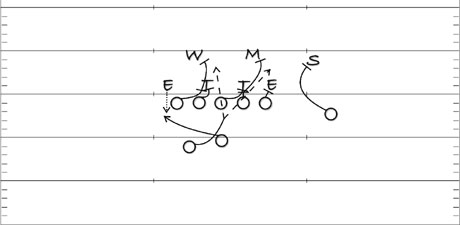
|
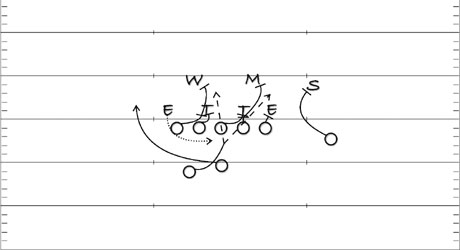
|
The speed option is the next play that is going to give you an opportunity to utilize your running quarterback or at the very least help keep a defense honest. The QB will step with his play side foot directly at the C gap. He will hold the ball in a baseball bat format with his play side hand firmly gripped on top and the ball held close to his chest. As the C gap defender continues on his track he will attack the outside shoulder.
If the C gap defender attacks up field he will step hard with his play side foot into the outside shoulder of the C gap defender. As he releases the pitch he will be going ‘heart to heart’ with our thumb ending in a downward pointed position. If the C gap defender attacks the running back, he should get his shoulders square and continue up field. If the C gap defender uses the feather technique, he will stretch him up to three yards before cutting back into the running lane he has opened behind the defenders inside hip (See Diagram 3). It is important that the pitch is down the line and not backwards to best help your running back advance. When practicing the pitch put your QBs five yards apart, staggering them five yards from each other and taking turns pitching forward. This will allow them to push the C gap defender and deliver a pitch in which the back can advance (See Diagram 4).
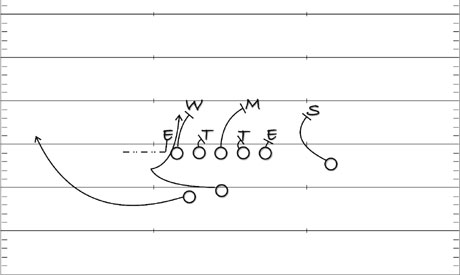
|
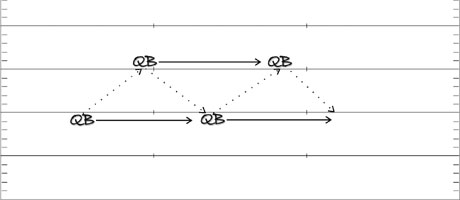
|
Both of these plays involve the QB being a secondary running threat even though he is in charge of distributing the ball and has the keep option in both. Combining the two will ensure that though your QB is making the read, the ball will be going to your better athletes or putting your QB in open space with numbers. The zone option allows for the speed option to be run off of the read zone. All rules stay the same as well as footwork (See Diagrams 5 and 6).
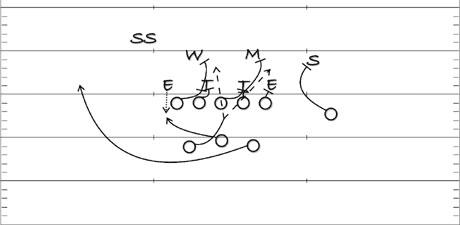
|
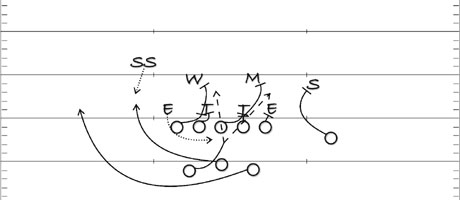
|
Though throwing motions will change from one QB to the next, the footwork will stay the same. In the three-step game the QB will take two steps before delivering the ball. When throwing left the QB, from his staggered stance, will step behind his left foot, known as the cross over step; then he steps with his left foot at 45 degrees, opening towards the target. When throwing to the right, the QB will take a six inch jab step with his right foot opening up to 90 degrees. He will step through with his left foot, getting his shoulder pointed at the target.
Throwing the ball in 5-step passing from shotgun uses a backpedal technique. This allows the QB’s eyes to remain down field and scan the entire field. The QB will step back first with right foot; he will then step back with the left; and again once more with the right. After the right foot takes its second step, the QB will push off enough to allow both feet to instantaneously leave the ground. At the same time he is moving his shoulders around and landing with his feet perpendicular to the line of scrimmage.
By popping the feet it insures that his feet are shoulder width apart and ready to become active. After he lands, the footwork has truly just begun. He does not want dead feet, because that will lead to a longer throwing motion and will throw off the timing of the delivery. Instead he will have ‘active feet’ and using a short chopping motion, he will make the reads. It is important that the left shoulder gets pointed at our intended target.
Upon delivering the ball, it is important that the left foot opens and is pointed toward the QBs intended target. The left foot should take a short stride, just breaking the outside of the shoulder pad. There should be a slight knee bend as you do not want the front leg locked out. The back leg will come through on the throw with the weight shifting from the back leg to the front leg as the hips come through. If the ball is floating and going over the receiver’s head, there is a good chance the QB is over striding.
Craig Smith recently accepted an assistant coaching position at the University of Wisconsin-Oshkosh. He previously was the Offensive Coordinator at Quincy College. He can be reached at CraigSmith@GridironStrategies.com.
WHAT IF?
Q1. What if the defense is in a 3-3-5 or 30 Stack? Do your blocking rules change or are any adjustments necessary?
In the 3-3 it is easier to hide the “C Gap” defender. In my experience the great equalizer is trips. You run the inside zone action away from the trips side, block the DE and allow the stack linebacker to play free. It puts stress on the stack linebacker because of the cutback lane off the zone scheme; he is responsible in some facet for #3 in pass coverage and must also play the bubble/pitch man in the option game. The running back reads the stacked backer behind the nose for cut-back read or to stay front side.
Q2. What if you face an all-out blitz by the outside linebackers when running the Zone Read? How do you react?
In most cases bringing an OLB off the edge means you are slanting the DE to that side. If the DE slants into the tackle on the back side he is now responsible for the DE. To the front side you can fan out to pick up the OLB, but it is not always necessary to do so as the aiming point for the inside zone back is the trail leg of the play side guard. The QB reads the C-Gap defender which in most edge blitzes becomes the OLB. In speed option, if the OLB is showing or is on the line, the OT makes a call or the QB makes the call to tell the OT to stay on the DE and he reads the next edge player.
Q3. What if the C Gap defender and another D-Lineman stunt? What is your best option?
Stunts turn into a guessing game. They may stunt and make a great play defensively. However if the O-Line stays on their zone paths it could create a big running lane and in the zone system a very big cut back lane. Stunts are not used a lot against our style of running as it takes defenders out of their option responsibilities and does not allow for proper run fits (in some cases) out of the linebackers and safeties.