WE’VE REACHED AN era in football, especially at the high school ranks, where some of the old guard who educated many of us are retiring or leaving the game. With them goes a wealth of knowledge of coaching the game of football.
For me, my understanding of football and how to coach it came from hours of watching, scouting, listening and working with young people. Yet one of the most significant parts of my coaching strategy came from the input of a former coach.
My former coach once told me that for every offensive running play, you should have a complementary running play and a play-action pass play. Some of the oldest plays that I use with my existing program came from those early years and they are still headaches for defenses even today.
Benefits of ComplEment Plays
The yo-yo dive, belly and power series have all been effective no matter what formation I run them from. For the purpose of this article, I’ve put them each in the storm formation against a 40 defense. For each of the complements, I will give the base running play,the complement play and then the pass complement for it.
The advantage of running these base plays with the complements are three-fold.
1. It cuts down on the teaching time because the plays, terminology and scheme are all similar.
2. You can run the complement play with the same personnel and cut back on extensive substituting.
3. Most importantly, it looks the same to the defense and if it isn’t paying attention it will give up a big play to the offense.
Yo-Yo Complements
The Yo-Yo Dive series allows the offense to force the defense to become individual-assignment type football and takes an aggressive, swarming scheme out of their package.
What makes this series effective is that if a defensive player misses his assignment, he could be giving up the big play. You’ll notice from the three plays shown in Diagrams 1 to 3 (shown only going to the right), that there are very few changes in the blocking schemes and direction of where the play is going, yet it still puts pressure on the outside of the defensive formation and player assignments.
DIAGRAM 1: Storm Formation, 21 Yo-Yo Vs. 40 Defense. Receiver X blocks the CB or LB. Y takes 3 hard steps upfield and runs a post pattern that seals the inside safety. 1-back takes the snap, opens up a 6 o’clock mesh point and makes the handoff with a two-pivot attack to the right. The 2-back takes the handoff and follows the 3-back’s block on the inside LB. On the snap, the 3-back lead blocks up the B-gap and attacks the inside LB, sealing him. On the snap, the 4-back takes two hard steps toward the LOS, aligns with 1 and fakes the option and seals the outside LB.
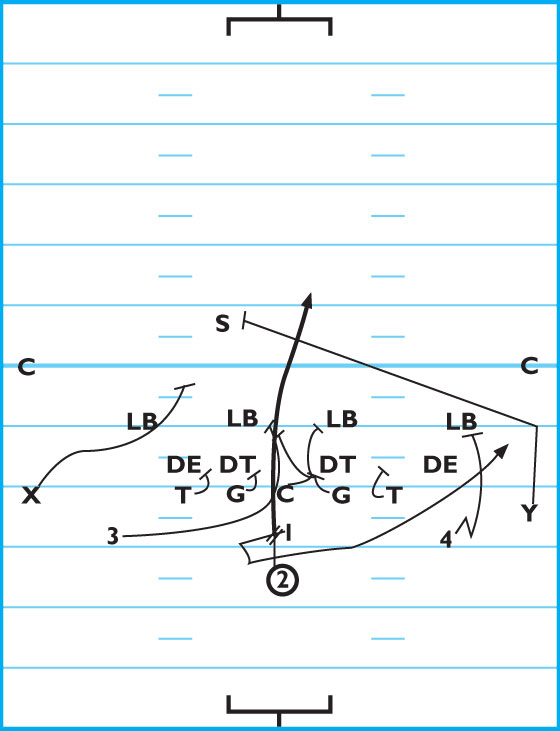
The players must be good actors on this play and if the mesh or handoff is missed, the 1-back carries out the option or turns upfield and follows the 2-back.
DIAGRAM 2: Storm Formation, 18 Yo-Yo Vs. 40 Defense. X blocks the CB or the LB, while Y runs a hard post pattern inside, sealing the safety. The 1-back opens up to the left, steps toward 6 o’ clock, makes a fake handoff and pivots to attack the play side. 2 sells the fake handoff and attacks the play-side shoulder of the inside LB, sealing him play side. The 3-back jab steps, comes under the 1-back and attacks the DE on the play side, sealing him. The 4-back takes two steps toward the LOS and aligns with the 1-back for the option.
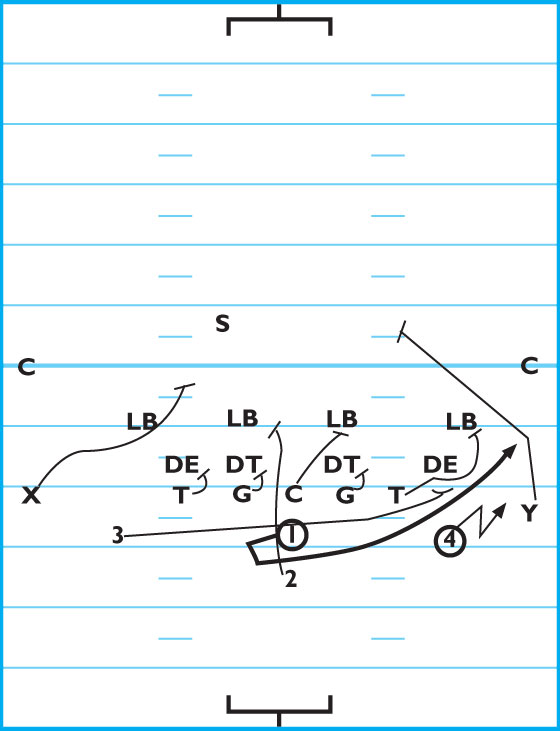
DIAGRAM 3: Storm Formation, 84 Box Vs. 40 Defense. X runs a fade pattern, while Y runs a fade pattern on the opposite side. The 3-back blocks the backside C-gap, while the 4-back runs a crossing pattern to the middle of the field. The 2-back runs a crossing pattern toward the play side.
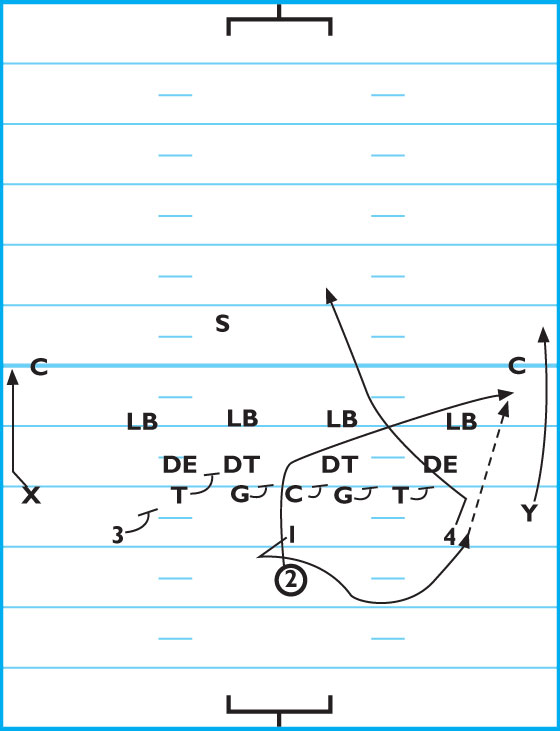
The 1-back sprints out, gets to the corner and reads a progression of the 2-back, the 4-back, the Y-receiver and the X-receiver.
Belly Complements
With the same philosophy in mind for attacking a certain area, the belly series is more like a stretch play. The back who receives the ball is supposed to run through the 4 or 5 hole, but this can easily be adjusted to more off-guard or off-tackle.
The counter is the perfect complement play and the pass allows the back to slip out to the flat quickly and effectively confusing the secondary.
DIAGRAM 4: Storm Formation, Belly 4. Receivers X and Y take two hard steps inside and then seal the CBs on their respective sides. The 3-back steps hard to the right and seal blocks from the LB to the safety. The 4-back steps hard inside and executes a lead block on the first opposite-colored jersey.
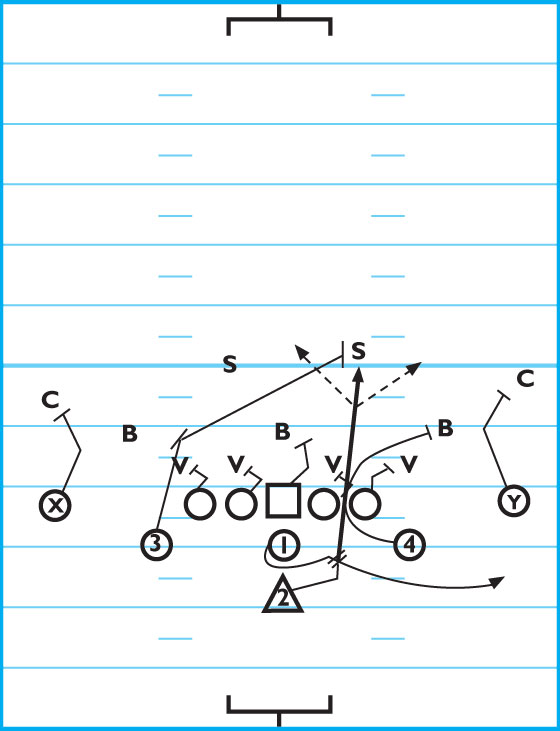
The 1-back reverses out and executes a mesh handoff with the 2-back and carries out the fake. The 2-back takes a belly step laterally, takes the handoff and attacks the 4-hole.
DIAGRAM 5: Storm Formation, 45 Counter Vs. 40 Defense. X takes 2 hard steps upfield and blocks the outside LB, while Y runs a hard post pattern and seal blocks the safety.
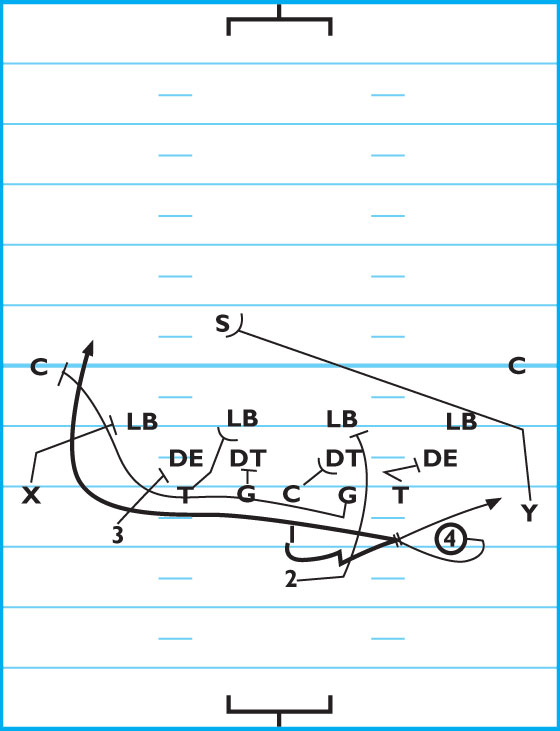
The 1-back reverses out, pivots on the right, fakes a handoff to the 2-back and hands off to the 4-back. The 2-back sells the handoff fake and attacks the B-gap, sealing the inside LB.
The 3-back blocks the DE or outside LB, while the 4-back takes a jab step, meshes and takes the inside handoff, attacking the B- or D-gaps while following the pulling right OG.
DIAGRAM 6: Storm Formation, 105 Belly Pass Vs. 40 defense. Receiver X runs a post corner pattern, while Y runs a deep post pattern (Y is the hot receiver on this play). The 2-back runs a fake belly play and runs a pattern to the flat. The 3- and 4-backs seal block on their respective sides.
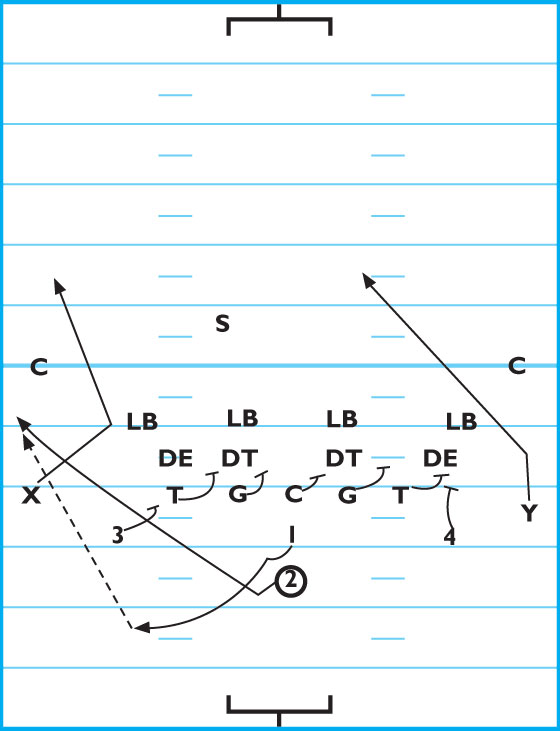
The 1-back reverses out, pivots on the left foot, fakes the handoff to 2 and reads a progression of the 2-back, the X receiver and the Y receiver (hot).
Power Series
Different than the other two complement series, the power series is designed to be a control sweep that can go off-tackle or outside if needed. In most defenses, controlling the C-gap is critical to shutting down the offense. The power series allows an offense the opportunity to effectively control and run off-tackle.
The pass has the post-corner pattern contained within it and it’s the toughest pattern to cover within most modern secondary schemes.
DIAGRAM 7: Storm Formation, 36 Power Vs. 40 Defense. This isn’t a sweep play, but rather an off-tackle play that can also be run outside.
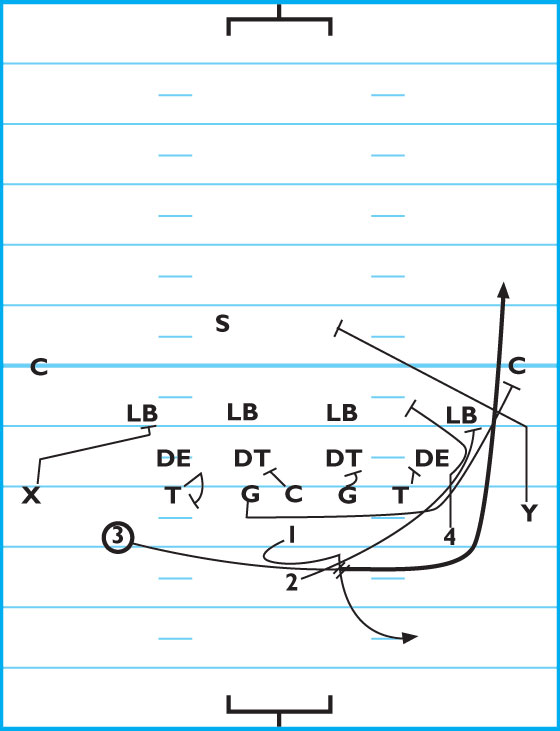
X takes two hard steps upfield and seal blocks the outside LB, while Y takes three hard steps upfield and seal blocks the safety. The 2-back attacks the C-gap and seals the outside LB. The 4-back works with the the right OT to combo block the DE and then blocks to the inside LB.
The 1-back reverses out and carries out a mesh handoff with the 3-back. After the handoff, the 1-back carries out the pass fake.
The 3-back meshes with the 1-back, secures the handoff and follows the pulling left OG’s lead block, looking for daylight from the inside to outside.
DIAGRAM 8: Storm Formation, 36 Power Keep. In this play, everything is the same as the 36 Power except that the 1-back keeps the ball and follows the back’s block around the outside. This is a highly effective change-up play.
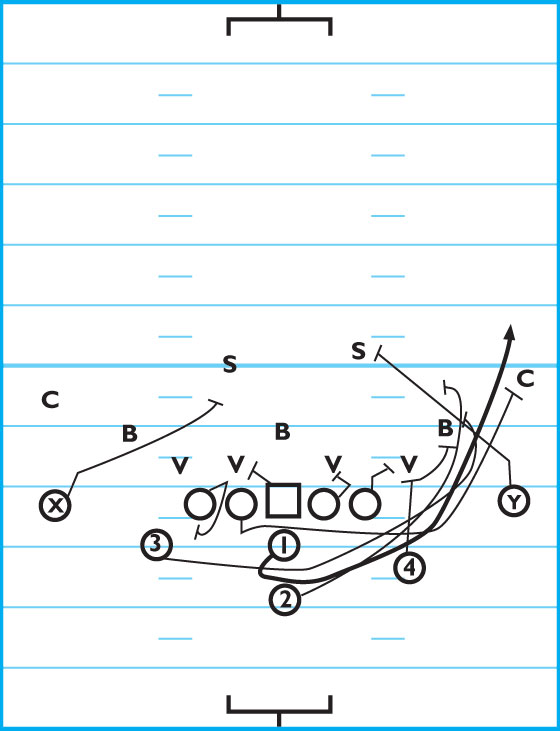
DIAGRAM 9: Storm Formation, 136 Power Pass Vs. 40 Defense. The X receiver takes two steps upfield and runs a skinny-post pattern, while Y runs a post corner pattern cut at 7 yards. The 2-back attacks the C-gap and combo blocks with the right OT on the DE. The 3-back fakes a handoff with the 1-back and seal blocks to the outside. The 4-back runs an out-pattern 5-yards deep.
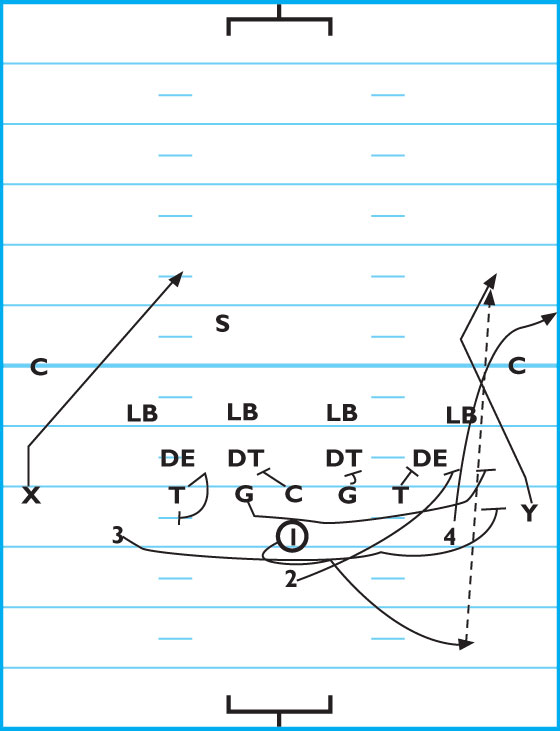
The 1-back reverses out, fakes a handoff with the 3-back, sprints outside to the right and reads a progression of Y, 4-back or X. This is a play-action pass and there’s very little help coming from the backside, so the 1-back needs to get outside quickly.