More and more teams are implementing zone schemes at all levels of football and for good reason. I have experienced great success at both the collegiate level and high school level using zone schemes. There are many variations of the zone scheme and many ways to teach it. The zone can be run from under center or the gun. Some teams will use two backs, others will run an option off the initial zone read. Some teams look to run outside zone with an emphasis on getting an edge and getting outside. Still others run a stretch zone and look to hit off tackle versus a 3-tech defensive tackle, and they will often call the same play to a 1-tech or a “zone cut” play. The nuances and wrinkles can be endless.
At Warren Fitzgerald High School, we run an outside zone play, which is essentially a sweep and the inside zone read. In the outside zone play, the RB is looking to get outside the tackle box and taking an off-tackle alley only if it presents itself as wide open. For this play, we will first try to align our formation with a TE or a wing to get the defense out-flanked on the end of the line of scrimmage, giving us an easier vertical climb and combo blocks that are relatively easy. To the defense, these two plays (the outside zone and inside zone read) can appear identical, but offensively we know we want to get to the perimeter and block accordingly.
Although the outside zone has been a very successful play for us and should be utilized by any variety of offenses, the play that I want to focus on is the inside zone read. In outside zone, you need to have a solid player on your edge and a fast ball carrier, and although it helps with the inside zone, you can run the inside zone with a bigger, slower back, a small/shifty runner, or a combination of the two. The key is vision and patience, both of which can be coached. Additionally, our outside zone is often set up by the success of our inside zone read. Because RB play and OL play are so closely tied together, this article will first explain some of the details of the zone read and basic OL principles as we teach it.
The primary focus of this article is RB play in the zone read. That is, his landmarks, reads, cuts, and coaching points to help him be more successful. In closing, I will share some of my favorite drills to help your RB become a better zone runner. These drills are useful for any RB’s coach, no matter the particular zone scheme - under center, stretch, sweep two-back, etc. These drills will develop the ability to read, cut, and anticipate from the RB position no matter the level of skill or experience.
The inside zone read is a staple in our
offense because it does several things:
1. It places the ball in the hands of your best offensive players and is a weapon for the QB and RB. The play forces them to read and react, instead of creating difficult blocks or reads for the OL.
2. The course of the RB gives the OL easier blocks than most other plays, because, generally speaking, they are all stepping right or stepping left and the RB’s path will bring the defenders to the OL, setting up easy blocks.
3. Because almost every block starts with a combo, it is easy for the O-Linemen to get movement on the line of scrimmage (they can fire off the ball).
Most coaches know the basics of the zone read concept but I feel it is important to discuss the fundamental principles that we teach in order to better understand how I teach my RBs. The OLs can visualize the combos and their course pre-snap. They can work covered to uncovered so that the man that is covered can stay on the DL across from them and the man next to them can look to leave to the linebacker as they work left or right. This is a simple way to teach it with a simple rule. It can change somewhat if the defense runs a lot of games or line slants. Everyone is working on a 45-degree playside angle. The OLs’ primary concern is to cover guys up and get movement. The rest is up to the RB.
If we are running the zone to the right against a 4-3 over with the outside backers on the fringe of the tackle box and the MLB is over the center and we have a 3-tech DT to the right and a 1-tech to the left, we would call this a 4-3 over and block accordingly. The left guard and center are combo blocking for the MLB. The center will step right, punch the 1-tech with his left hand, keeping his eyes on the MLB climbing to him while keeping his shoulders square the entire time. The left guard will step right to the 1-tech and cover him up. The right guard will step with his right foot and block the 3-tech, trying to get movement. The right tackle will step right, punch the 3-tech and look for the Sam linebacker while keeping his shoulders square (See Diagrams 1-6, running the zone right vs. different fronts).
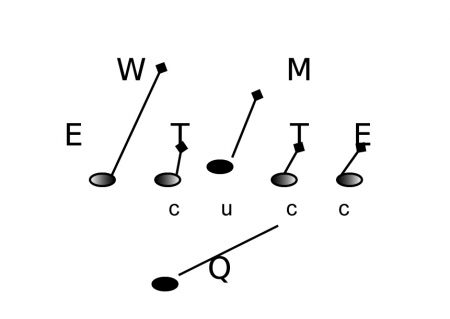
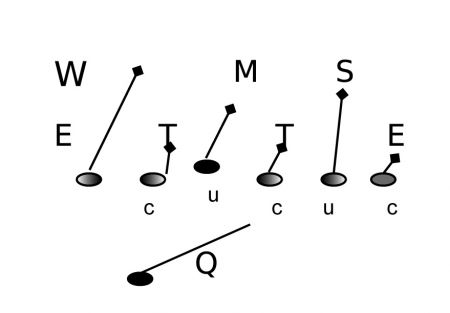
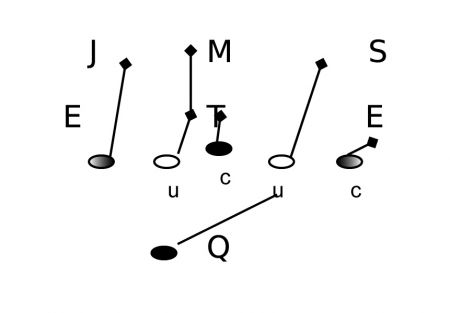
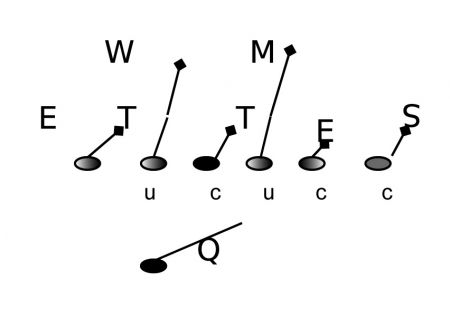
We all know in the zone read play everything starts from the QB read and the QB/RB exchange because it is essentially an option play. It is up to the QB to put the ball in the pocket where the RB will slowly squeeze the ball as the quarterback leaves it for him and does not pull it. That being said, the first detail that makes this play successful is the RB’s aiming point. It is essential that the RB aims for at least the outside leg of the playside guard. I know that this play will rarely bounce all the way outside but this aiming point not only gives the RB this option, but it starts to set up the blocks up front and create running lanes. This aiming point forces the LBs to move more horizontal and less vertical, creating lanes and running them directly into the double team blocks as the OL are climbing to the next level. Our OL never have to chase because of our RB’s course. The LBs are brought right to them as often they are caught on their heels (See Diagram 7).
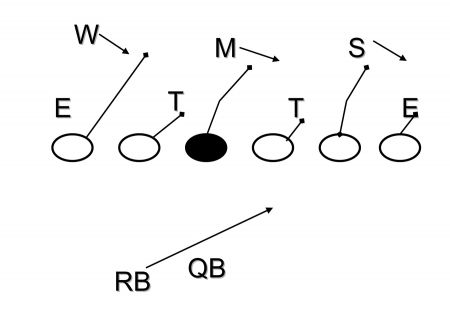
Whatever the defense does is wrong as long as the back can read correctly. They can try different fronts or slanting and angling their lines pre-or post-snap. The defense can try various blitzes which can be picked up easily because our OL have their eyes on the second level. The RB has the option to bounce outside to the C-D gap or wider, hit the front A-B gap or cut back to opposite A-B gap and get upfield. Rarely can these cuts be determined pre-snap. The RB must be ready to read and react.
The second detail is simple, but often hard for RBs to follow – carry the ball with patience. In order for the inside zone to be successful, the RB must let the play develop. As they move toward their aiming point, their eyes must look downfield and they have to be thinking “slow to, fast through.” The RB will know when the seam opens because he is reading the DL and how the OL is blocking them. Therefore, he must run at a controlled speed until he sees the seam. Then he needs to turn it on and get north and south.
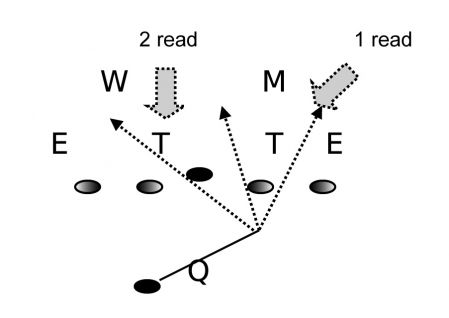
The last point is in how you coach your RB. You have established an aiming point for him. You have preached patience and now you must coach his eyes. Some players are naturally good zone runners with great agility. Others must be made through teaching these simple reads. Some backs cannot see the whole field and make great cuts consistently, so it is essential that we break the field down and focus on small, simple reads. His first read in a four down defense is the playside DT, 3-tech or the 1-tech depending on which way the play is being run. After his aiming point, his course is dictated by the DTs. Let’s break down the four down scenarios.
If he is running to a 3-tech and the 3-tech stays or widens, he is going to bang it inside front side A to opposite A. If the 3-tech stays a 3-tech, his eyes go immediately to the backside 1-tech DT. If the 1-tech is covered up and sat down by the left guard, the RB is to run front side A and read his center’s block on the inside linebacker. He should read 3-tech to 1-tech to the center’s block on the inside linebacker.
To a 1-tech DT, the RB is reading the 1-tech. If he stays as a 1-tech and gets covered up and sat down by our center and right guard, his eyes go to the DE. He is now looking to hit the B gap as long as the end is not merging down to the B gap. If he does merge, then he should look to bounce outside, where he will then read his RT’s block on the OLB. Now his progression is 1-tech, to DE, to OLB.
Obviously, defenses will shift pre-snap, merge, angle, and pinch on the snap. For this reason, it is important to teach our RB to adjust his reads. For the OL it is all the same play. We can call it the same play to any front or any defensive strength because it is up to our RB to adjust and find daylight. If a 3-tech pinches and becomes a 1-tech, our RB is taught to read it like a 1-tech and his eyes will go on the DE. If the 1-tech becomes a 3-tech, we train our RBs to cut back and get their eyes on the backside DT and go through his regular 3-tech reads. If the defense is getting beat by our zone in their base, they will try these things. Nothing changes and we can still make our reads and create big plays (See Diagrams 8-12, RB reads vs. various defenses).
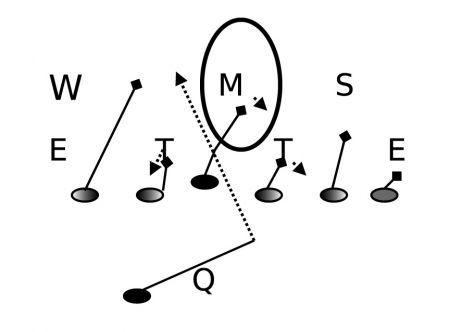
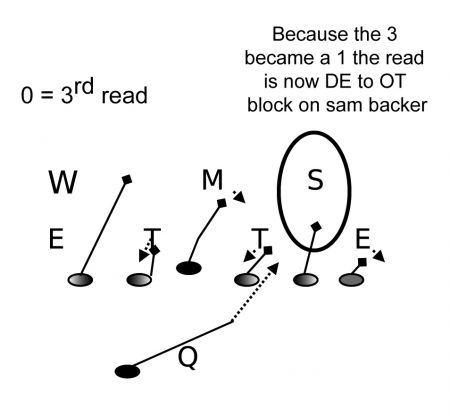
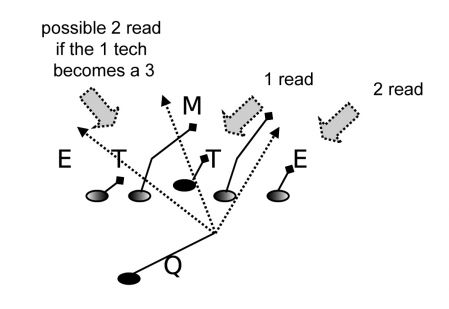
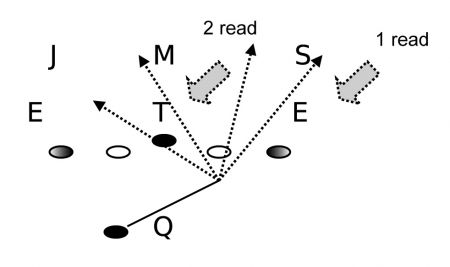
Against a 3-tech down front, the RB is reading the DE to the nose with the same principles on the OL. Because so many three down teams blitz and move their DL, we teach our OL to step right and pick up defensive players as they climb vertical on a 45- degree angle. Our RB has the same aiming point and reads the DE to nose or DE to OLB. If the DE is blocked out, he turns his eyes to the nose. If the nose is covered up and sat down by the center, he will hit straight through the frontside A-B gap. If the nose is fighting to become a frontside 2-or 3-tech, then the RB will cut back to the backside A gap and read his left guard’s block on the inside linebacker. On this play, the RB can bounce inside or cut back. As you practice run exchange or plays on air, it is crucial that you are forcing your backs to read these players with bags or coaches simulating the DL. Coach their eyes to see what they need to see and react. Drill work is a great time to develop vision.
DRILLS
A simple drill that can be done at any level is bag running. As the RBs run through the bags with either one foot in each, two feet or three feet, they need to keep their eyes up on the coach. The coach will stand at the end and hold up numbers with his fingers for the RB to call out as they run. At the end of the drill, the RB will burst five yards and cut off the coach.
Another similar drill is staggered bags. In this drill, we still want the coach to hold up numbers with his fingers to keep the RB’s eyes up. At the end, the RB will run toward the coach and cut left or right (See Diagram 13).
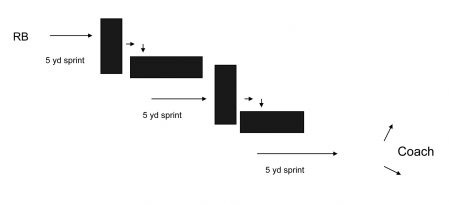
Another agility drill with a visual reaction requirement is the coach point drill (See Diagram 14).
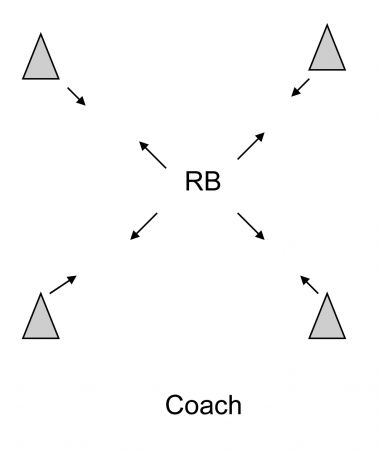
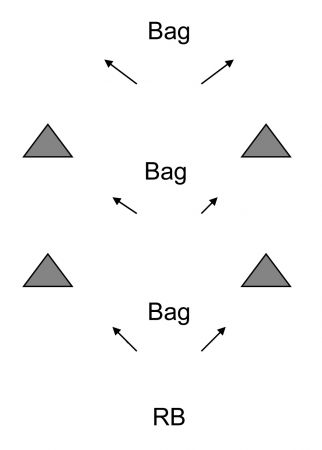
My favorite drill to create good zone runners is the “cut off bag drill.” In this drill, the players will run to a bag. The bag will be moved left or right and the RB will cut/jump-cut the opposite way the bag is going. He will run around the cone and approach another bag. You can have them run to the bag on an angle or square the bag up every time. This drill forces the RB to see and react and simulates running the inside zone play (See Diagram 15).
I hope that some of these pointers and details can be applied to your program and to the play of your running backs.
About the author: Matt Johnston is a veteran high school and college coach and is currently an assistant coach at Fitzgerald High School in Warren, MI.