With the emergence of the spread offense in the game of football, defenses have become more complex with the ability to rush defenders from a number of areas on the field. Coverages have also become more complex with the ability of secondaries to read routes. Defensive backs are doing a better job at recognizing tendencies of wide receivers and breaking to the reception point. Defenses are becoming better at pattern reading and reading the footwork of the quarterback. With these new challenges and sophisticated defenses, I feel it is important for receivers to recognize when to run an assigned hot route. In order to do this they must:
1. Learn coverages.
2. Understand the drops of the underneath coverage.
3. Learn how to recognize blitz keys.
With a good basic understanding of these keys, your wide receivers should be able to identify (pre-snap) if they will be the hot receiver or not.
We are a half-slide protection team; our protection allows us to block a maximum of six defenders (See Diagrams 1 and 2).
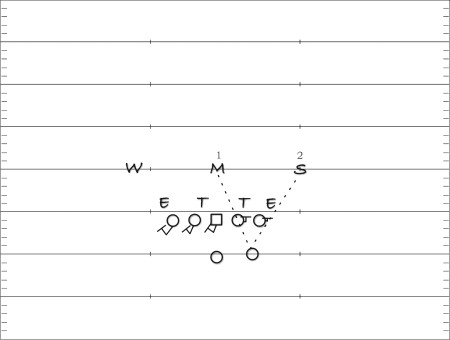
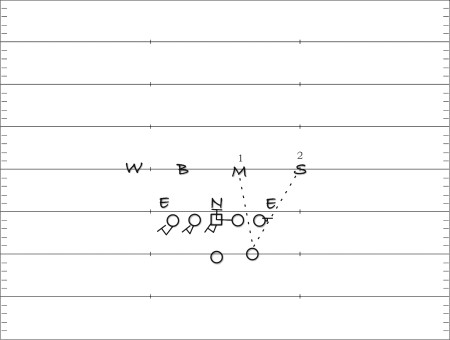
By designating a man side and a slide side, if we receive four rushers from the man side of the protection, a hot receiver must be thrown the ball. The inside receiver to the man side of the protection is the hot receiver. Depending on what you see on a weekly basis, you can vary what route you choose to run with him. You have four choices:
1. Speed Out.
2. Slant Read.
3. Blitz Replace.
4. Check to Screen.
Your choices of how you choose to handle ‘hots’ depend on what your players feel comfortable throwing and catching along with the blitzes you may see.
All receivers are taught the DEL concept from day one. DEL represents:
1. Depth.
2. Eyes.
3. Leverage.
Slot receivers must know if the SS/OLB is a potential rusher or dropper by his depth.
We discuss a five-yard rule; that is, if the defender is creeping down or is at a depth less than five yards, be ready to run your assigned hot route. Next, they must locate where his eyes are focusing. Are the defender’s eyes located directly on you, or are they peeking in the backfield constantly? The leverage and alignment will tell you a lot about this player. Identify if the defender is inside, head up, or outside leverage. Make sure you talk about the third level defender working towards the slot if the blitz occurs.
Once your WR has applied the DEL philosophy, he should know what the coverage is along with identifying if he is the hot receiver or not. His next objective is to identify the first LB in the box (See Diagram 3).
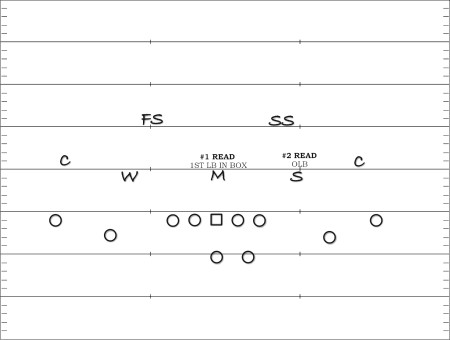
The term ‘it takes two’ is constantly being used. We are running hot if the SS/OLB and first LB in the box blitzes to his side. He’s taught to key the first LB in the box. As he releases vertically, if the SS/OLB crosses his face, he runs his hot route (See Diagrams 4 and 5).
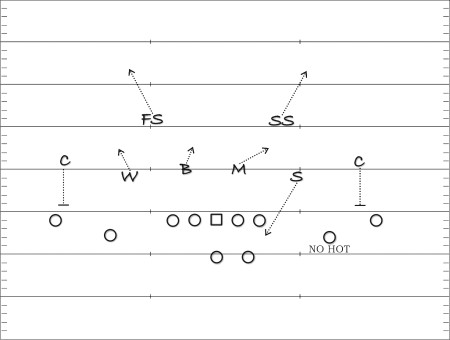
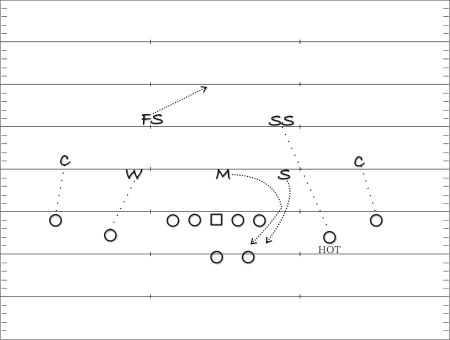
As mentioned earlier, our hot route depends on your athletes along with what you may see on a weekly basis. The speed out allows the WR to stay away from the dropping LB, and also in case our receiver reads it wrong, he doesn’t run into an inside LB (See Diagram 6).
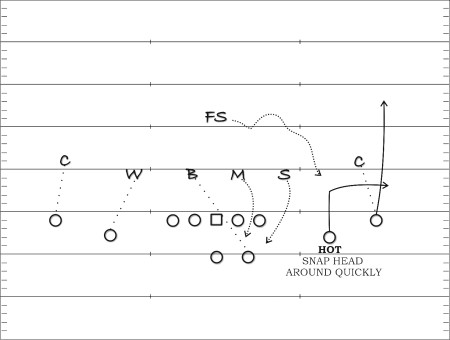
A slant read allows the receiver to adjust if one of his reads doesn’t come (See Diagram 7).
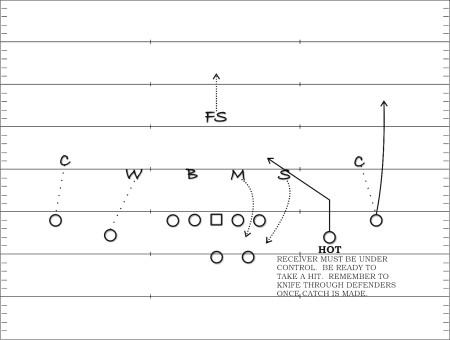
He can now slant inside and keep the route skinny if one of his reads doesn’t blitz. The blitz replace is a great answer when you anticipate both reads coming (See Diagram 8). This gives you a chance to run directly into the void with the possibility of a huge gain.
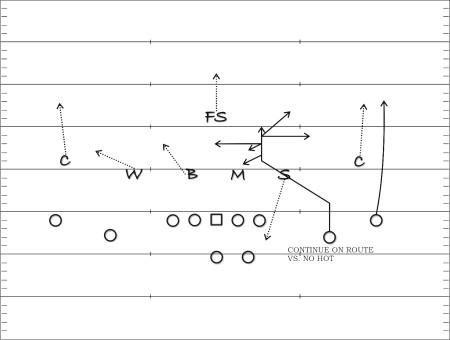
A change up to that can be incorporated by allowing your outside receiver to be hot on certain plays (See Diagram 9).
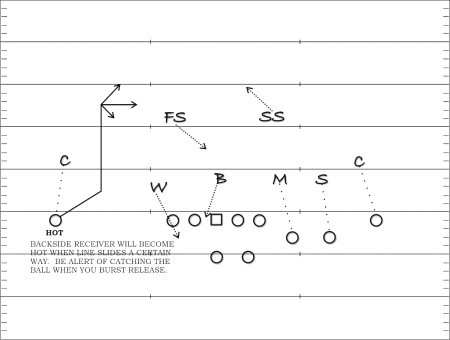
Allow him to take a seam release inside for approximately 3-5 yards. His reads are the same as for an inside WR. If his reads decide there is no blitz, then he continues vertical and runs his assigned route. It is essential to remember to run your inside WR on a route that allows him not to be in the throwing lane if the blitz occurs.
Oftentimes defenses tip off blitzes by allowing safeties to be replaced from normal alignment. We will always tell the QB to locate the safeties pre-snap. By locating the safeties, they can be aware of any secondary rotation and any potential blitzers. As they read the triangle, which consist of a safety, the OLB, and a corner, they will have a mental picture of what may occur at the snap of the football. We allow him to check to different screens if he gets a certain look. The RB slip screen can be very effective if the QB recognizes some kind of overload blitz (See Diagram 10).
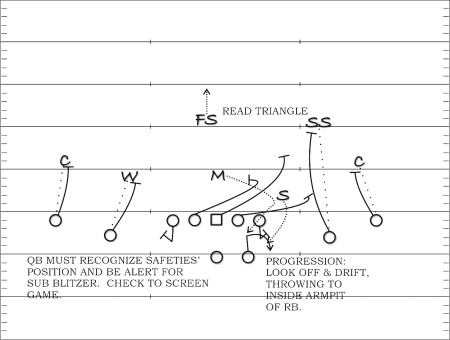
Remember the key is not to get a home run from the screen every time. The key is to get positive yardage and slow down the pass rush. This screen will also make defensive linemen run which will wear on them as the game goes along.
The great thing about these concepts is the ability of them all to be taught to skilled positions regardless of the level of football. So many times quarterbacks and wide receivers are not on the same page when the blitz occurs. Applying these simple rules and reads will allow your wide receivers to ‘Burn the Blitz.’
Jerry Mack recently joined the staff at the University of Central Arkansas. He had been an assistant coach at Jackson State. You can reach him at JerryMack@GridironStrategies.com.