In this offense, the receivers make adjustments to their routes based on coverage. These coverages are divided into four base categories – single safety zone, two safety zone, man and blitz. We will concentrate on “choice” routes and the receiver’s conversions vs. single safety zone coverage.
The choice route is designed for the single receiver in a 3 X 1 formation (Diagram 1). Proper alignment is very important to stretch the defense both vertically and horizontally (Diagram 2).The receivers will be numbered playside 1 and backside 1, 2, and 3.
Techniques of the Playside Single Receiver vs. Single Safety Zone Coverage:
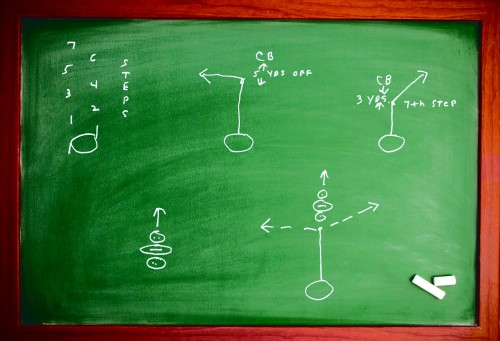
The single WR will run his route and make a decision based on the man covering him by the time he gets to his seventh step. By his fifth step, he should know where he’s going to go (Diagram 3).
Coaching Point: the receiver should always line up with his outside leg back in his stance.
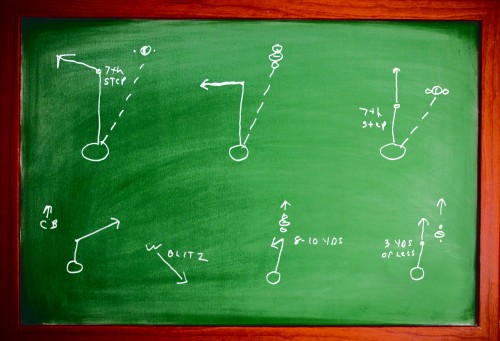
If the defender covering the single WR is three to five yards deep, by the time the receiver reaches his seventh step, he will run a speed out (Diagram 4). That seventh step is taken at 45 degrees in which the WR brings his inside leg over the top. This is a speed cut technique which is different than your normal plant and cut technique of an out route. As the WR runs his route upfield, he wants to attack the outside shoulder of the defender covering him.
If the receiver breaks down the cushion of the defender to three yards or less, then on his seventh step he will run a skinny post (Diagram 5).
Coaching Point: It is important that the receiver run this post route skinny so the free safety does not come into play.
If the defender is playing an open technique and crosses his legs over, this is considered either a man or zone technique. For the purpose of this article, we will consider it a zone technique (Diagram 6). 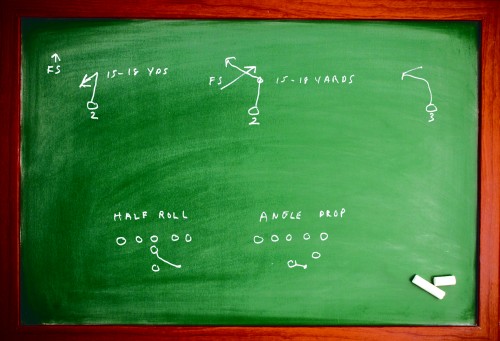
The rules are the same for the WR attacking a defender playing an outside “open” technique. He is against a defender using a backpedal technique except that the receiver will be attacking the hip of the open technique defender instead of the outside shoulder of the defender (Diagram 7).
If the defender is playing a hard inside technique, then the receiver will run a straight line up the field and make the proper conversion on his seventh step (Diagrams 8A - backpedal technique and 8B - open technique).
If the receiver breaks down the defender’s cushion to three yards or less, he will then continue to run vertically upfield instead of a skinny post route (Diagram 9).
Versus a blitz, the receiver will run three to five steps upfield and then break to a ‘quick’ post route (Diagram 10).
The backside routes are just as important as the frontside routes. All four receivers need to know their routes and conversions for the play to be successful.
Backside Routes:
Backside 1
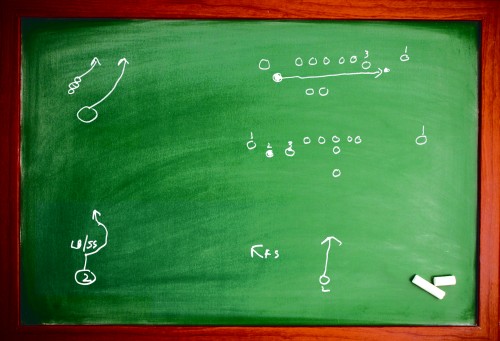
The WR is reading the drop of the defender covering him. If the defender in his drop opens his hips to the inside and is playing high over the top, then at a depth of 8-10 yards, the WR will hook up and find the open window back to the QB. If the WR is able to break down the defender’s cushion, then he just takes him upfield (Diagrams 11A and 11B).
If the defender opens his hips to the outside, then the receiver just takes him upfield (Diagram 12).
Backside 2
The WR can either be motioned over into a 3 X 1 formation or just line up in the #2 position in trips (Diagrams 13A and 13B).
At the snap of the ball, the WR runs upfield and avoids contact with the second level defender. After clearing, he will read the position - a seam read – of the safety (Diagram 14).
If the free safety rotates over to the play side, then he will keep running the seam route (Diagram 15).
If the free safety stays in the middle of the field, then at 15-18 yards the WR will hook and find the open window back to the QB (Diagram 16).
If the free safety rotates to cover the WR, then the WR will break across his face to the open area he vacated and get upfield (Diagram 17).
Backside 3
In this instance, the WR is running a crossing route at a depth of 5-7 yards (Diagram 18).
The WR’s job is to hold the underneath coverage and be the “hot” read for the ILB blitz. In zone coverage, the WR wants to work his way across the field and find the open window back to the QB.
Quarterback
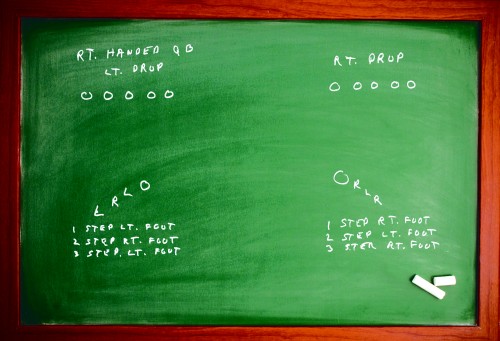
There are two different ways to teach the drop of the QB: (1) the traditional half roll drop or, (2) having the QB in the shotgun with a three-step angle drop (Diagrams 19A - Half Roll and 19B - Angle Drop).
Correct footing is shown for the angle drop out of the shotgun for a left and right-handed QB.
1. step with left foot 1. step with right foot
2. step with right foot 2. step with left foot
3. step with left foot 3. step with right foot
By the QB’s third step, he should know if he is going to throw front side and what conversion route the WR is going to run. If the QB has any indecision, then he will go to the back side and the next progression. By going to the back side, the QB will pick up the location of the FS. Where the FS is will let the QB know what conversion the backside #2 receiver makes on his seam read (Diagrams 20A and 20B).
Pass protection - is a six-man pass protection with the single back going to the single receiver side.
I am sure that some high school coaches will ask if high school players are able to make these conversions and my response is ‘yes.’ For example, when I was coaching in Italy in 2008, I had a receiver that had been playing American football for less than a year and he was able to make the proper conversions playing the playside number #1 position with less pre-season practice time than a high school player would get.
Like a team that runs the triple option, the Run ‘n Shoot is all about repetition and paying attention to detail. If you are a coach that wants to run this offense, it is very important that you do not combine other offensive philosophies with the Run ‘n Shoot. Again, this is due to repetitions during practice time. If you are coaching two different philosophies, you’re not going to have enough practice time to be good at either one. If you are going to commit to the Run ‘n Shoot, then you need to totally go all in. It is a fun offense to run and your players, coaches, and fans will enjoy it. p
About the Author: A frequent contributor to both American Football Monthly and Gridiron Strategies, Wayne Anderson has over 20 years of coaching experience on the high school, college, and professional level. He is the former head coach of the Bialystock Lowlanders and has also coached in Italy, Denmark, and Poland.