EVERY SUCCESSFUL OFFENSE must have an effective inside trap. In our offense, the Buck series has provided us with an effective inside running option against even or odd fronts. This has been a very successful play due to the options we have within our blocking rules.
The following examples show the variations for executing the Inside Buck Trap.
DIAGRAM 1: 830 Buck Trap Vs. 4-3. For this play, the backside split end stalk blocks. The backside offensive tackle has one rule, “reach to stove pipe” meaning that he steps to the inside and continues on this path to the next level. The backside offensive guard takes a 90-degree pull step and traps the 2-alignment or out. The center gap blocks back toward the backside OG. The play-side OG reach blocks to the backside linebacker, meaning he steps inside toward the center and continues on this path to the LB. The play-side OT steps inside to the LB. The play-side tight end steps inside to the C-gap and continues his path to the LB or stove pipe.
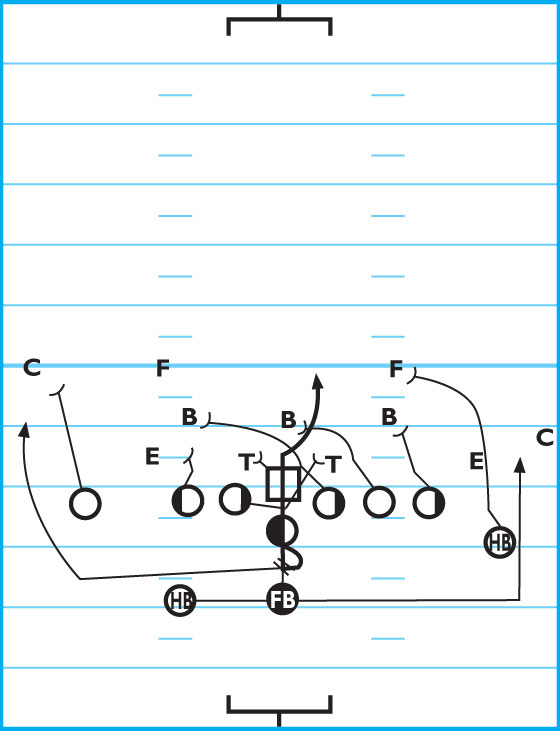
The play-side halfback fakes the down block and continues his path to stove pipe. The backside HB takes his backside arm and leg and crosses over 180-degrees and continues on the buck sweep path while carrying out his fake. The fullback takes his play-side foot and steps to the midline. On his second step he receives the ball and hugs the wall created by the center and OG.
The quarterback reverses out 6 inches over the midline, handing the ball off to the FB. On his second step, he fakes the handoff to the backside HB and crosses-over with his third step and sets up for the boot-leg pass or boot-leg run.
Dealing With A Fast-Flow LB
DIAGRAM 2: 830 Buck Fold Vs. 4-3 With A MLB Filling The Center. In this example, we see the Buck Fold vs. a 4-3 defense with a fast-flowing filling LB.
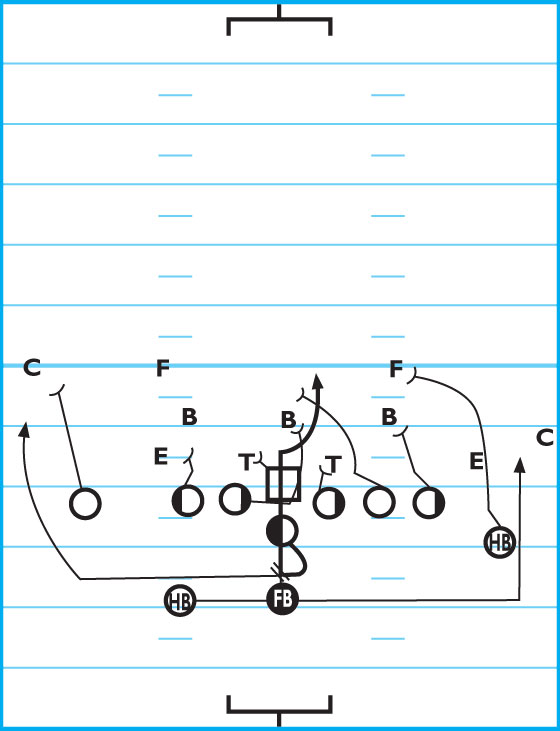
The backside SE stalk blocks. The backside OT has one rule, “reach to stove pipe” meaning that he steps to the inside and continues on this path to the next level. The backside OG takes a 90-degree pull step — and this time — leads up through the hole. The center gap blocks back toward the backside OG. The play-side OG gap blocks, while the play-side OT steps inside to the LB. The play-side TE steps inside to the C-gap and continues his path to the LB or stove pipe.
The play-side HB fakes the down block and continues on his path to stove pipe. The backside HB uses his backside arm and leg and crosses over 180-degrees and continues on the buck sweep path while carrying out his fake. The FB uses his play-side foot and steps on the midline and on his second step he receives the ball and hugs the wall created by the center and OG.
The QB reverses out 6 inches over the midline and hands the ball off to the FB. On his second step, he fakes the handoff to the backside HB, crosses over with his third step and sets up for the boot-leg pass or boot-leg run.
830 Buck Gut Vs 5-2
In our last example we see our Buck Gut vs. a 5-2 defense.
DIAGRAM 3: Buck Gut Vs. 5-2. For this play, the backside SE stalk blocks. The backside OT blocks down to the inside LB, while the backside OG blocks out on the second down lineman. The center blocks the defensive lineman on him and tries to drive him in one direction or the other. The play-side OG blocks out on the second down lineman and the play-side OT blocks down to the LB. The play side TE steps inside to the C-gap and continues his path to the LB or stove pipe.
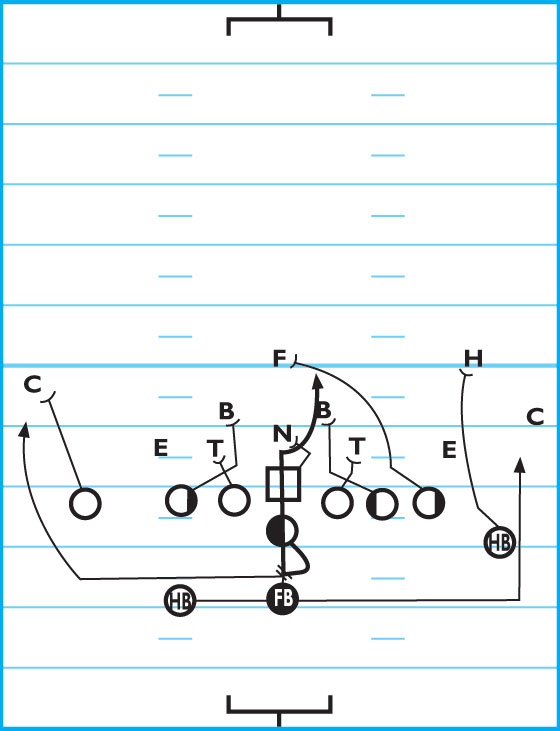
The play-side HB fakes the down block and continues on his path to stove pipe. The backside HB takes his backside arm and leg and crosses over 180-degrees and continues on the buck sweep path while carrying out his fake. The FB takes his play-side foot and steps to the midline and on his second step, he receives the ball and reads the blocks of the center and both OTs.
The QB reverses out 6 inches over the midline and hands the ball off to the FB. On his second step, he fakes the handoff to the backside HB and crosses over with his third step, setting up for the boot-leg pass or boot-leg run.