The motion system I’ve used over the years is based on simplicity. All RBs and WRs in our offense have the potential to be placed in motion. One keyword is all it takes to put a player in motion. The keyword also dictates a directional key.
Flanker (Z) Motions:
ZIP: Z motion into the formation,
but not across the formation
ZAP: Z motion across the formation.
‘Z’: Z motion into backfield.
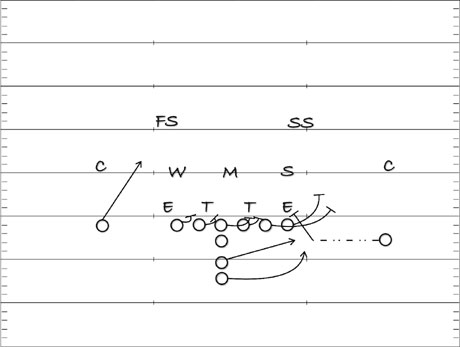
Example (Diagram 1).
Right Zip 38 Crack.
The motion in this case gives the offense
an advantage in the blocking scheme.
|
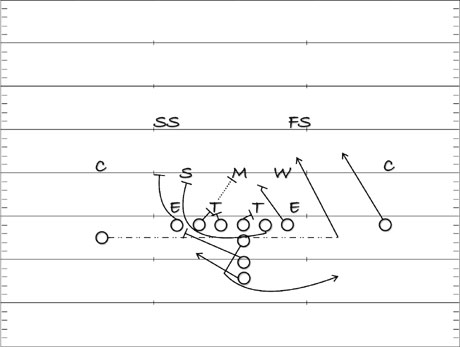
Example (Diagram 2).
Left Zap 34 G.
The motion is used as a decoy. The offense should note any defensive adjustment.
|
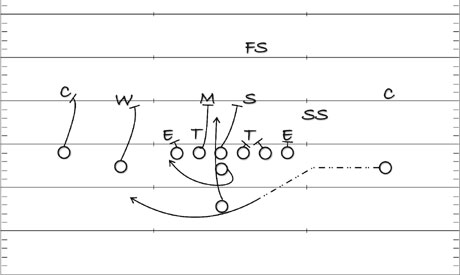
Example (Diagram 3).
Red Z 11 Triple.
Z motions to heels for F and becomes the pitch man.
|
RB (F & H) Motions:
Our RBs are labeled F and H. Again, we use keywords to place either RB in motion, using the player’s letter code plus a directional key.
F Motions:
FILL: F motion to the left
FUR: F motion to the right
‘F’: F motion into the backfield
FIP: F motion into, but not across a formation
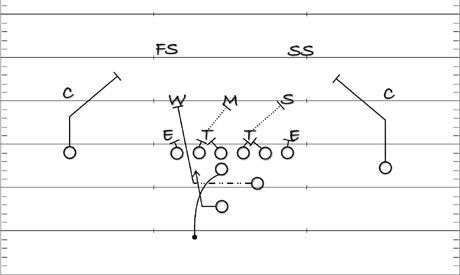
Example (Diagram 4).
|
Example (Diagram 5).
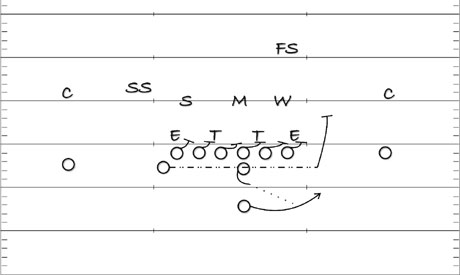
|
Example (Diagram 6).
Rex Fip 30.
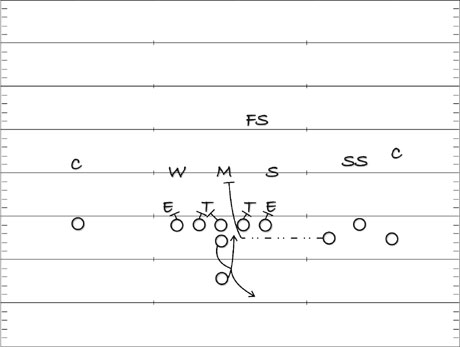
|
H Motions:
HILL: H motion left.
HER: H motion right.
HIP: H motion into, but not across a formation.
‘H’: H motion into the backfield.
Example (Diagram 7).
Red Her 65 H Flat.
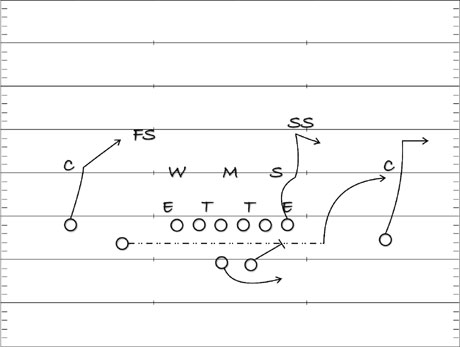
|
Example (Diagram 8).
Leo Flex Hip 8 Sweep.
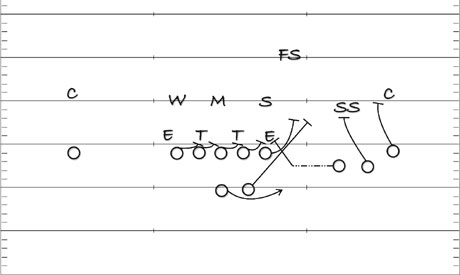
|
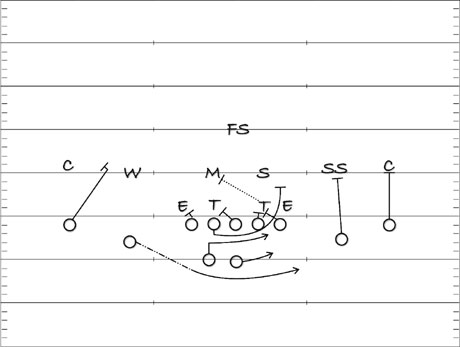
Example (Diagram 9).
Rip H 6 Shovel.
|
TE Motions
The tight end is labeled ‘Y.’ All Y motions begin with ‘Y” and give a directional call.
YIP: Y motion into, but not across a formation.
YAP: Y motion across the formation.
“Y”: Y motion into the backfield.
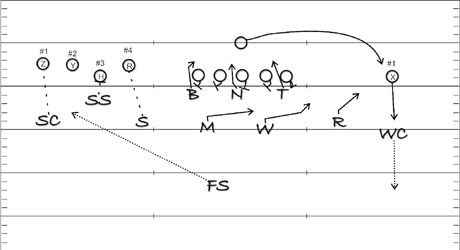
Example (Diagram 10).
Right Off Yap 35 G.
|
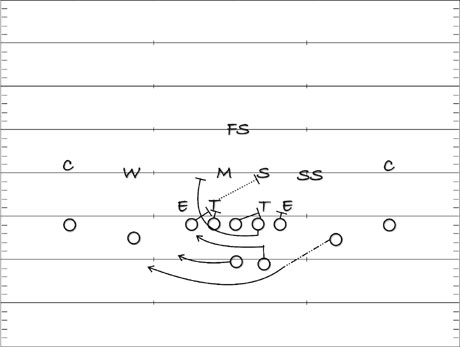
Example (Diagram 11).
Rip Y 7 Shovel.
|
The “IT” Tag
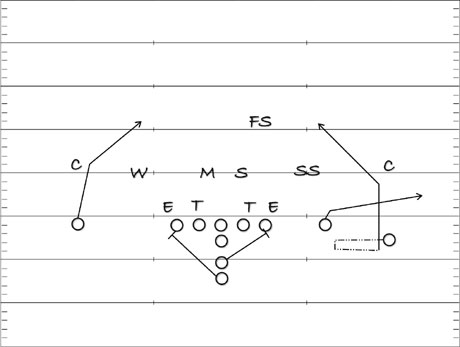
Any motion keyword using “-it” at the end tells a player to begin motion and then reverse motion back to the original alignment.
Example (Diagram 12)
Right Flex Zip-it 92 Flat
|
Example (Diagram 13).
Lex Fip-it 36 Boot.
|
|
Use keyword identifiers as part of the play call to put players in motion and create more confusion for a defense. This is a simple, yet effective way to make any offense more complex.
If you have any questions you can email the author at RickBouch@GridironStrategies.com
POINT OF VIEW
David Dean of Valdosta State won a Division II National Championship last fall in his first season as Head Coach.
“I like the way Coach Bouch has put together his motion series. It causes the defense to make quick adjustments and can create some confusion. We do the same thing in that our motion is designed so that the defense has to make a quick adjustment. But the other thing that we do with motion is that we want to know if the defense is in man or zone. It helps both our receivers and quarterback determine which it is. If the defender follows you across the defense it usually is man coverage. If there is a lot of shifting, then it’s usually zone coverage.
“In our system we have basically five motions. Our backs and receivers know all of those motions. We tap our guys with that motion. If we want to send ‘Z’ in motion, we just go ‘Z move, fly or orbit.’”
Kurt Bryan is the Head Coach at Piedmont High School (CA) and architect of one of the most unique offenses in America: The A-11 Offense. It is named in reference to the concept that all 11 players can potentially be eligible.
“ One of the toughest things a coach has to do is come up with terminology that is short, not too wordy or confusing for the offensive players and tells them everything they need to do without making a mistake. If you can send players in motion with a buzz word like ‘Zip’ as Coach Bouch has done, it’s easy for the guy to remember so he can tag the acronym on the back of his designated letter, like ‘Y’ or ‘Z.’
“I think there are a number of reasons why coaches use motion: 1-Find out what the defensive coverage is; 2-Create leverage and try to out number the defense in certain parts of the field; and 3-Attempt to put your best athlete in a position where he is in a personnel mismatch.”