By following specific blocking responsibilities, the run game can be effective in the air raid offense.
The Air Raid offense is a system that features a great deal of pass-first mechanics and timing. The majority of the practice time and “scheme” time is spent on the passing game and so the offense rightly gets the moniker of a pass-happy system. However, many air raid teams have been very effective at running the football. This is mainly because most air raid teams keep the run game very simple and, therefore, this aspect of the offense gets a great deal of time to work on repetitions. There are so many things that go into running the passing game correctly that the offense just cannot manage having a large number of run concepts. What we have found is that this causes us to work on things that might be fine tuned inside each run play because we do not use very many concepts.
We operate with the “less is more” philosophy of running the football. We have two blocking schemes which are zone and gap blocking. We will run the inside and outside zone plays and we will run Power, Counter, and Dart in the gap scheme. That is the entire run offense in our version of the air raid offense. This keeps the offense very simple and allows us to get really good at these things. The past two years we have been fortunate to pass for over 4,000 yards but still rush for around 3,000 yards. Our run game is not flashy and it’s not complicated but our kids can execute it at a very high level.
Why do we zone block?
• Hard nosed, physical football.
• Allows us to create double teams at the point of attack.
• Block all fronts, stunts, and blitzes.
• Creates cut back opportunities.
• Use of multiple personnel groups/formations.
• Option running by the ball carrier.
• Few negative plays.
• Use of different kinds of athletes.
• Creates great play-action passing game.
There are specific blocking rules for the covered playside player, the covered backside player, and the uncovered player:
• Covered PS= first level defender head up or callside gap.
• Covered BS= first level defender in backside or gap.
• Uncovered = covered at depth or covered by read.
Each player has specific OL steps and aiming points:
• Covered PS (6 inch step up and out at 45-degree angle. Attack outside armpit and drive block. If color goes away, work second level).
• Covered BS (pick it up and put it down and punch with inside arm and get eyes into callside gap).
• Uncovered - lateral step and prepare to overtake - work second level.
• Inside Zone - Outside armpit (covered). Near armpit - uncovered.
• Outside Zone - Outside armpit (covered) Sternum - uncovered.
• On OZ, all linemen are uncovered and all take a bucket step and attempt to rip through and overtake the next first level defender.
Backfield Responsibilities:
• The tailback aims at the inside leg of the playside guard in IZ (read first lineman past the center for cutback)
- L step by tailback
- QB opens to 5 or 6 o’clock and reads C gap.
• The tailback aims one yard outside the tight end or ghost end in OZ (no cutback)
- Step forward
- No read
We also have gap blocking, primarily for running our power, dart, and counter plays. Why gap?
• Hard nosed physical football.
• Allows us to create double teams at the point of attack.
• Block all fronts, stunts, blitzes.
• Use of multiple personnel groups/formations.
• Few negative plays.
• Character football.
• Zone gets predictable responses Counter/Power/Dart
Counter
The counter play has evolved into one of the base plays in the air raid offense - we averaged over 5 yards per carry in 2012. It’s a simple concept based upon the gap scheme premise of running the football. The play is basically a simple down block and double kick-out scheme. The concept works well because it is blocked essentially the same versus all fronts and stunts and it handles any defensive adjustments. The counter is a simple play without many “moving parts” and so it is a “go to” play for almost any down and distance (See blocking assignments against different fronts in diagrams 1-4).

Diagram 1: Counter vs. 4-2 (3 tech)
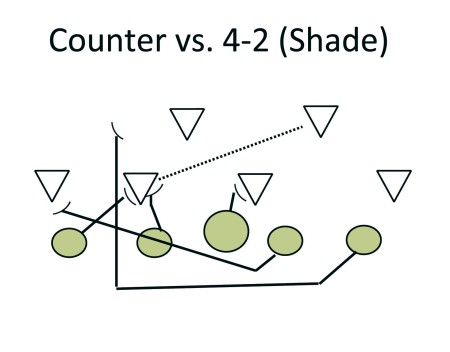
Diagram 2: Counter vs. 4-2 (Shade)
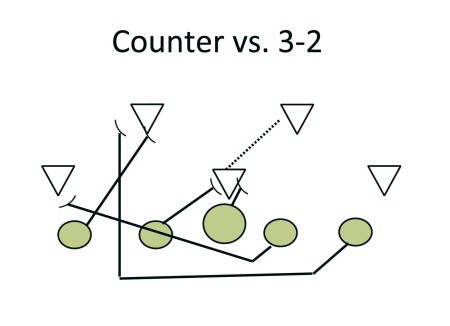
Diagram 3: Counter vs. 3-2
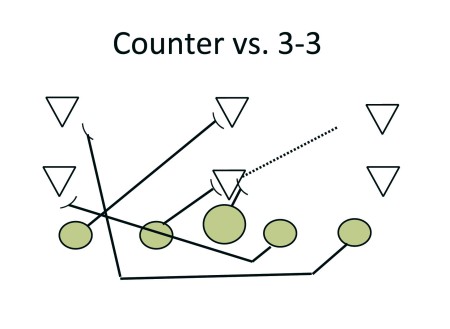
Diagram 4: Counter vs. 3-3
Power
Power is another gap scheme run play and can be run with or without kick-out blocking schemes. The concept is able to be run from a one-back or a two-back set and enjoys the advantage that it is a “no frills” play that hits downhill quickly and is a very low risk play. The power play is not usually as effective as the counter play but it allows for a very simple way to get three or four yards (Diagrams 5-6).
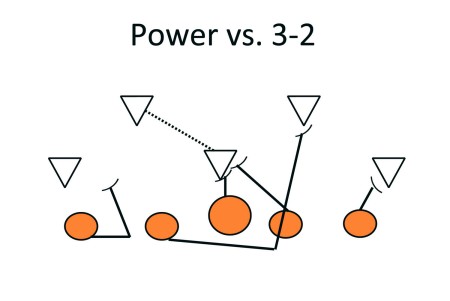
Diagram 5: Power vs. 3-2
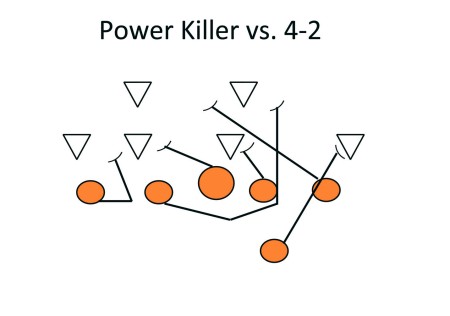
Diagram 6: Power Killer vs. 4-2
Dart
The dart concept is essentially the power play without a pulling guard but instead a tackle is used. The dart concept is a way to run power-type plays without utilizing two backs. The play is best run toward a shade technique but can be taught effectively versus either a three or shade technique. In addition, the dart concept is a great way to run the football versus odd front defenses that are becoming more common in today’s football landscape (Diagram 7 vs. a 4-2 defense).
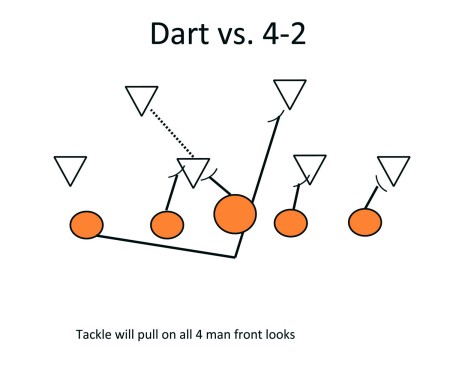
Diagram 7: Dart vs. 4-2
About the Author: Coach Rich Hargitt recently bec ame the passing game coordinator and receivers coach at Ashbrook High School in Gastonia, North Carolina. He previously was the quarterbacks coach and passing game coordinator at Nation Ford High School (SC). He recently completed a series of DVDs on his offense, now available at AFMvideos.com.