For the first six years of being a head coach, coaching the offensive side of the ball, our teams were strictly a Wing-T football team. We had success running the basic buck and belly series mixed in with a 3-step passing game. We really did not need to add much than just get better at what we did fundamentally. I have always wanted to add the option to our attack. My reasoning was that I was an option quarterback in high school in a Wing-T offense under the coaching of my father, Mike. We liked the dimension that the option added to the Wing-T. That was the style we wanted to get back to but we did not have the quarterback to execute it. Our QBs were more passers and less runners.
When I received the job at Flandreau (SD), I saw different types of athletes that were unlike those players at our previous school. I saw a chance to implement the option which would benefit the kids while still being a Wing-T team. I spent some time with a retired football coaching friend, Dan Whalen, who helped me with the way he ran option on his teams. Considering his success, I was more than willing to listen to what he had to say. From there, I read about every option book there is and got involved with some flex-bone materials influenced by Paul Johnson. I read books written by Tim Stowers and Barry Butzer (“Coaching Football’s Spread Offense”) and Tony DeMeo’s, “101 Ways to Run the Option.” The way I describe our option will sound a lot like these coaches. I was on the flex-bone association website every day reading up on the many coaching points and continually asking questions. I also gathered film on Air Force, Navy, Georgia Tech, and many other colleges, and I spent time breaking down film.
From there, I took all the information that I had gathered and simplified it to match our system. It worked smoothly. What I have found is that you can’t reinvent the game, but you can take bits and pieces from someone else’s offense and make it your own - the idea of interchangeable parts. We jumped into the option game head first after careful thought. Below is a checklist of things you must accept if you decide to run the option. I collected this list from other coaches that have run the option and from our own experience coaching the system.
1. You must be ready to accept failure when putting in the option.
2. Option is a gamble.
3. The chances of fumbling will increase but so will the chances for big plays.
4. QB must be able to count the defenders and audible.
5. Trust the QB and coach him to make the right decisions.
6. QB must be willing to pitch it.
7. You need to work on the MESH every day.
8. You must work on pitching technique every day.
9. If in doubt, give to the dive.
10. You must have a fullback that can take punishment but can also punish defenders.
The option game has been a difference-maker for us the past two seasons. It suits our personnel and especially our quarterbacks, high school through our middle school program. The risks of running the option are high but we have not experienced much failure with it, fumbling only four times in two years. All of those fumbles have come from the QB/FB exchange, when our QB has made a late decision and pulled the ball out late. But the reward of running the option has been worth it. In our playoff run this past season, our QB scored a TD in each game we played. We do not run option every play; rather, we run it 40% of the time. We use the traditional Wing T plays (buck and belly series) along with Ice and Jet which we added this season.
We run many different types of options from our double wing sets: midline, dive (ISV), veer (OSV), speed, load, belly, trap, counter, waggle, and a split end option. Once you understand how it all works, you can become creative with the concept and then make shifts and add different formations. But, to keep it simple, we will discuss the old fashioned but consistently reliable option, the veer or outside veer (OSV). Our linemen picked up the blocking scheme quickly and they actually enjoyed blocking for the option, as it seems to develop a unitary block across the line. Our QBs took some time learning the mesh as did our fullbacks, but our pitchmen adjusted quickly. The teaching of the option is an every day fundamental and the mesh must be practiced every day.
We run the option from all of our formations, but the two base formations we use are double wing, with a tight end (See Diagram 1 ),
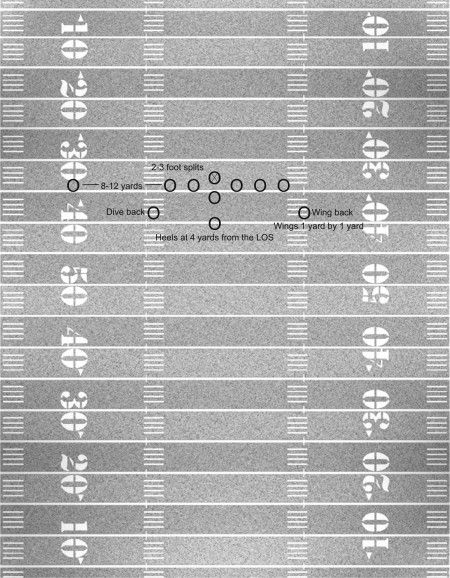
Diagram 1
and the unbalanced double wing (See Photos 1 and 2 and Diagram 2) that we call “OG”, named after a traditional double wing school in Sioux Falls, O’ Gorman High School. In “OG” we bring the tackle over to the SE side (long side) and reduce the TE next to the guard (short side or nub). Our linemen have a spacing of two feet between them. Our wings are one yard by one yard off the end man on the line of scrimmage in a 45-degree angle and our fullback has his heels at 4 yards from the LOS. Our quarterback is under center with the fullback directly behind him. We are a mirrored offense so we can run option to either side of the formation.
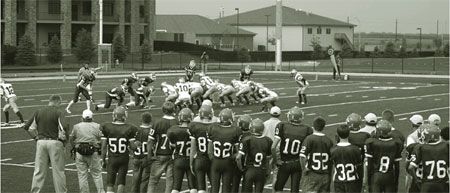
Photo 1
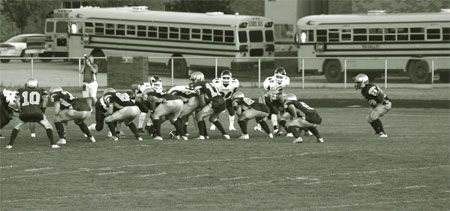
Photo 2
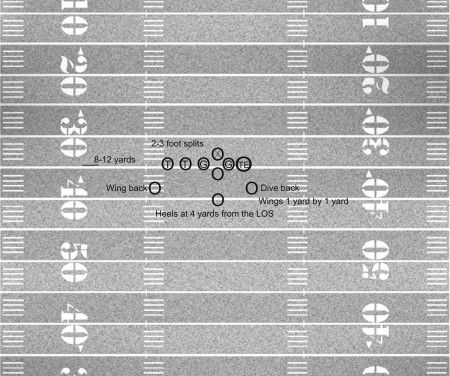
Diagram 2
Our belief in running OSV is to attack a down defensive lineman outside of the B gap. This blocking scheme can change depending upon the opponent that week. So, if we have a 7-technique DE (outside shade of the TE or OT in OG) we will leave him unblocked. We follow our Wing-T down rules with our wingback following his down zone but not blocking the DE on our dive read. The backside linemen will scoop or reach to the playside gap. It’s simple, but you must spend time every day working their foot fires and progression. An example of our veer play rules are shown in diagram 3 and we will change our rules accordingly depending on the defense that we will see that week.
The Mesh
The QB/FB exchange is where the most time needs to be spent when you install the option. This is like a marriage and these positions must get to know each another very well. Our basic rule is that the QB will give once the FB is past the QB’s front foot. We use a point mesh method and add a shuffle and ride to this read mesh. In the point mesh, the QB will step at either 3 or 9 o’clock with his playside foot getting as much distance as he can cover to the FB’s landmark. We want the QB to work into the LOS on the read, to get inside of the dive key or get upfield quickly. Once the QB has reached the landmark, he will be parallel to the sideline looking at the dive key. The ball is then extended out from the backside hip. Once the FB gets to the ball, the QB will step into the line with his front foot and “ride the FB” into the line. When the FB has crossed the QB’s front hip, the QB gives. If the QB knows what the DE is doing beforehand, it makes this read easy. If the DE continues to get up field or “sit” on this technique, he gives the ball. If the DE or dive key reduces or C stunts the gap, the QB will keep it but ride the FB to sucker the dive key to the FB. If the QB is confused, we have a rule: “If in doubt, GIVE.” Whatever technique the defense performs, we adapt. As the game moves along, the QB will need to become a “salesman” at the mesh and dive read. We tell him to play one on one with the DE as the game moves along (See Photo 3 – Veer Option).
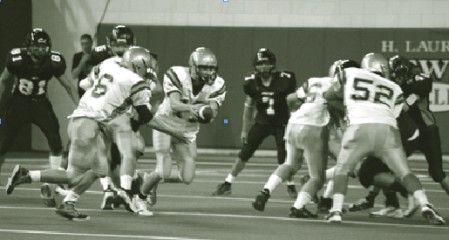
Photo 3
The FB will have a landmark he needs to get to based upon the called option and defender. Since we are attacking a 7-technique, the FB’s landmark will be the inside foot of the first OT. His foot work will be a 6-inch lateral playside, the first step of his belly steps, and then he will attack his landmark. He needs to fit the mesh with the QB, as the QB is not looking at the FB but at his dive key. The FB will take the ball in his gate, closing down on the ball like it’s a loaf of bread and when he passes the QB’s front foot, he squeezes down hard. This takes time to master and get the correct feel with the QB. That is why we practice this mesh every day (See Photos 4 and 5).
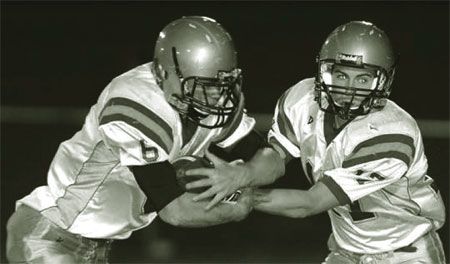
Photo 4
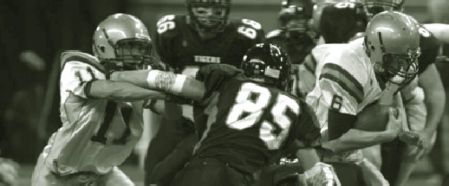
Photo 5
The pitch man must work to get out in front of the QB about 2-3 yards deep and mirror the QB’s actions. The WB will start in a one-step motion and work to top end speed to get to where he needs to be. We want him to start this motion and work toward the “belt line” of the FB. The pitchman will run to the sideline with hands and eyes on the QB. Once the QB has decided to keep the ball, he will attack the pitch key inside out. We want the pitch key to attack the QB so the pitchman is alone in the flank. When the QB decides to pitch, we use a one handed pitch with the thumb down. The QB must pitch the ball from his heart to the pitchman’s heart and then follow the ball in case of a fumble.
One area in option that we have found to be a deciding factor in a successful play is our flank blocking. The split end must be an outstanding blocker. We spend a lot of time every day on their stalk blocking technique. They must also be physical. If you watched our big running plays from 2010, you will see our SEs making some outstanding down-field blocks. I say this because the split end is usually not thought of when you are talking about blocking. How many of us spend time with SEs working on blocking? We all know that everyone is needed to make a play successful, but the big plays usually come down to the downfield blocking from SEs and WBs. Our Split End Coach, Todd Foster, begins each individual session with blocking fundamentals and then moves onto catching and route drills.
The other important aspect that we have used with our option game is the audible. We use two different types. We want our QB to be able to make the correct decision and have the opportunity to attack the defense where they are weak. It’s a numbers game at this point and he may find a player that he feels can be exposed. We have been fortunate to have a QB the last two years to be able to do this. Our QB likes to give dummy calls on the line as well to keep the defense from picking up the play. He doesn’t do it often but he has actually called off the play in the huddle on the line because he senses the potential for a better play. I have given him permission to do so because I want him to trust himself with leadership decisions. This process has actually won us some close games because the QB called me off and made the right call.
What we have found is that the option has given us another dimension to our game. The Wing-T with all of its misdirection, power, sweeping, and trapping makes it hard enough to defend. By adding an old but successful system into what we already do has made our offense more difficult to defend. We do not have the biggest or fastest athletes and we are one of the smallest schools in our class system. So by adding option, we have played to the strength of our team the past two seasons.
Here are some drills that will help your overall execution:
Drills
Double Ball Mesh (Diagram 4)
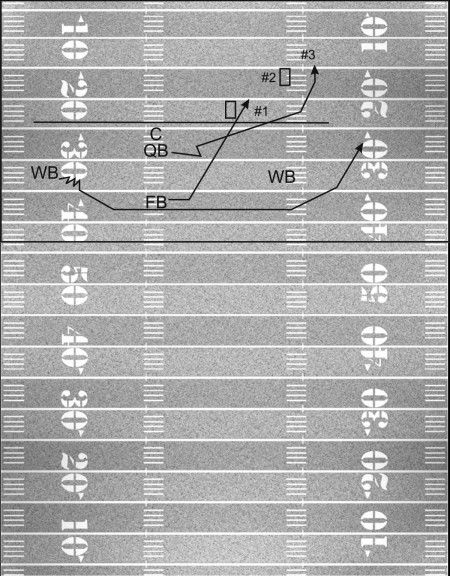
This is a drill that we ran in high school under my father, Mike Stadem. Once our FBs and QBs have gone through their mesh and the WBs have finished their blocking progression, we use a two-ball option. We want to put it all together for our backs in a high-tempo drill. This is a time to use a center with the backs so he can snap the ball to the QB. It also helps with the natural timing.
We divide our backs into groups of two WBs, QB, and FB. We set out a line spacer, two flat dummies, two hand shields, three coaches, and two footballs. We want repetitions and high intensity. We will call ‘Veer’ and the QB will repeat the play back to the players. The flat bag will be placed as the landmark for the FB/QB and the FB will run to the outside edge of the bag. The QB will work on doing correct footwork and his ride mesh, with no reading. We find that we forget about all that the QB has to do on this play and it all happens in two seconds or less. The FB will always get the ball. Once the QB hands off the ball, he will attack upfield, receiving a hand off from coach #1 holding out a ball. The QB will then attack his pitch key, coach #3, and work on his pitch. The pitchman will work on his pitch mesh track and spacing. The playside WB will block his assignment which will be another coach, #2, holding a shield. We will practice running this drill to both sides.
Double Ball Read Mesh (Diagram 5)
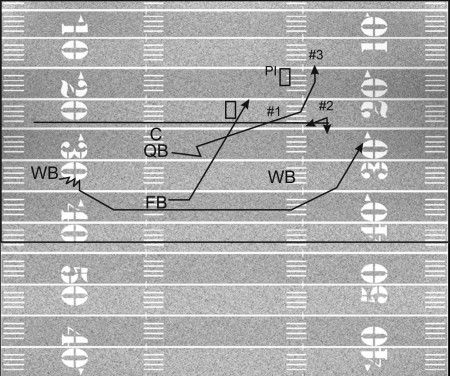
This drill is set up the same way as the Double Ball Mesh. We just incorporate our basic FB/QB mesh with the Double Ball Mesh. This time we will place the #2 coach as our dive key and we will have another back hold the hand shield. The #2 coach will perform a number of different stunt techniques that the QB must read. He will either give or keep. If the QB gives to the FB, he will then continue working on the option by getting the ball from coach #1, similar to the first drill. If he keeps, he will not take the second ball from coach #1.
About the Authors: Chad Stadem has coached high school football for 11 years with eight of those years as head coach. His overall coaching record is 55 – 26 and 11-6 in playoff competition. His first head coaching position was at Howard, SD where his teams won two conference titles, one regional title, and a State Championship in 2004. For the past three seasons, Stadem has been the head coach at Flandreau High School. His Flandreau teams have won two conference titles and a State Championship in 2010, finishing the season with an 11-1 record. He is a graduate of the University of Sioux Falls and is currently working on his Master’s Degree in administration at South Dakota State University.