THE 3-STEP, QUICK PASSING game is the core foundation of a strong air attack. The ability to connect on a high percentage of pass attempts under 10-to-12 yards is essential to keep the chains moving. But in order to consistently throw the ball further downfield requires an effective 5-step passing game.
Efficiency is a key ingredient to any offensive scheme, and the utilization of a half-roll, 5-step game adds a versatile and efficient phase to your offensive attack.
By rolling the quarterback on his 5-step drop to a depth of 6 -to-8 yards and setting him up behind the offensive guard and tackle, the offense gains advantages that a straight 5- or 7-step drop does not offer.
To look at these advantages, let’s analyze a base pattern of the 5-step package.
DIAGRAM 1:
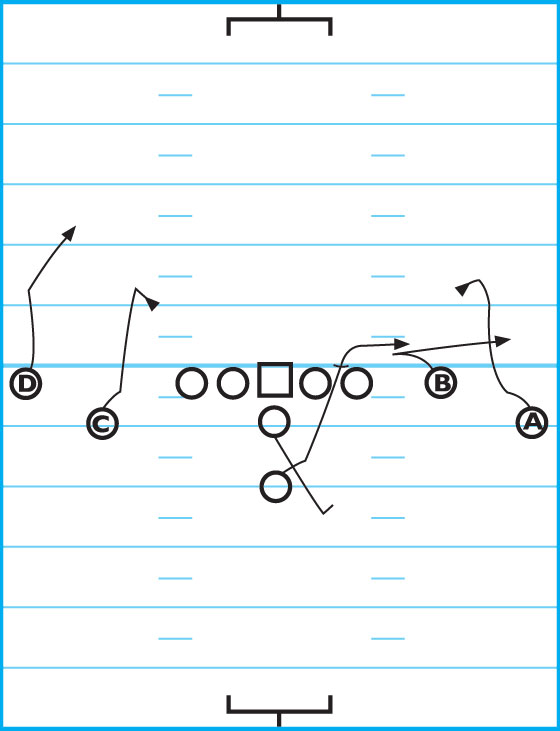
80 Curl. The 80 curl pattern consists of the following individual routes.
- Play side A — curl. - Play side B — flat.
- Back side C — hook. - Back side D — post.
- Running back — check-flat.
QB Read Progression
By rolling the QB on his pass drop, the read progression can be simplified. In the 80 Game, the QB has a 3-progression read that is consistent across all 80 Game patterns.
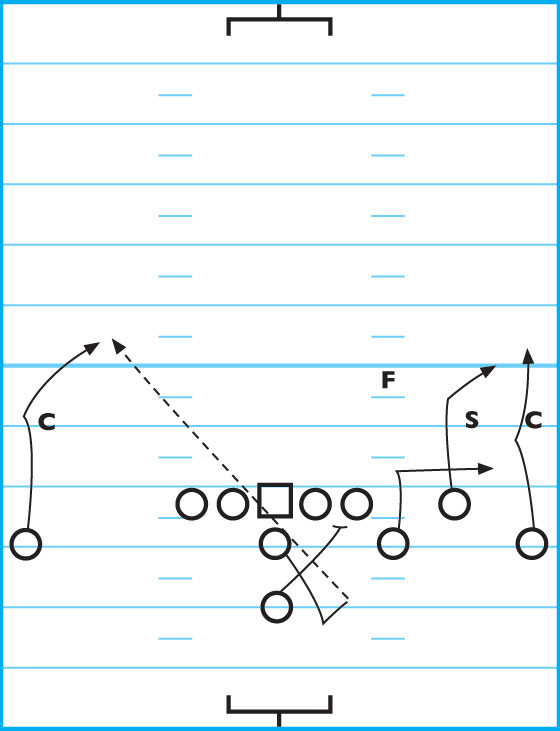
1. In his pre-snap scan of the defense, the QB will first identify the safety coverage. With no safety or over-adjusted secondary coverage, the QB will throw the backside post to the No. 1 backside receiver (See diagram 2).
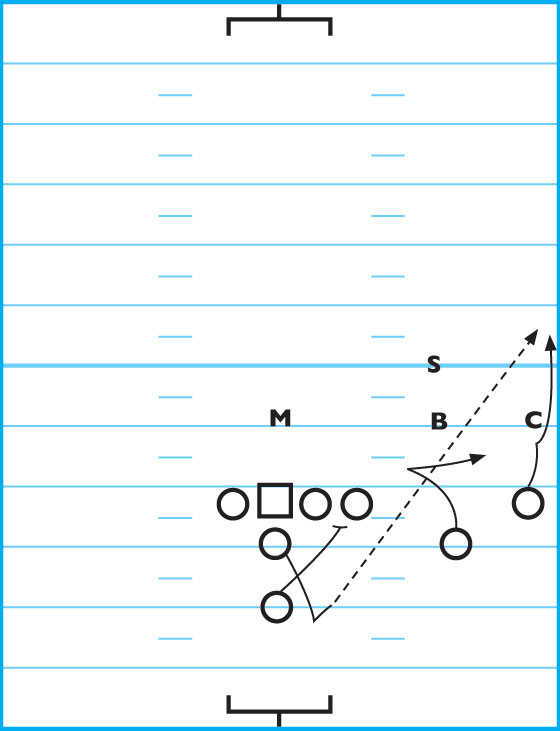
2. When the safety remains in “centerfield” or the QB gets a 2-deep secondary coverage, he’ll check the next read in his progression. The second check is the vertical read. If we have a receiver with a vertical advantage, the QB will throw the vertical ball on the fifth step of his drop (see diagram 3).
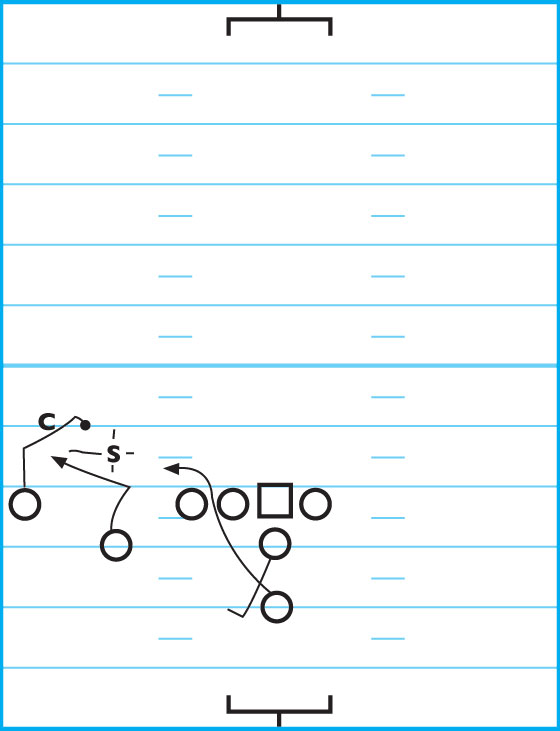
3. When there is no vertical advantage, the QB will make his throw by keying the movement of the flat player. The flat player is the defender responsible for flat coverage. This is a read that primarily is made after the snap of the ball as the QB is in his drop.
The QB will key the reaction of the flat player as we bracket that defender with a horizontal stretch. The routes of either the No. 1 or 2 receiver, along with the running back will place the flat player in a no-win scenario. The QB knows that whatever decision the defender makes will be wrong (see diagram 4).
DIAGRAM 2: 80 Game With Backside Post Route Vs. Over-Adjusted Safety.
DIAGRAM 3: Vertical Read On 80 Z-Go Vs. Cover Z.
DIAGRAM 4: Horizontal Stretch Read Of Flat Player.
QB Arm Strength
One advantage of the 5-step, half-roll package is the momentum it creates for the QB. The straight 5-step drop is limited without a strong-armed QB, but the 80 Game enables a player with average arm strength to execute in the vertical passing game.
DIAGRAM 5: Throwing The Deep-Out From 5-Step, Half-Roll.
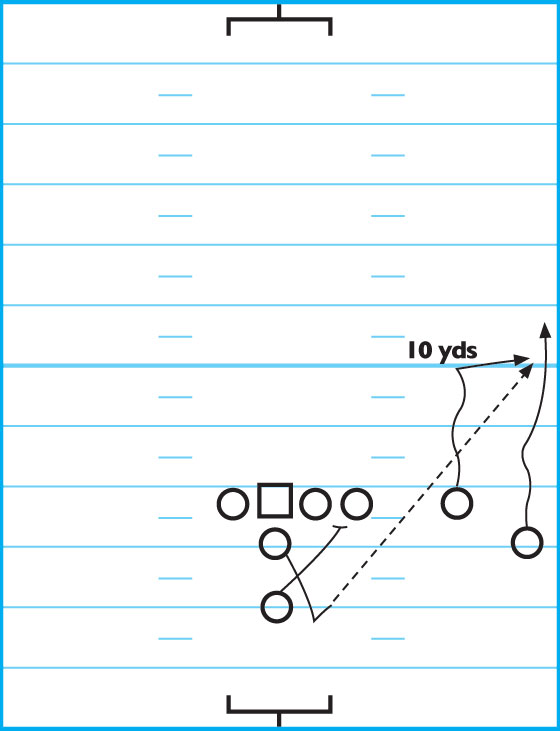
Not only does the half-roll action create momentum for the throw, but it also cuts down the distance the ball must travel. Consequently, the average-armed QB is still able to throw the deep out and vertical routes that are critical in the 5-step scheme (see diagram 5).
Versatile Protection Schemes
With any pass package, the offensive unit must have versatile protection schemes that are adjustable to a variety of defensive fronts. Use a combination of man and zone schemes to protect the passer in the 5-step package.
The flexibility of this protection scheme allows you to execute the 80 Series from either 1-back or 2-back sets. To the play side, utilize a man scheme.
By using the man scheme, your OGs and OTs will be able to block with defensive down techniques. Anytime we can block down linemen with our “big boys,” that is our preference. The RB (tailback in a two-back set) will run a check-flat on the play-side linebacker.
DIAGRAM 6: Check-Flat By RB. If the LB rushes the passer, the RB is responsible for picking up the blitz.
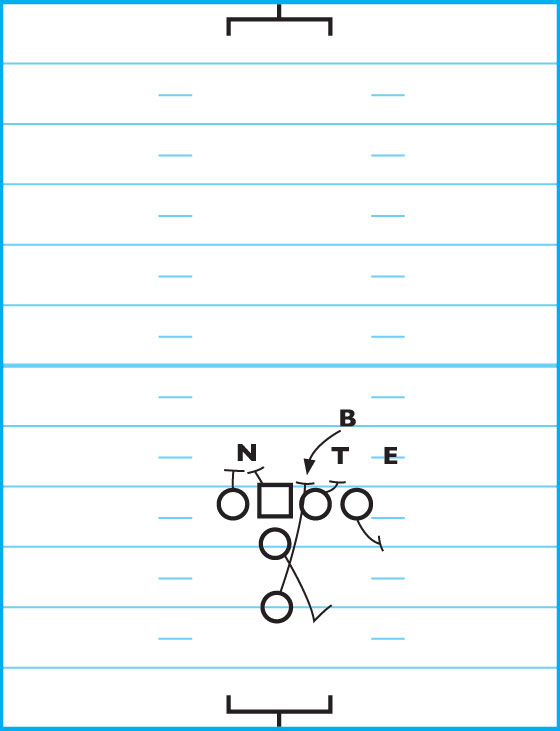
DIAGRAM 7: RB Flat Route Vs. LB Pass Drop. When the LB drops into coverage, the RB will convert into a flat route.
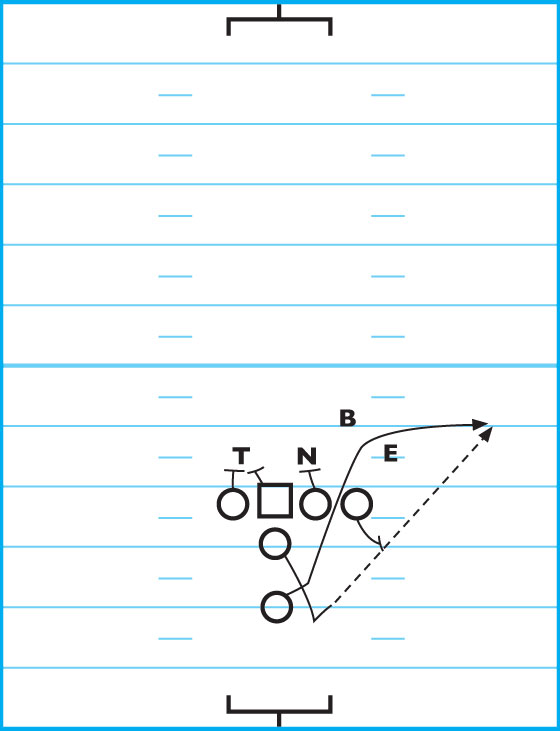
Check-Flat Very Effective
The check-flat is a great weapon that allows you to place five receivers into the pattern, creating more pass coverage problems for the secondary. Use a zone-protection scheme to protect the backside of your 80 package.
DIAGRAM 8: Backside Pass Protection In 80 Game. Protecting with zone principles on the backside allows your team to account for up to four defenders with only three offensive linemen.
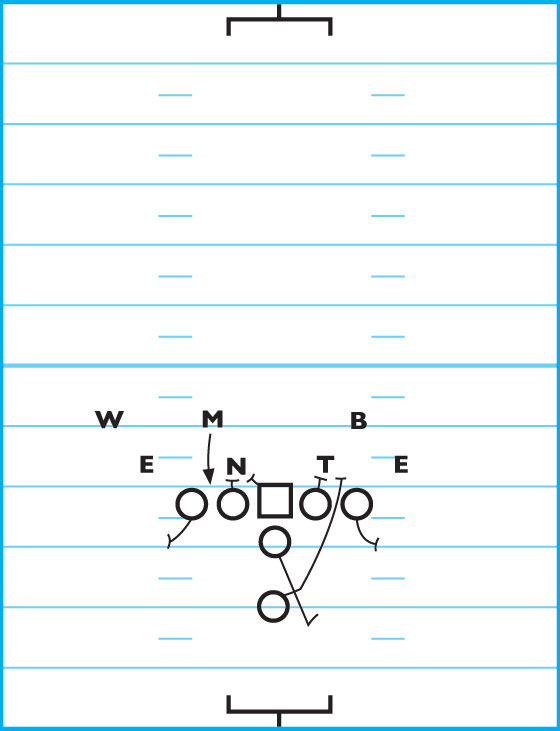
When throwing from the 80 series out of 2-back sets, the fullback is used to pick up “bandits” (extra defenders) on the backside. With only slight adjustments, you’ll also be able to release the RB into the pattern as an extra receiver.
In addition to the check-flat route shown in diagram 4, we also adjust our formations and protections to allow the RB to free release (no protection responsibility) into the pattern. The versatility of the 80 Game allows you to add a FB and/or tight end to the formation so that the RB is able to free release.
DIAGRAM 9: Free Release Of RB Into Pass Pattern. The FB/TE is able to account for the sixth defender in the protection scheme which allows the RB a free release.
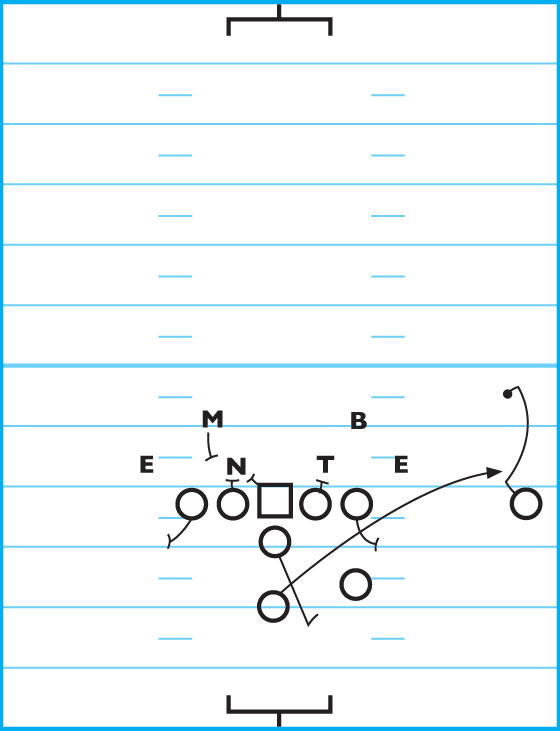
Backside Routes
The big plays in the 5-step game will come consistently from the QB connecting with his backside receivers. The No. 1 backside receiver often runs a post route in 80 patterns.
As mentioned earlier, this post read will be the initial read in the QB’s progression. Have him try to take advantage of the vacated coverage area when the safety rotates.
When attacking a 2-deep secondary coverage, the No.1 backside receiver will break his post to the middle of the field. Versus a 2-deep shell, the soft spot rests between the 2-deep defenders.
DIAGRAM 10: Backside 80s vs. 2-Deep Coverage. Try to get a receiver into this area and give your team an opportunity to capitalize on the coverage.
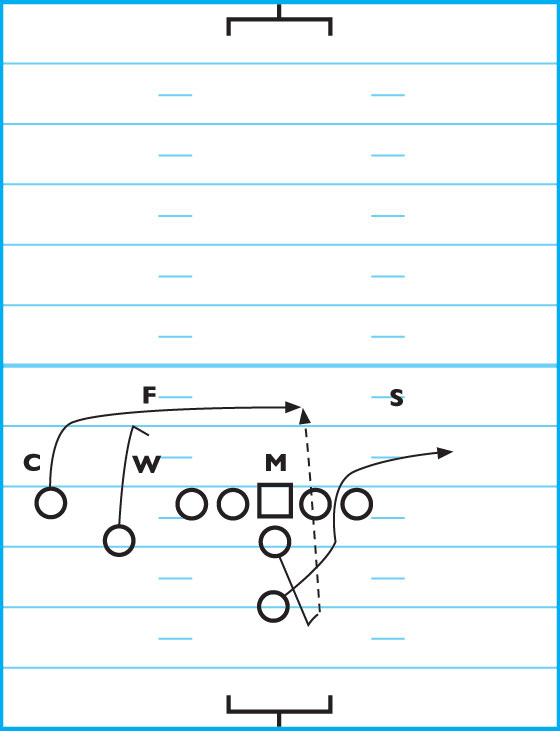
Hook Routes
The hook route by the No. 2 backside receiver has been a very productive third-down route for our team. The half-roll by the QB reduces the angle of the pass drop by the second level defender.
DIAGRAM 11: “Hook” Route By No. 2 Backside Receiver. When the LB’s pass drop is dictated by the half-roll action, a natural throwing lane is created for the QB.
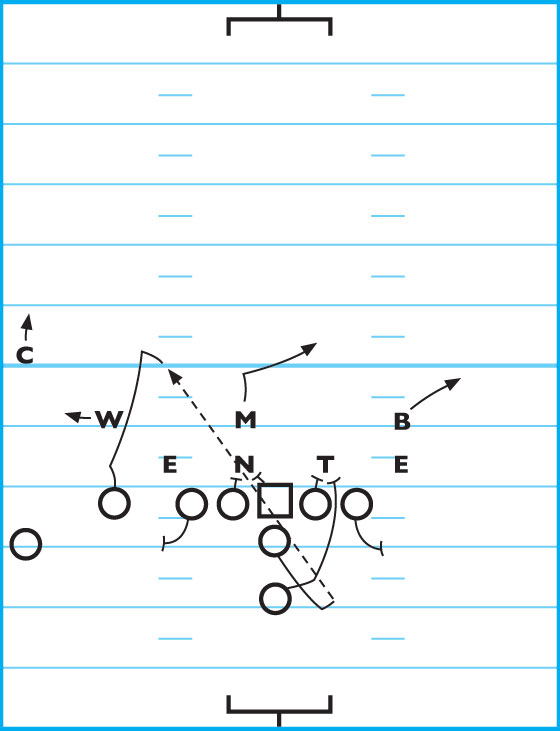
Jab Draw Complements Attack
Any successful passing attack is going to have a complementary run scheme to keep the defense off balance. Our 5-step scheme makes the Jab Draw a natural complement to our passing game.
DIAGRAM 12: Jab Draw. Take advantage of LB pass drops dictated by QB action.
The jab play is versatile enough that it can be run from 2-back sets as well as 1-back formations.
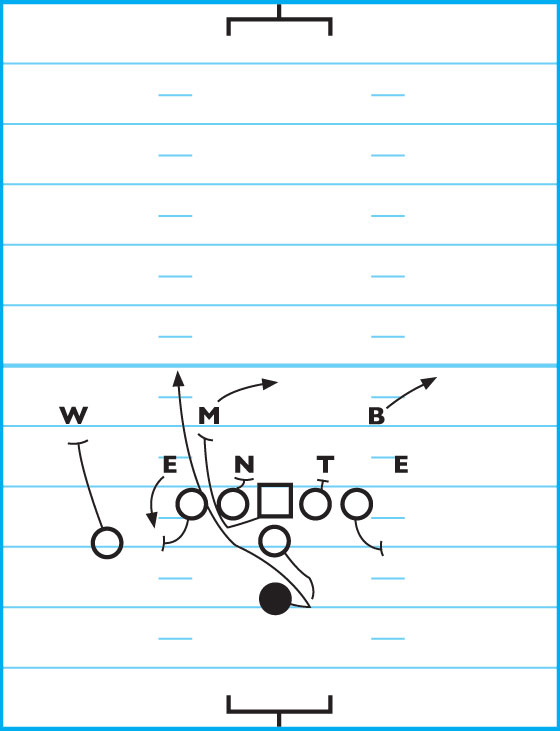
DIAGRAM 13: Jab Draw From 2-Back Set. Running the jab from an I-backfield gives your team a lead blocker so all offensive linemen can be used to secure first-level defenders and backside LBs.
Efficient, Versatile
Try these high-percentage 5-step sets to improve your team’s efficiency and to keep the chains moving.
This offense is extremely versatile and can be the basis for an effective air attack.