I’ve always thought that a 4-3 defense is one of the most adaptable defenses ever created. The one flaw to it, as I see it, is the positioning of the cornerbacks prevents them from really being involved with assisting with tackling on inside plays. The 45 defense is a modified 4-3 changing the positioning for the corners, which we refer to as Thunder (Rt Corner) and Lightning (Lt. Corner) our “Crazy Corners”. We want to try and force our opponents to run inside at us, towards our linebackers that are our best tacklers and we want our corners to be in a better position to control the Alley and be there to assist the linebackers on quick dives inside.
Why the 45 Defense?
• In our conference you will see teams that run Wishbone to 5 Wide Receivers and we needed a defense that would be able to easily adapt to what they are seeing with the personnel on the field.
• Defense can easily be used at any level of football from youth to college.
• Blitzes are called as the offense lines up and cancelled if any motion occurs. This also means we can adjust alignments to make sure the offense does not get an advantage “in the trenches” by having more personnel than we do within the line of scrimmage.
• There is no need to huddle, which means that an opponent that likes to run a No-Huddle offense, would not get the advantage they are looking for.
• It allows the players to be aggressive because even if we change our look-- everybody’s responsibility is the same as it is in the Base defense. Our defensive linemen slant to the wideside of the field on every play. It doesn't matter what position they are playing, they know they will slant to the wideside.
• This is a hardworking, aggressive defense causing you to substitute to get constant results. This means that the number 2 & 3 people on the depth chart should play like they are number 1 and should practice like they are number 1.
• We substitute a great deal on the defensive line because we want the players to be able to go all out on every play they are in there.
• We also match up players so that they compliment each other. We have used bigger, slower Noseguards with smaller, quicker Defensive Tackles.
• Players only have to worry about one gap protection/responsibility. This also makes it easier for the LBs to only have to concentrate on the one open gap to their side, which is the gap they blitz through if called.
• In a normal 4-3 alignment, the cornerback can be positioned anywhere from 5-7 yards deep and normally 4-5 yards outside a TE or wing to cover the flats (See Figure A).
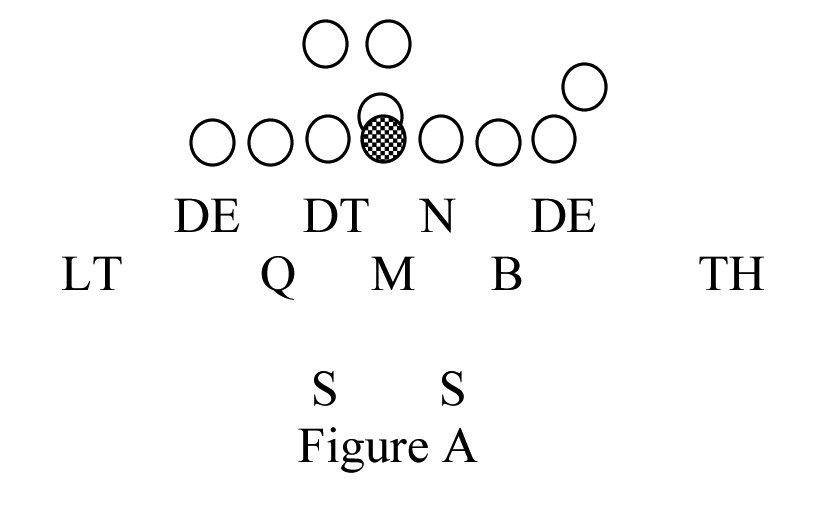
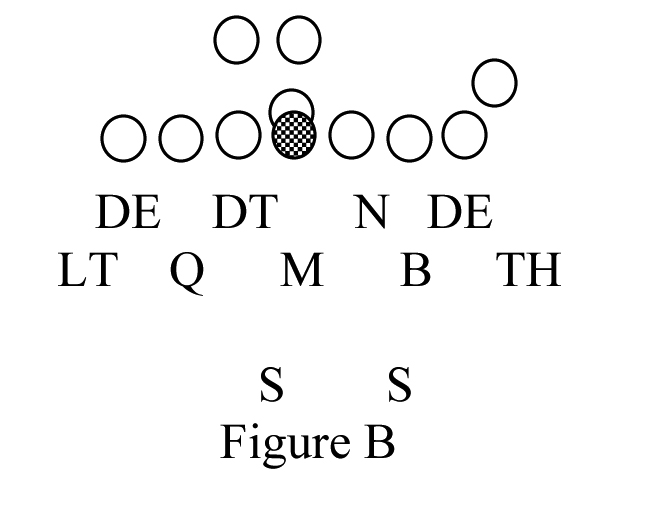
This does not help in the run game defense. The 45 moves the corners inside to help on the run game and still puts them in position to cover the flats (See Figure B).
THE BASICS OF THE 45 DEFENSE
ALIGNMENT & Player Description
A. Defensive Tackle - In the base defense, the DT will line up in a 2 position on the slantside (frontside) of the defense. He will be in a 3 pt. stance with his gap hand up and in position.
B. Nose Guard - In the base defense, the NG will line up in a 2 position on the back-side. He will be in a 3 pt. stance with his gap hand up and in position.
C. Defensive Ends - Both should be semi- tall and semi-quick players to watch contain and sack the Q.B. In the base defense, the ANCHOR D.E., to the back-side of the slant, will line up in 6 position in a 3 pt with his gap hand (outside) up and in position. The Anchor D.E. must be a patient & cautious person, he will deliver a good pop to the tight-end on the snap of the ball, and then expect a counter or bootleg roll-out to his side.
The Anchor sits just at the heels of the offensive line at first to see what is going on. We want him to collide with any lead blockers with his inside shoulder, keeping that outside arm free.
The RUSH D.E. to the slantside will line up in a 6 in a 3 pt. stance with his gap hand up (outside) and in position, he will deliver a good pop to the tight-end on the snap of the ball, his job is to find the QB and go after him.
The Rush needs to aim for nearest back as he comes off the ball. We want him to collide with any lead blockers with his inside shoulder, keeping that outside arm free.
D. MEAN (Middle L.B.) - 3 to 4 yards deep in a 0 position. Should have a nice balanced stance so he can go side-to-side or straight ahead. The natural team leader on "D", best tackler and an athlete.
E. BEAR & QUICK (Outside L.B.s) - 3 to 4 yards deep, normally in a 4 position with their outside leg back (so they will not get hooked so easily). If on the weak-side without a TE, they should almost be stacked on the D.E. Not as large as MEAN, but quick to cover contain and passes, should be number 2 and 3 tacklers.
F. THUNDER & LIGHTNING (“Crazy Corners”) - 4 to 5 yards deep in a 7 position with the outside leg back – normal Strong Safety types (can hit like a L.B. and cover flats & go man-to-man with T.E. easily as the average corner). I’ve normally found out that the best corners in this defense are wrestlers.
G. SAFETIES - 10 to 12 yards deep, depending upon their speed. They should be keying the number 1 receiver to their side. Your best man-to-man people that will be strong corner support on running plays. I’ve normally noticed that basketball players make my best safeties in this defense.
Responsibilities (45)
A. D.T. - Responsible for the "B" gap to the slantside. Keeping the offensive guard off MEAN and have the dive on option teams.
B. NG - Responsible for the "A" gap to the slantside. Keeping the center off MEAN and have the dive on option teams.
C. D.E.s - Will control the "C" gaps, have the Q.B. in the option and outside contain always. Force the play back towards the LB.
D. MEAN - Must control the "B" to "B" zone in the middle, but have the mentality to try and tackle sideline to sideline. Dive man in option. Read your Key.
E. BEAR & QUICK - Help control the "C" gaps to the ALLEY. Pitch in the option. Read your Key. BEAR lines up on the 2 or more receiver side of the field (or wide side if even). QUICK lines up on the side opposite BEAR. Read your Key. They are responsible for the #3 receiver to their side in Man-to-Man coverage.
F. THUNDER & LIGHTNING - ALLEY control on the strongside of the formation forcing the play back towards the LBs. Q.B. responsibility in the option, make sure it is not a option pass first. The number two receiver in Man-to-Man coverage. Read and react to what the #2 receiver is doing.
G. SAFETIES - Pass first, then corner support on running plays, look for the pitch man in the option. Read #1 receiver to the ball. Cover #1 reciever in Man-to-Man coverage.
Defensive Shades and Gaps
Linebacker Reads
MEAN backer - Read Fullback (QB in Shot Gun) to Near Guard to Ball (See Figure C)
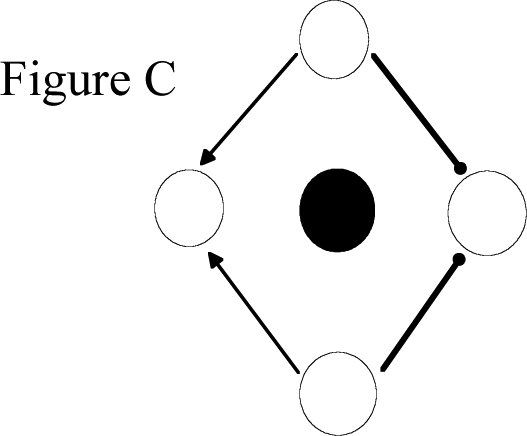
A. FB steps right --
Read right
offensive guard
B. FB steps left -- Read left offensive guard
1. O.G. pulls outside -- Flow Outside
2. O.G. pulls across -- Flow Across
3. Doubles on D.G. or D.E. -- Step up & Read
4. Leads out on you -- Play Big and find the Ball
5. Pass Block -- Drop to Pass Defense
BEAR & QUICK - Read Near Back to Tackle (See Figure D).
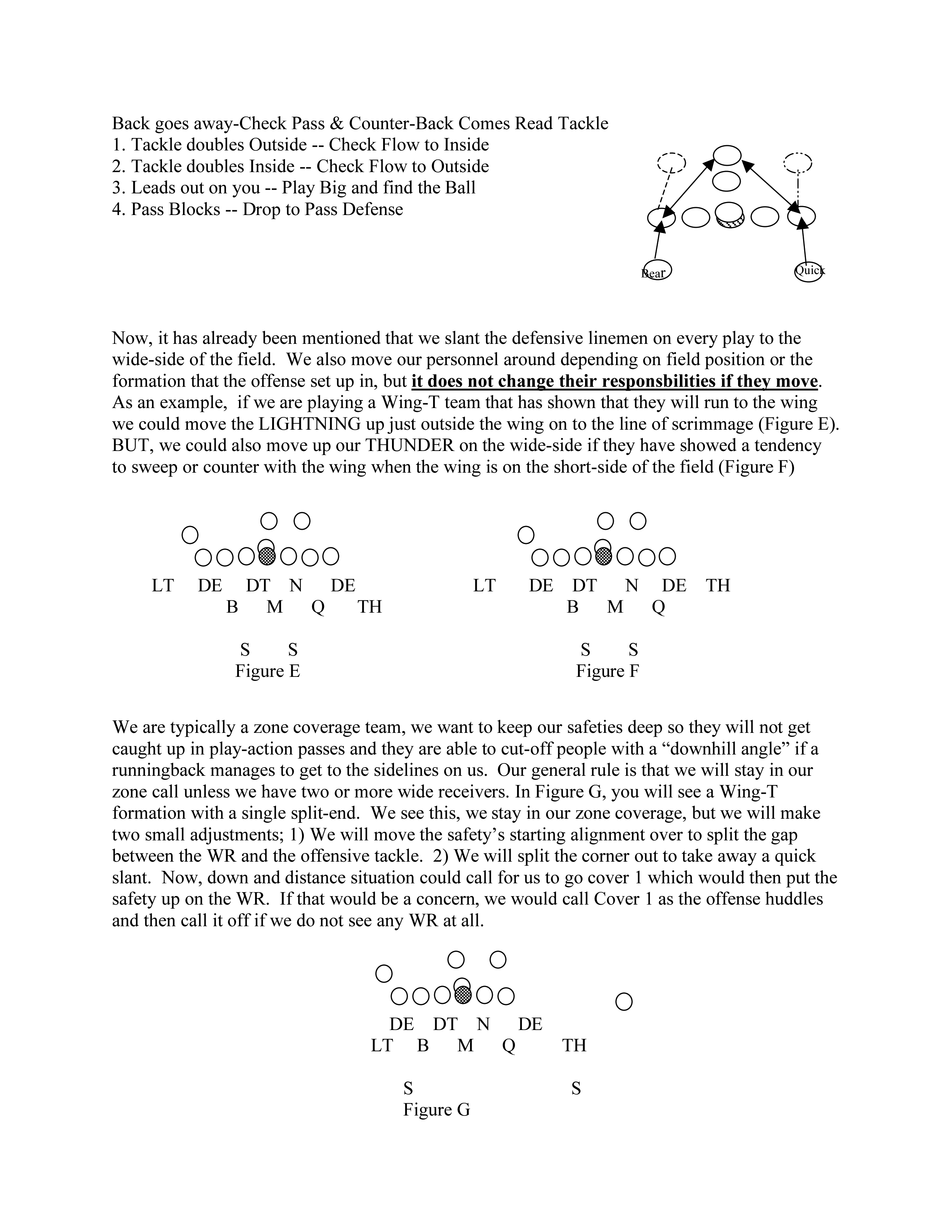
If Back goes away-Check Pass & if Counter-Back Comes Read Tackle
1. Tackle doubles Outside -- Check Flow to Inside
2. Tackle doubles Inside -- Check Flow to Outside
3. Leads out on you -- Play Big and find the Ball
4. Pass Blocks -- Drop to Pass Defense
Now, it has already been mentioned that we slant the defensive linemen on every play to the wide-side of the field. We also move our personnel around depending on field position or the formation that the offense set up in, but it does not change their responsibilities if they move. As an example, if we are playing a Wing-T team that has shown that they will run to the wing we could move the LIGHTNING up just outside the wing on to the line of scrimmage (Figure E). but, we could also move up our THUNDER on the wide-side if they have showed a tendency to sweep or counter with the wing when the wing is on the short-side of the field (Figure F).
We are typically a zone coverage team, we want to keep our safeties deep so they will not get caught up in play-action passes and they are able to cut-off people with a “downhill angle” if a runningback manages to get to the sidelines on us. Our general rule is that we will stay in our zone call unless we have two or more wide receivers. In Figure G, you will see a Wing-T formation with a single split-end. When we see this, we stay in our zone coverage, but we will make two small adjustments; 1) we will move the safety’s starting alignment over to split the gap between the WR and the offensive tackle. 2) we will split the corner out to take away a quick slant. Now, down and distance situation could call for us to go cover 1 which would then put the safety up on the WR. If that would be a concern, we would call Cover 1 as the offense huddles and then call it off if we do not see any WR at all.
Against teams that would play us in a traditional Pro-Split back formation we would look like Figure H. Again keeping the numbers even in the area of the LOS. The safeties position should be on the inside shoulder to force the receiver to the outside.
Against a team that would play a Spread Shotgun we would move the corners out so they could cover the #2 receivers. The DEs would stay in their normal position, as if the TE was still there, this would cause the OTs to have to move out to block them. This also would be a blitz call for our Quick LB through the “B” gap potentially meeting the running back on any type of VEER READ-Give call (See Figure I).
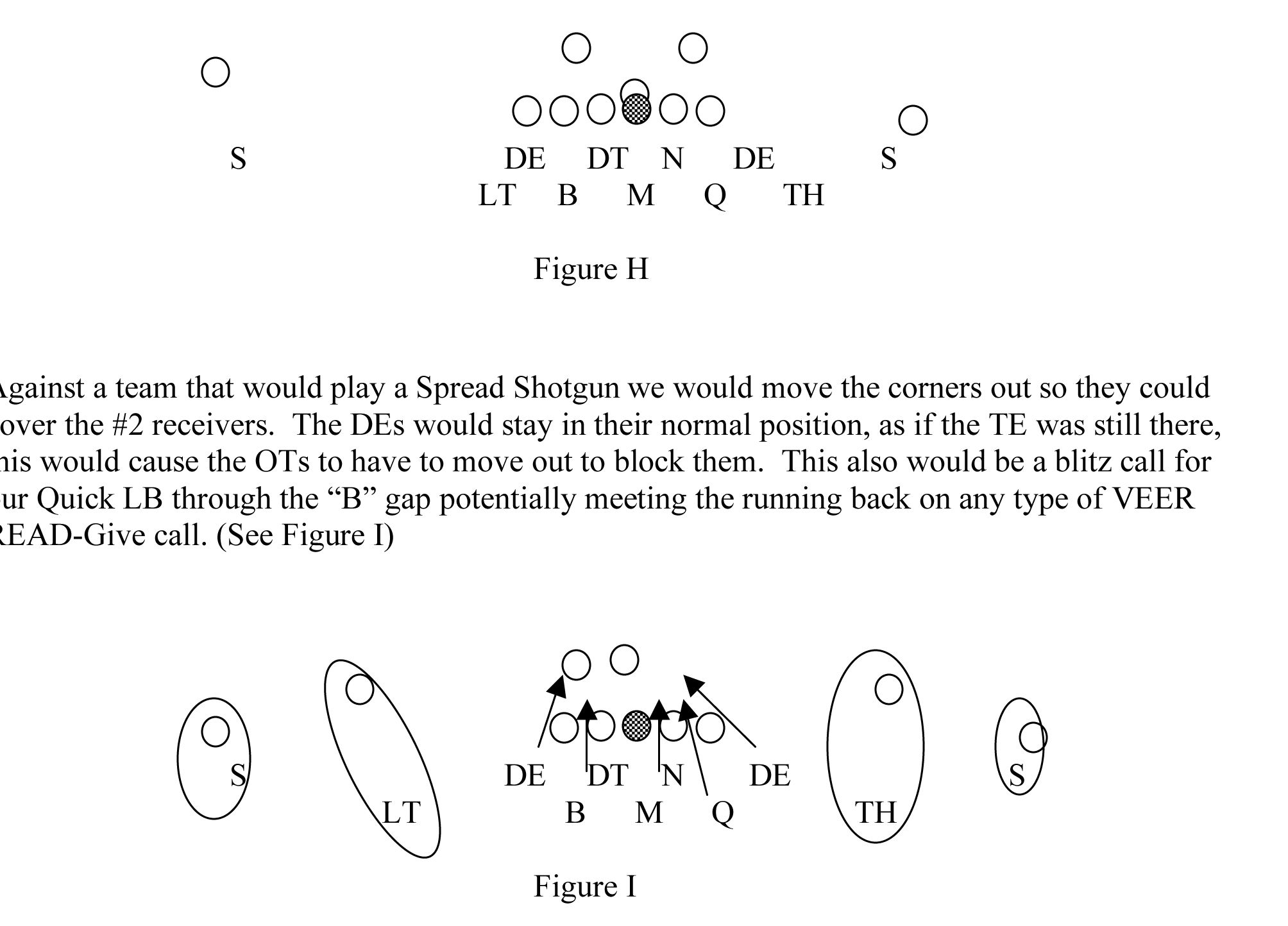
The hardest part of this defense is calling the blitzes because the 45 wants to attack the formation causing the offense to account for more defenders at the point of attack. Blitzes are literally called on the fly by the defensive coordinator as the offense lines up, this means as the defensive coordinator you have a better chance to call a blitz that would work in your favor.
45 PASS DEFENSE
We call a Zone Coverage every time (with the exception being on short yardage where it would be Cover 1), this is called off if the offensive formation contains two split-ends/wide receivers. When we see that, we will automatically go Cover 1. Our pass defense consists of these coverages:
1. Cover 1 -- Man-to-Man Defense -- In Man-To-Man coverage the defensive backs need to line up on the receivers' inside shoulder, backs towards the formation, forcing the receiver to the outside.
2. Cover 2 – Safeties deep halves, 5 under
3. Cover 3 (Robber) -- 3 deep, 4 under-Backside (away from slant) Corner rotates into Middle-Third
4. PREVENT PASS COVERAGE Cover 4 -- Combination --- Man-to-Man with the Safeties with 3 under (LBs) 2 over (CBs)
In a ZONE coverage, the ball is the issue. This means that the DB must drop to the proper position & keep his eyes on the QB to look for the throw. All secondary personnel (Ss, LBs, & THUNDER/LIGHTNING) must cover ground while the ball is in the air – See Ball, Go to Ball!
In a MAN-to-MAN coverage, the receiver is the issue. Focus on the receiver and do not let him shake you. The only acceptable catch against us in Man-to-Man would be a “highlight” reel catch over the DBs head.
About the Author:
Jeffrey Holley had coached football for 16 years from Youth Football to GA at Aurora University with the majority of his career in the West Carroll Consolidate School District area where he has been a Head Coach (of the former Mt. Carroll School district for three seasons). Recently, Holley has helped in the creation of the West Carroll Youth Football Association while he was working on his Masters in Education Administration and Supervision.