A few adjustments in a quarterback’s technique can improve his short passing game.
The Drop
When teaching the 3-step passing game, scheme is important, but I always look first at how fast are we getting the ball off. The set and drop by the quarterback is critical. After years of teaching a straight drop 3-step, I worked a camp at the University of Virginia and found something I liked better and that made more sense. I’ve always taught my quarterbacks to have their push foot slightly further back in their stance to gain a little extra depth on the set. But I never looked at the angle at which they drop. Making a great throw in the quick game means getting the ball off fast. This means getting the throwing shoulder aimed to the target as fast as possible. It also means getting the quarterbacks hips in line to the target as well.
Pre-snap, our QBs select the side they are reading and throwing. So on the snap we have the drop at an angle slightly away from the throw. Instead of pushing straight back, we push to the “A” gap away from the side we’re reading. With eyes on the read, by the time you hit the third step, the QB should have his shoulder aimed to the target as opposed to dropping straight back, then having to open the hips to make the throw. This slight angle drop gets everything in line to the target and can be done on throws to the left or the right. I find that for right handed QBs throwing left or left handed QBs throwing right, this technique is especially productive in getting the ball out fast and accurately (Diagram 1).
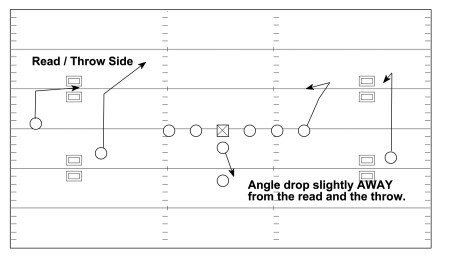
Diagram 1.
We have an extensive 3-step passing game out of a variety of different looks. This one is one of our most successful. Our QBs like it because it’s flexible. It allows for answers to a lot of different defenses and coverages. We never have to check out of this play. That confidence helps our QBs be deliberate and accurate delivering the football on time.
The Scheme
One of our more successful schemes is run out of a 3 X 1 Set. On this play, we have our X running a 4 to 6 yard speed out. If he gets press man coverage, he has the option to convert it to a fade. His split should be inside the numbers.
Our Y runs a 5-yard Stick route. He is coached to attack for outside leverage of the first defender outside of him. At 5 yards, he’ll sit and work the window vs. zone. Our nickel – the second receiver on the trips side – runs a 3-yard speed out. His split should be less than halfway between the Z and the Y.
The Z runs a fade and must outside release and maintain leverage on the bottom of the numbers. We call that a ‘fade hole’. We want to leave a window for an outside fade throw (Diagram 2).
Diagram 2.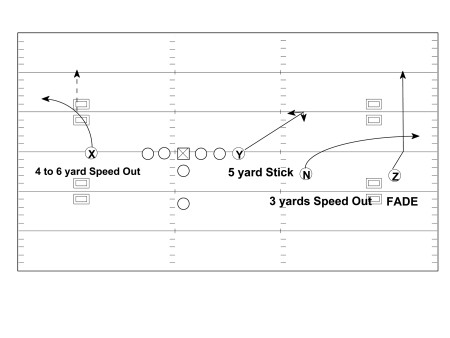
The Read
A team could play just about any defense or coverage against this 3 X 1 formation. Pre-snap, we always look to see if we have the home run. By that I mean do we have a single coverage on our Z or X with bump man-to-man? Is there safety help? If so, we can take the best matchup or the shorter throw if it’s a blitz. We work fades every day, so we’re comfortable taking a shot at the big play (Diagram 3).
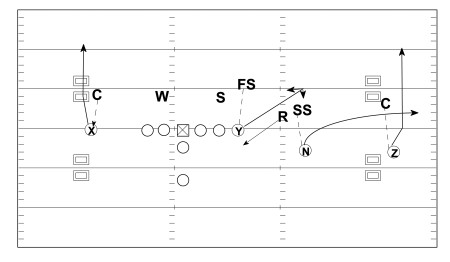
Diagram 3.
If a team is playing anything else, then we start with the single receiver side. Can we complete the speed out? If the corner is off, we take the speed out. If the corner is hard and has safety help, then we know that side of the field is closed. Take your pre-snap read to the three-receiver side (Diagram 4).
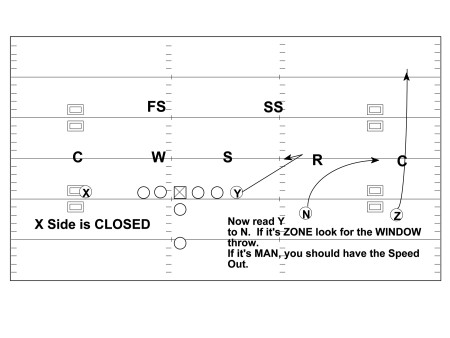
Diagram 4.
On the three-receiver side, you read the first defender outside the Y. If he expands with the Y, hit the Y’s inside shoulder. If he sits, hit the speed out. We end up hitting the Stick route often. If teams try to match up and play 2-man or man-free, use the stick or the speed out.
The pre-snap read is the key. Know what you have open and what you have closed. Take what the defense gives you.
About the Author: Coach J.D. Shaw just completed his first season as offensive coordinator for Bridgewater College. A 1993 graduate of West Virginia, Shaw previously was the offensive coordinator at Averett University, a position he held since 2002.