OUR TEAM RAN a successful 2-point conversion play and after using the play a number of times, we decided to expand on it. We’ve even successfully used this formation from various positions on the field.
You should have at least three options for 2-point attempts, even though you’re usually only going to need one per game. It’s nice to have a second play if you have to go for a 2-point conversion on consecutive scores.
The formation has the tight end and wing on one side and a twins formation to the other. We usually ask the officials to place the ball on the hashmark in order to use the wide side of the field for the double slant and split route.
DIAGRAM 1: Play A. Your quarterback reads the coverage and can tell who will be open. Give him an option to call the rollout pass to the wing side or run the wing in motion and call one of the other plays. (We prefer the rollout to the wing side.)

The wing steps down and breaks for the goal line, 3 to 5 yards deep. The tight end releases inside, then breaks out to the back corner of the end zone, 10 to 12 yards deep.
DIAGRAM 2: Play B. Send the wing in motion across the formation. He runs a flat route behind a double-slant route by the twin receivers. The TE releases hot and looks for an open seam to sit in without getting too deep or too far across or into the slants.
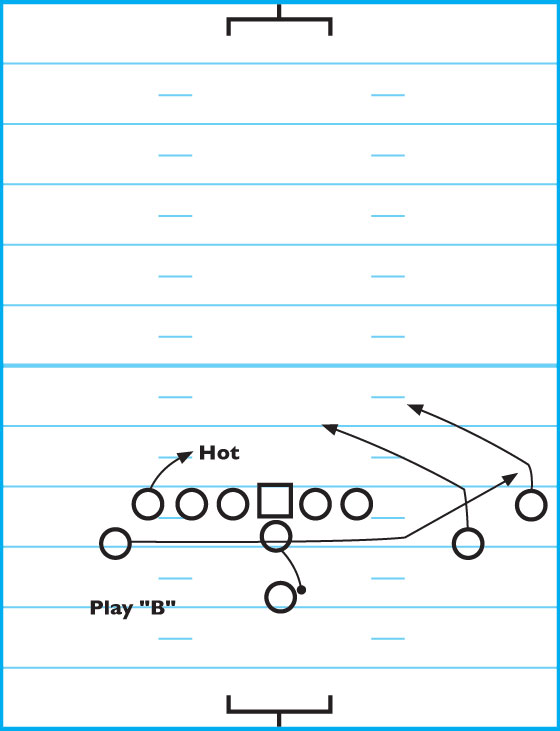
Use 3-step pass protection and QB steps for this play.
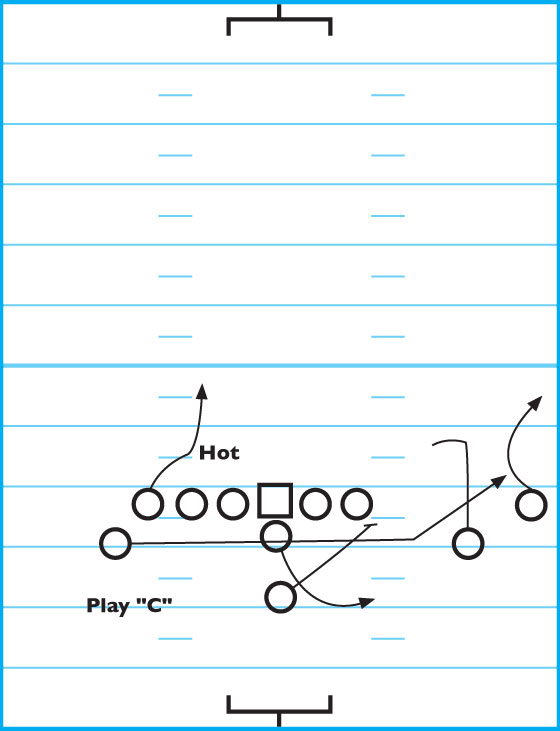
DIAGRAM 3: Play C. Send the wing across and out on the same route while the twins run a short version of a sprint-out route. The SE starts a slant and cuts for the deep pylon in the right corner of the end zone, while the flanker runs a curl at 6 to 8 yards and works for a seam. The TE releases hot and drifts deep to keep away from the curl route. The flat route or the curl will usually be open.
—Johnny Metcalf, Former Head Coach,
Erwin High School, Birmingham, Ala.