STARTING A NEW football program from scratch can be a difficult task for any coaching staff. Our staff has been in place since Fort Zumwalt West high school opened 6 years ago. The school currently has an enrollment of 2,300.
Being allowed to build up a program to your own vision and standards, however, can have its benefits. You can put your preferred offensive and defensive philosophies into place at each level and slowly assimilate and expose your players to your system from the very beginning.
Our staff decided to implement an option-style offense from the onset and have had considerable success. In 4 years of having a varsity football program, we have won 2 conference championships, with a 19-7 record and 3 district titles (compiling a 10-2 record overall).
Quarterback Iso
The best complementary running play out of our triple-option package has been the “13-Quarterback-Iso.”
The “13-QB-Iso” is a great play to call that takes advantage of an overaggressive, overpursuing defense or against a defense who assigned its defensive end to key-in on and follow the QB.
Another advantage to this play is its versatility. We use our ISV scheme (or any other triple scheme) and only two people on the offense have a responsibility to make changes to their assignments (the QB and the fullback).This versatility allows your team to become extremely adept at executing the 13-QB-Iso, with minimal practice and preparation time.
If you have a solid athlete at QB, it’s also another great way to keep the ball in his hands, remain a potential scoring threat and get him past the first level of defenders.
“13-Iso” Vs. 40 Front
This play was put into the playbook to take advantage of teams that defend the QB with an edge player and to use against teams who are overaggressive. Preach ball security and only use this play if your QB can be a physical back.You can use the QB Iso with any of your other triple-option looks.
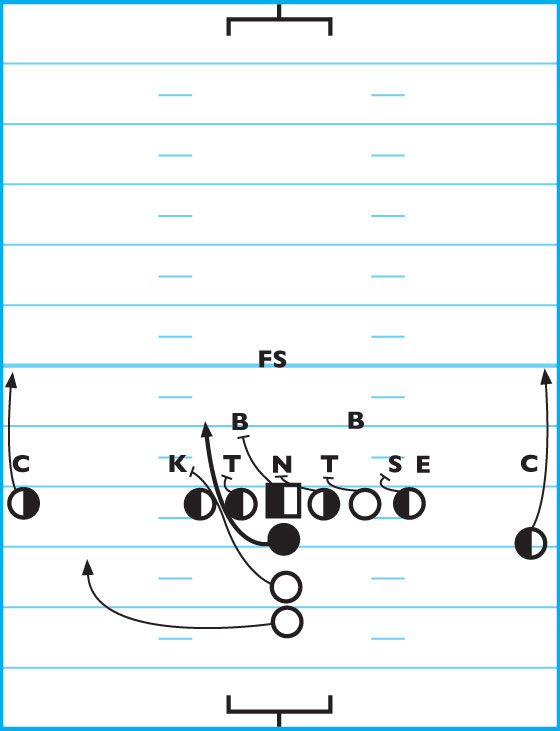
The following diagram illustrates how the “13-QB-Iso” is executed against a 40 front defensively.
DIAGRAM 1: “13 Iso Vs. 40 Front.” The kick-out block key is always the first person outside the B-gap on the line of scrimmage.
PLAYER RESPONSIBILITIES:
Play-Side Tight End: Takes an arc route and blocks the alley defender.
Play-Side Offensive Tackle: Combo-blocks to the inside and then on to the next level.
Play-Side Offensive Guard: Fit on the 1-, 2- or 3-technique. If left uncovered, combo-block from the backside to the next level.
Center: Fit on the shade or zone defender to the play side.
Backside Offensive Guard: Zone block to the play side.
Backside Offensive Guard: Zone block to the play side.
Receiver X: Stalk block the cornerback or use tight-end blocking rules if aligned tight.
Receiver Z: Stalk block.
Fullback: Mesh off the first person on the line of scrimmage inside the B-gap. Run a “banana” route to the inside of the kick key (who was the dive key in the veer offense). Must make solid blocking contact and must keep his feet moving.
Tailback: Line up at a depth of 6 yards. Run a pitch path, keeping a 4-by-2 relationship.
Quarterback: Mesh with the FB and must let the FB execute the kick-out block for him. The QB must be patient and must not be overanxious. He must let the play develop, keep position inside the kick-out block and cut upfield. He should look to use a possible cut-back move once he’s through the initial hole.
“13-Iso” Vs. Other Fronts
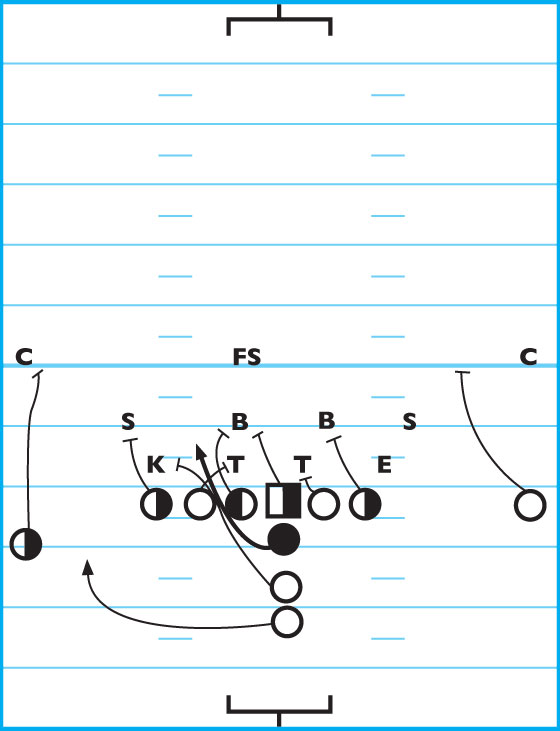
The following two diagrams show how the 13-QB Iso works against other defenses that we’ll often face.
DIAGRAM 2: “13 Iso” Vs. “50 Front” Defense.”
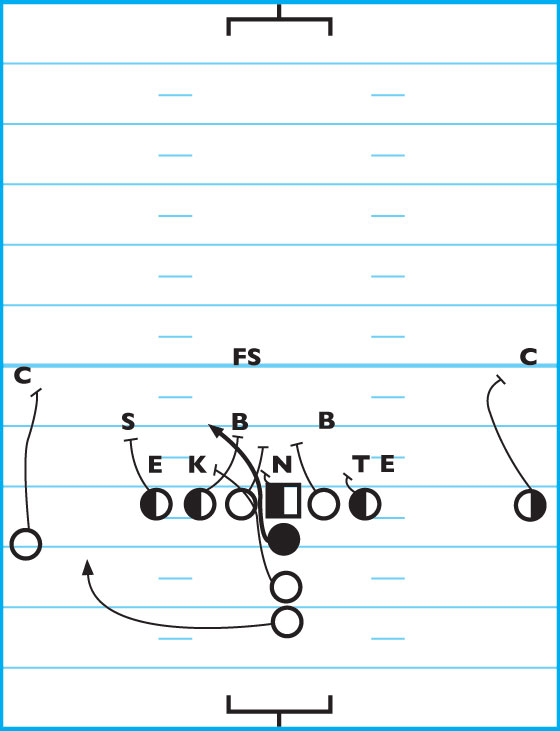
DIAGRAM 3: “13 Iso” Vs. The 46 Defense.”