The objective of Double Wing teams is to make you cover 10 gaps. When you spread yourself out to cover those gaps, they get more people to the ball than you have to defend. This gives them a huge advantage at the point of attack. Their base play the ‘Pitch’ must be stopped to be successful. Double Wing creator Don Markham was quoted as saying, “I ran the PITCH play 30 times in a row one game. If they can\'t stop the PITCH, the game is over.”
|
|
|
The ‘PITCH’ play is simple in its invention, but overwhelming in it’s application. If you don\'t stack the odds in your favor, you will be run over. Double Wing teams run up huge scores against opponents, who either have no idea what they are facing or are too proud to realize their own weaknesses against it.
I compare the Double Wing offense to a chess game. They get so many pawns in the way, my queen and rooks cannot be effective. So as in chess, my strategy is to clear the field and let my queen and rooks play against theirs.
The PITCH’s objective is like coach Vince Lombardi’s famous Green Bay Sweep. They want to create a width by the FB sealing the outside; the TE/OT’s double team sealing the inside; and the offside OT/OG/QB wedging through the hole, giving the wingback an alley to run through. Most times this alley is so big, “you could drive a truck through it.”
The PITCH play works like this; both wings line up on the LOS. The QB reads the defensive set and bends down under center. At this point the Wings take their place. One wing sets up as an unbalanced second TE. At the same time the second wing sets up as a wingback. He takes a quick motion back five yards behind the guard.
|
|
|
The QB snaps the ball and pitches a dead, non-spinning ball chest to face high at the motioning wing. He then pulls through the point of attack and seal outside, blocking the CB. The offensive line has foot-to-foot splits to prevent stunting. The play side TE and OT double team at the point of attack. They are taught to act like Siamese twins joined at the hip. Even though there are no gaps or running lanes they create them with their double team.
The unbalanced TE/Wingback gaps down to seal off the LB. The offside OT/OG pull to the POA. The OG responsibility is to seal inside. The Offside OT is to seal up any penetration and help the OG seal inside. The backside TE\'s job is to seal off backside penetration.
The FB’s job is to kick out the man responsible for Force. He takes a banana route, keeping an inside relationship to the Force man. Because of this banana technique, he can’t effectively kick out and never have to read the force and worry about logging him in. This technique allows him to concentrate fully on kicking out the force and creating the seam for the wing to run in.
The Wingback takes the pitch and reads his pulling OG/OT, many times pushing him through the hole. This adds deception to power of the play. Many times people are there to defend but cannot see the ball carrier as he hides behind the pulling lineman. The wingback has many options; as he runs through the holes he can stay on path, kick it outside or the most dangerous cut back across the grain. This is devastating because most of the pursuit is coming at the POA and does not properly defend the cut back.
The five main objectives in stopping the PITCH are:
1. Cover all 10 gaps.
2. Stop the overload at the POA.
3. Stop the pulling lineman.
4. Stop the cut back.
5. Find the ball carrier.
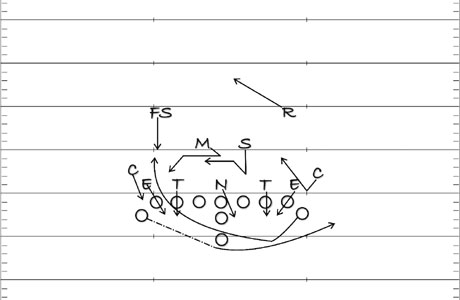
The only way to properly cover the 10 gaps and be sound in pass coverage is to run a 9 man front with a two deep secondary. To stop the overload at the POA, we have our defensive linemen cut the offensive line. Like trading pawns in chess, we clear the board by cutting their line. My DT for your OT, my DE for your FB, etc. With slanting and the pile created from the cutting, we hope to stop the backside pulling lineman. Backside pursuit must scrape down the LOS looking for cutback and keep our heads up looking for the ball carrier. Everyone must play responsibility type defense. One mistake will cause a hole and give them a big play.
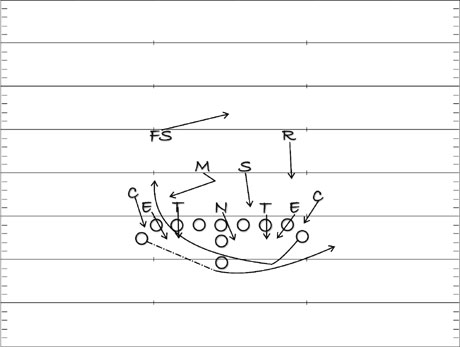
The way we defend the Double Wing is to line up in a 54 defense: 5 down linemen, 4 linebackers, 2 safeties. The main cog in the defense is the nose guard. He might not make one play all night but he is vital to the defense. The NG plays head up on the center and slants to the play side A gap. We determine play side by motion, best back, or tendencies. The NG can see the quick motion by the wing back with his peripheral vision. He rips through the center trying to get into the backfield.
Depending on their blocking scheme he may come untouched into the backfield. Most likely he will be doubled with the OG. Minimally he needs to impede the pulling OG/OT.
Both DTs will cut at the outside shoulder of the OT. This should cut the double team by the OT and TE, drive through and cause a pile up. The DT on the pulling side should try to cut the pulling DT if he does not get the cut pursue down the LOS looking for cut back. Keep an eye out for the TE blocking down or trying to cut you.
The LB to the motioning side should blitz the B gap. If the OG has blocked down on the NG a lane should open up. The LB away from motion should slow scrape downhill . Both LBs should read the FB. If the FB kicks out the DE, PLB should continue his blitz up field, with WLB scraping, looking for cut back. If the FB pauses or delays, both LBs should go at the FB looking for trap or reverse.
The CB to the motioning side should fill C gap forcing the play outside. The strength of the play is inside so any back running outside is by himself, defeating the purpose of the play. The PCB uses an ole’ technique, like a bull fighter, avoiding all contact. If the PCB sees more than one block, cut the pack and cause a pile up.
The CB away from motion slow reads and looks for reverse. If no reverse, scrap, looking for cutback. If reverse comes, use the same technique as PCB. The FS to the motioning side reads his TE. If the TE blocks, he becomes an alley player filling C gap and contains D gap if the PCB forces the play wide. If he reads pass from the TE, he covers the deep half jumping a corner route by the TE. The FS away from motion slides to center field and reads his TE for pass or run. If he reads reverse, he now becomes the fill/contain man to his side.
If every one does their responsibility, two things should happen. First we have a RB that has nowhere to go, running into his line. He ends up trying to bounce outside or falls over his own man. Sometimes the RB bounces out to an open space. While this is usually a problem, it is not. In this case, the RBs in the Double Wing are used for running behind people. They are not open field runners. A usual scenario has our line taking out their line and the CB’s end making the tackle.
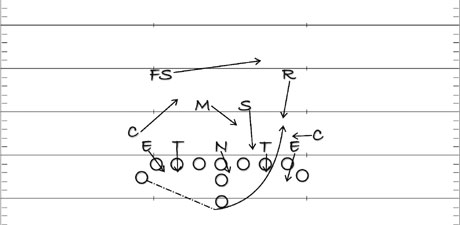
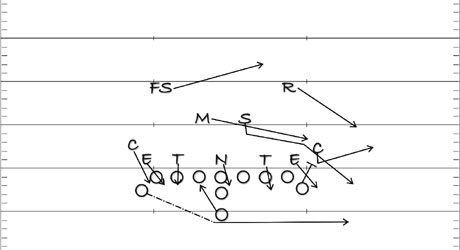
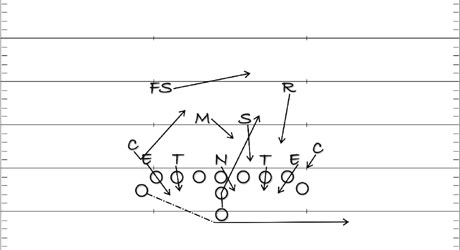
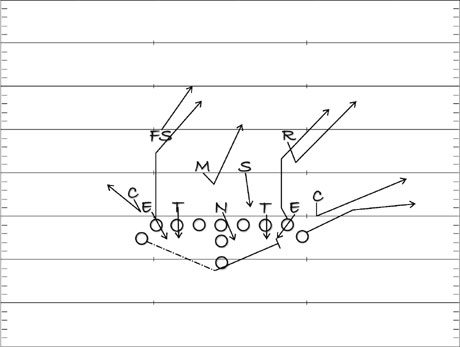
Included with this explanation are our ‘54 Pursuit’ for other Double Wing plays: the Toss, Buck, Trap, Reverse, Spin and Play Action (See Diagrams 1-6). The Double Wing has many advantages that if left untended will cause the field to tilt in their favor. By using the 54 and evening the odds, we are able to compete with this explosive offense.
Bruce Eien is the head coach at Brethren Christian School in Huntington Beach, CA. He can be reached at BruceEien@GridironStrategies.com.
WHAT IF?
Q1. What if you’re in a situation with the 54 defense where their pulling lineman is successfully blocking the defense. Would you make any adjustments?
That’s the beauty of the DW offense. If they can get their linemen to the POA there really is not much you can do. Stopping backside linemen pulling by creating piles in front of them along with closing the off tackle hole is the key to “slowing down” or controlling the DW because I don\'t think you can truly stop it.
Q2. What if you’re in a situation where your nose guard is not effective? Do you then need to make any changes in your defensive front?
If the center can block your NG by himself and he is not penetrating, then I think it would be smart to go to a 61 look and try to create piles that way. The thing I like about the NG is he can do a lot of damage (penetrating) and allow you to get more bodies on the off tackle gap. If the NG is ineffective then you have to take someone from the outside and secure the middle.