Having a practice results board that details effort, busts, turnovers, sacks, three and outs and big plays should
motivate your team.
After spring practice in 2011, our defensive staff brainstormed on how we could make effort and takeaways a larger focus of our players. We conduct various drills stressing effort and takeaways and discuss them all the time in meetings and film sessions, attempting to keep it on the players’ minds. We decided to develop a practice results data board to put further emphasis on these two areas. We track certain items in practice and display the data in the defensive meeting room. The first thing we do each day is review the data, talk about the good and the bad and any big items that need to be addressed to improve the data for the next practice.
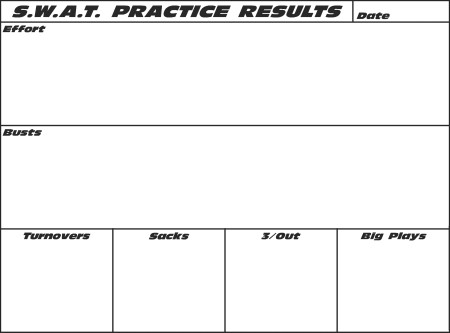
Our practice results board consists of Loafs, Busts, Sacks, Three and Outs, Takeaways, and Big Plays. We track Loafs and Busts by groups – DL, LBs, and DBs. QB sacks and three and outs come during our live scripted team periods. Takeaways and big plays are part of each complete practice (See Chart).
First, effort (or “loafs”) is tracked by each position coach. As the coordinator, I also track defensive unit loafs. Busts include wrong execution of the defensive call. Poor technique, missed tackles or getting beat does not constitute a bust. QB Sacks are counted during our live team periods, which make up about 15 minutes of practice. Three and outs are counted during our situation period and two minute period which totals 10 minutes of practice. Takeaways and big plays are counted throughout practice in all team periods. We define a big play as 25 yards or more.
To further stress the importance and make the data more meaningful, we set goals for practice. We want to have three turnovers each practice, win the two minute drill, and decrease busts as we progress through the week to zero on Thursday’s practice. We expect busts early in the week during implementation of the game plan. Plus, I believe it goes back to setting realistic goals. We don’t want mistakes, and they are unacceptable, but we don’t overreact on Tuesday about busts. We want to see a decline throughout the week and If we have any on Thursday, we spend additional time in our walk-through practice on Friday to fix and reinforce.
We believe that keeping this data as a visual in front of the players and reinforcing the positives and negatives of the data improves our practice effort and causes positive game results. Relating our practice results to specific education practices, our team psychologist suggests that 65% of the population is visual, and 80% of athletes are visual. This is scientific data that supports getting more visual information in front of the athlete. Also, celebration is listed by some psychologists as the most important aspect for the mental health of the athlete. Meeting practice goals and not having any busts during practice does cause excitement and accomplishment. You can sense the satisfaction in the players.
We stress focusing on preparation. We believe setting small practice goals and tracking practice results assist in keeping our players focused on improving their skills and learning the game plan, thus improving their defensive performance in games.
Here is a summary of our 2012 game stats that relate to our practice results board:
Takeaways = 2.5 / gm
Sacks = 4.4 / gm
TFL = 7.5 / gm
Big Plays = 3.4 / gm
About the Author: James Cheatham was selected as the new head coach at Miami High School (OK) this past December. He had been the defensive coordinator at Northeastern Oklahoma A & M College when this article was written. Cheatham also serves as the athletic director for Miami’s public schools.