Back in the 1960’s, when many of today’s high school coaches and even some college coaches weren’t born yet, ‘Monster Defenses’ were the rage. These formations featured one player, usually the best athlete, who appeared to be lining up wherever he pleased. Actually these ‘Monster Men’, as they were so often called, moved around based on a coach’s formula determined by down, yards to go, field position, and the location of the opponents’ best player. The monster became, in actuality, an extra outside linebacker or cornerback who played on the right or left side as the situation dictated.
What brought monster defense to an end was good scouting. If the monster man’s location could be predicated from past observations, it then became relatively easy to run or pass away from his expected coverage area. A beautiful example of beating the monster defense occurred when one high school coach and his players dreaded meeting a future opponent. The star of this rival team was an all-state back who was widely recruited by several major universities. Of course, this player’s coach made him the team’s monster man.
Scouting revealed the positioning rules for the monster man and a game plan was developed on how to deal with his presence. During the game the opposing star was completely avoided and he neither intercepted nor broke up any passes. Moreover, the only tackles he made were on punt and kickoff coverage. He ended up too far away from running plays to be any kind of a factor in stopping them.
The aftermath of this game got the winning coach thinking – if a monster defense can be beaten by running or passing to the side away from the monster man, how about using a player who moves vertically forward and backward in the middle of the defense, rather than horizontally from side to side? In other words, if the designated monster man is such a good athlete, why can’t he be a lineman on some plays, a linebacker on others and also a safety?
Subsequently, the winning coach developed such a defense, as he had a gifted athlete capable of handling all three roles. Back in the 1960’s, this meant fitting a ‘middle monster’ into the now somewhat old-fashioned 6-2 defense. In modern football, a middle monster man might adapt to a 4-3 or 3-4 scheme, but a little intellectualizing makes this possible, too.
The middle monster defense addresses four opposing challenges – A. Goal line or short yardage defense in which the monster plays nose guard. B. Normal alignment with a running play in which he plays middle linebacker. C. Normal alignment with the opponent’s pass more likely in which he plays safety. D. The prevent defense in which he drops back to safety. Diagrams 1-A through 1-D illustrate these situations with the middle monster in the 6-2 defense. The monster man is depicted as a wedge and other defenders are shown as X’s.
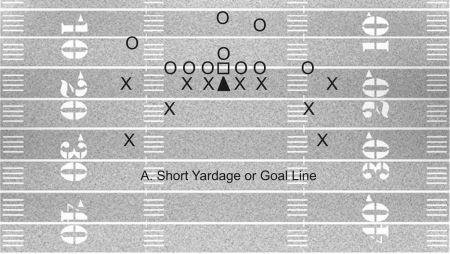
Diagram 1A
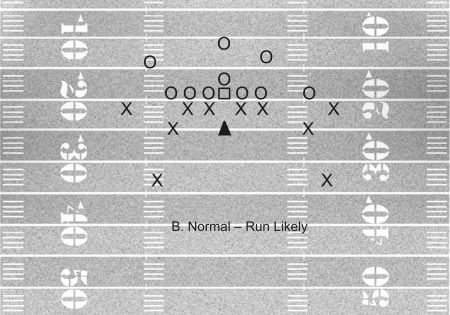
Diagram 1B
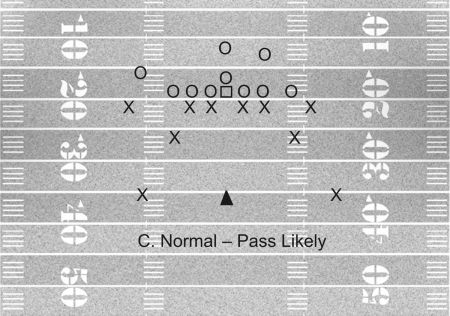
Diagram 1C
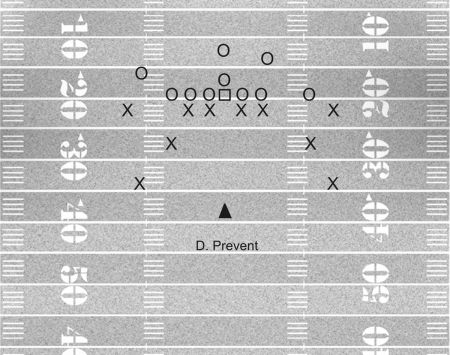
Diagram 1D
Fast forward to the modern era. If a 4-3 defense is used, won’t the middle linebacker get in the monster’s way? If a 3-4 is used, the nose guard certainly will. When a pass is anticipated, he fits in better and becomes a free safety. If a coach drops off a linebacker in an obvious pass situation, the middle monster becomes a nickel back.
Diagrams 2A through 2-D and 3A through 3D show a theoretical monster in a 4-3 and 3-4 defense, respectively. Diagrams 4A through 4B shows him in a nickel back role in three different defenses. In the 4-3 defense, the normal middle linebacker moves over so he and the monster man align head up with opposing guards. Of course this positioning is all theoretical, as finding a conventional monster defense adapted to the 4-3 and 3-4 defensive alignments are rare, let alone the middle monster concept itself.
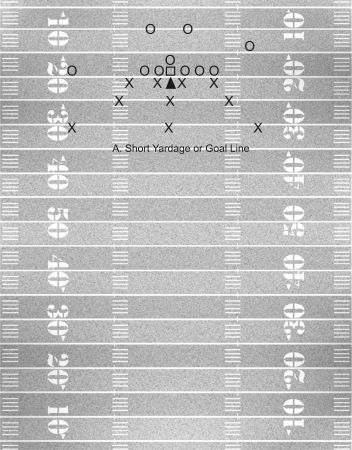
Diagram 2A
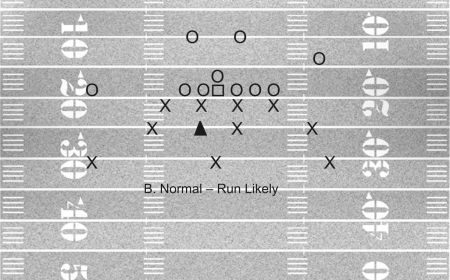
Diagram 2B
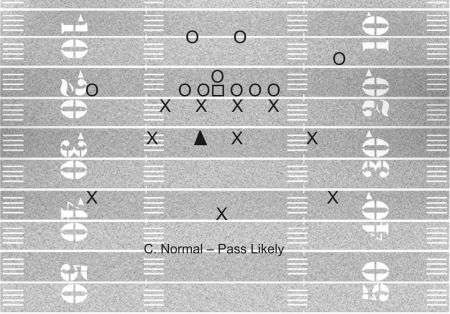
Diagram 2C
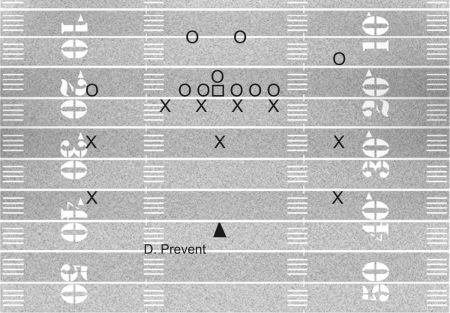
Diagram 2D
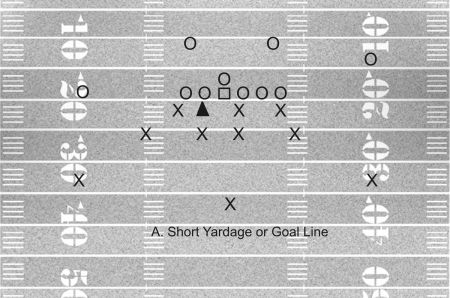
Diagram 3A
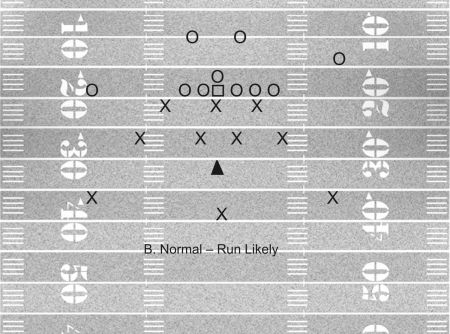
Diagram 3B
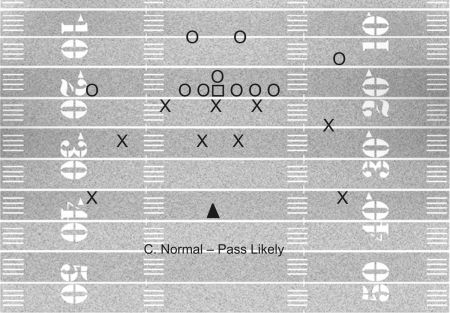
Diagram 3C
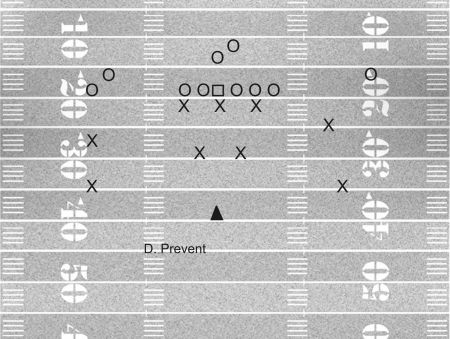
Diagram 4D
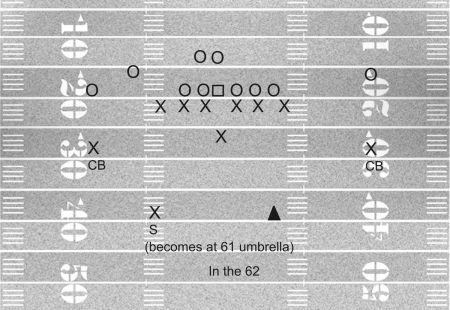
Diagram 4A
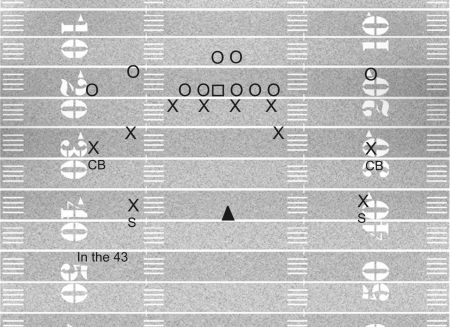
Diagram 4B
A major stumbling block to employing a middle monster defense in today’s game is the fact that many teams don’t have an individual capable of playing both the defensive line and defensive backfield roles effectively. This reality is balanced against the fact that many high school coaches, especially in smaller schools, often are confronted with a talent pool where aptitude for various positions isn’t clearly obvious. This may be compounded by the fact that sometimes there may be a few players big enough to handle the role of the defensive linemen.
A middle monster concept may allow a coach to get a maximum defensive contribution from a defensive back who is ‘big enough’ to help out in the line or from a defensive lineman ‘fast enough’ to assume backfield responsibilities. At least it’s worth a thought.
About the author:
Glenn Dahlem coached football and track at Marshall High School (WI). He also served as a scout for various high schools and colleges and is now retired and living in Hawaii.