Over the years our defensive staff has successfully identified areas our defense needed to improve on. After identifying these weaknesses we have the ability to think of some innovative drills to help our players improve in the specified areas. This past season we identified that while getting into their zone pass drops, our linebackers and defensive backs were not reading the backfield action and the quarterback.
In order to improve in this area we came up with our ‘Color Drill.’ In this drill we have a coach stand directly behind the quarterback as he gets into his drop (whether it is a straight drop or a rollout). As he begins to set, the coach holds up a colored card. He holds it directly above the quarterback’s helmet until he releases the ball. At the conclusion of the play the coaches will ask a specific defensive player what color was held up. To keep the drill honest (and to keep the players from guessing) it is best to have a stack of many different colored cards, or even some cards with numbers instead of colors. This drill can be done during individual periods, 7 on 7 periods, or even team periods.
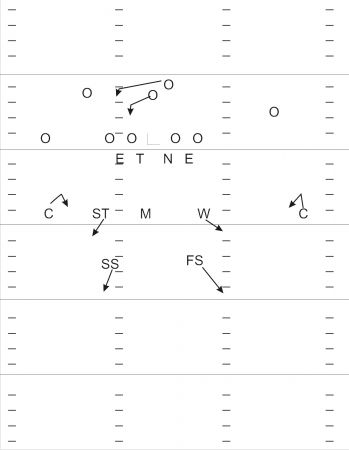
We have found that our players have gotten better at keeping their eyes in the backfield on their drops and reading the quarterback’s eyes on his throws. Also, we feel it helps them get a better idea of dropping to an area rather than finding a landmark on the field to drop to. We hope to use this drill more during our off-season days as we feel that it will be a huge benefit to our players once the season begins (See Diagrams 1 and 2 for ‘Color Drill’ with a Cover 2 and Cover 3 defense).
|
|
Diagram 1: Cover 3
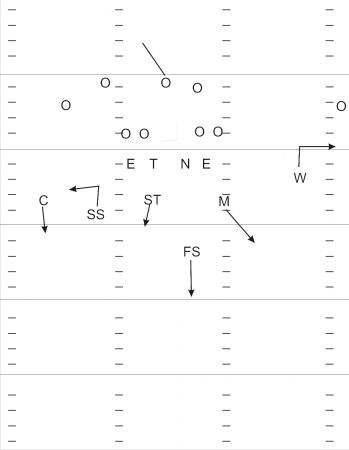
Diagram 2: Cover 2
Rob Senor is the Associate Head Coach and Defensive Backs Coach at Shaker Heights High School (OH). You can reach him at RobSenor@GridironStrategies.com.
POINT OF VIEW
The Clue Drill
Carey Baker
Assistant Head Coach and DC
University of Charleston
I love Coach Senor’s “Color Drill.” The advantage of zone defense is that everyone sees the ball thrown and you have more opportunities for interceptions and pass break-ups. Zones must be played with the eyes and zones must be adjusted based on the actions of the quarterback.
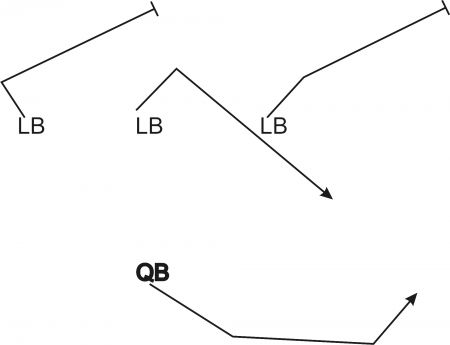
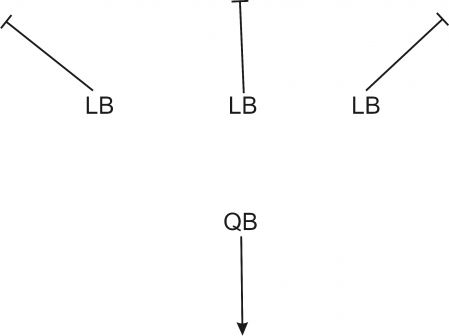
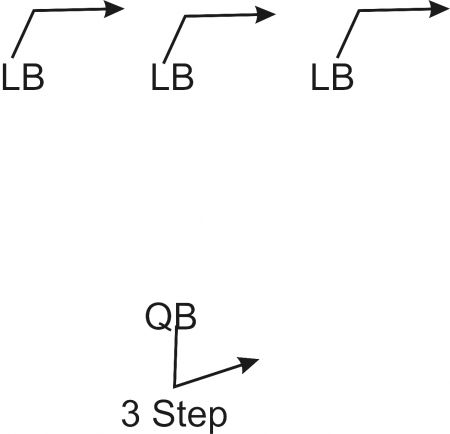
At the University of Charleston the depth and direction of linebacker drops is directly dictated by the quarterback. Their eyes must be in the backfield. We emphasize this with our “Clue Drill.” If the quarterback takes a five-step drop, the LB’s all drop to 10-12 yards deep and look to break on the ball. If the quarterback takes a three-step drop and opens his shoulders to throw a hitch or slant, all LB’s immediately stop their drop and work flat immediately to where the quarterback looks. If the quarterback rolls out the OLB’s still work for depth but “roll” their zone with the quarterback. The middle LB will come out of coverage and push to the QB’s inside hip (See Diagrams 3, 4, and 5).
By tying our drop depth to the action of the quarterback, the under-coverage must keep their eyes in the backfield to drop appropriately.
|
|
Diagram 3: 5-Step Drop
|
|
Diagram 4: 3-Step Drop
|
|
Diagram 5: Sprint Out