Our Power series can be easily incorporated into your offense. You can also run these plays from various formations but the one’s described below are the most conducive for the series.
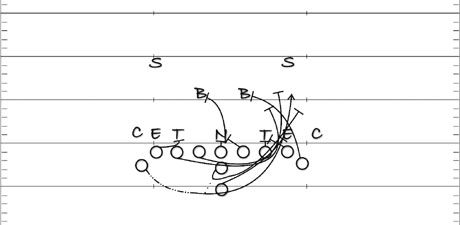
24 Power (Diagram 1)
This is play one out of the five play series that we run at Clovis East High School. Since we see a lot of 5-2 Cover 2, I am going to draw up each play against this front. The right wing blocks the play side backer. The right tight end and right tackle double team the play side tackle. The right guard and center combo the nose to the backside backer. The left guard and left tackle pull around the double team and wall off. The left tight end cuts the backside tackle. The fullback aims for the near hip of the right tackle and kicks out the defensive end. The quarterback reverse pivots without any depth and pitches the ball to the left wing. He then leads through the hole and picks up the first defender to outside on the second level. The left wing goes in motion one second before the ball is snapped (foot or cadence motion both work), catches the ball and aims for the outside hip of the double team.
|
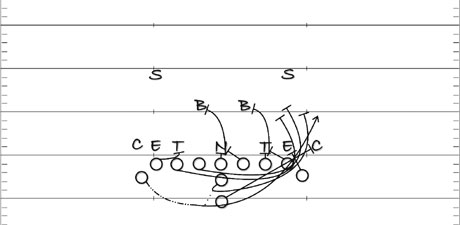
24 Power Down (Diagram 2)
When the defensive end is squeezing too hard for our fullback to kick out we like to run 24 Power Down. Most of the rules stay the same for each player except we are hitting the play one hole wider. The main change is the right wing is going to block down on the defensive end and the fullback is going to kick out the Cover 2 corner. Since the right tight end / right tackle double team is no longer the point of attack we allow them to combo to the next level.
|
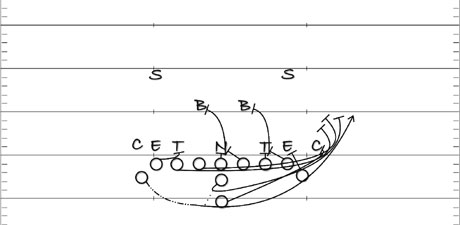
24 Power Down Log (Diagram 3)
Now when the Cover 2 corner is squeezing too hard for our fullback to kick out we like to run 24 Power Down Log. Again, most of the rules are still the same as 24 Power Down but we are going to hit it one hole wider. The main change is the fullback. He is going to log the corner with his inside shoulder instead of kicking him out with his outside shoulder.
|
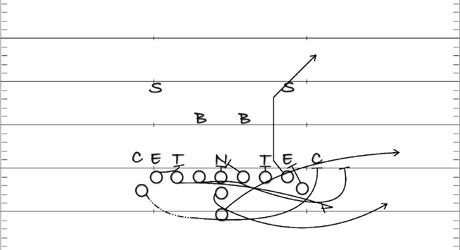
18 Power Pass (Diagram 4)
When the safety starts becoming a factor in any of these run plays and is coming up hard to stop the run, we like to call 18 Power Pass. The right tight end must come off the ball like he is blocking and not show that he is running a route until he gets to the second level. At three-four yards he straightens his path to get depth and between 8-10 yards he runs a corner route. If he is not open the fullback usually is, since his route looks exactly like the blocking angle he takes on the prior three plays. If he is covered also, the quarterback tucks the ball and runs. The key to this play is to make the defense think you are running one of the prior three plays. To do this your O-line must come off the ball exactly the same way they do on the power run plays (remember they can go down as much as two yards down field without being flagged). Your quarterback must sell the pitch and your left wing must sell the catch. Your left wing can either finish his fake until the whistle blows or become an extra blocker on the edge. Obviously, you can run several other combinations of pass patterns off this play as well.
|
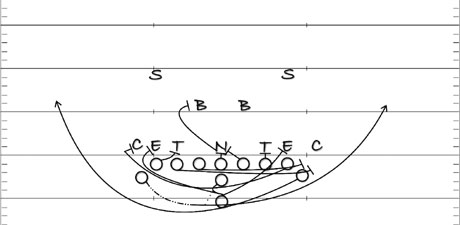
24 Power Pitch and Give (Diagram 5)
We have several counters off our three base power plays but the one I think is the most deceptive is 24 Power Pitch and Give. Again, the key is to make the play look as similar as possible to the base plays. The rules are the same for the entire offensive line except for the right tight end. He is going to pull getting three yards of depth immediately and block the first defender outside the quarterback’s block. You can also pull your right tackle and have your right tight end cut; but usually your tight ends are faster than your tackles. The fullback kicks out the defensive end just as he does on 24 Power. The QB pitches the ball to the left wing and log blocks the defensive end. This may seem hard to do but most of the time the end is squeezing so hard or trying to chase the left wing down from behind, it really becomes a simple block. The right wing takes the hand off from the left wing with his right arm up and reads the block of his pulling tight end. This play kills teams who read your pulling linemen or fullback.
|
These five plays can really do some damage to opposing defenses. No matter what the defense is doing to stop you, you have an answer. Obviously there are a lot of other plays and variations we run in addition to these five.
Tim Murphy is the Head Coach at Clovis East High School (CA) and can be reached at TimMurphy@GridironStrategies.com.
WHAT IF?
Q1. What if you’re facing an even front rather than an odd man front? Do the blocking assignments change for any of the plays you outlined?
With our rules it makes it very easy no matter what front teams come out in. As you can see we simply double-team the first man inside the tight end on 24 power series so there aren’t many changes. Since the other plays hit outside the 4-man (right tackle) we no longer need a double team so we simply down block the entire play side.
Q2. What if you’re in a situation where the two linebackers (in the 5-2) blitz on your running plays? What adjustments do you make?
Part of the beauty of this offense with its tight splits and multiple pullers is teams that blitz us usually end up hurting themselves with no adjustments needed. If the backers are not getting caught up in the tight splits or picked up by the pullers, we simply make a “down call.” That just means we abandon double teams and down block everything. This enables every gap and every defender to be accounted for.
Q3. If there is a safety blitz on 18 Power Pass, does that affect your routes of play selection?
We have had two safety blitzes in 5 years against our Power Pass. Both have gone for touchdowns. As you can see we have an extra blocker on the edge in which the quarterback in rolling out is very simple to pick up. As far as route adjustment we tell all our receivers that if you are running a route to a zone that is vacated by a blitz, look to the quarterback as soon as you break to that zone. In this case the tight end will look over his right shoulder the second he breaks for the corner.
Conclusion: The reason we feel our offense is so productive is the system enables our players to adjust to anything the defense throws their way. When your players have this type of confidence they can play highly aggressive and continue to attack the defense no matter what the situation.