This defense gives you more time to stem during pre-snap and makes blitzing more effective.
Recently, many high schools have relied heavily on a 5-3-3 style defense. The theory behind this defense was to crowd the line of scrimmage to help stop the offensive running game since most high school teams relied on their run game for the majority of their yardage. This was a great strategy when high school football was focused on power-style play. Now, many high school athletes are training in more areas then just weight training because more kids participate in two, three and even four different sports. These multi-sport athletes train in different ways to cater to the needs of each sport. This is causing those athletes to become a more rounded football player. They are mobile, strong and fast. 5-3-3 defenses are becoming helpless against this new breed of athlete, because eight players are tight on the line of scrimmage and get trapped in the box when a ball carrier breaks containment. For this reason, I am proposing a switch to the 4-4-3 defense.
The X’s and O’s of the 4-4 Defense
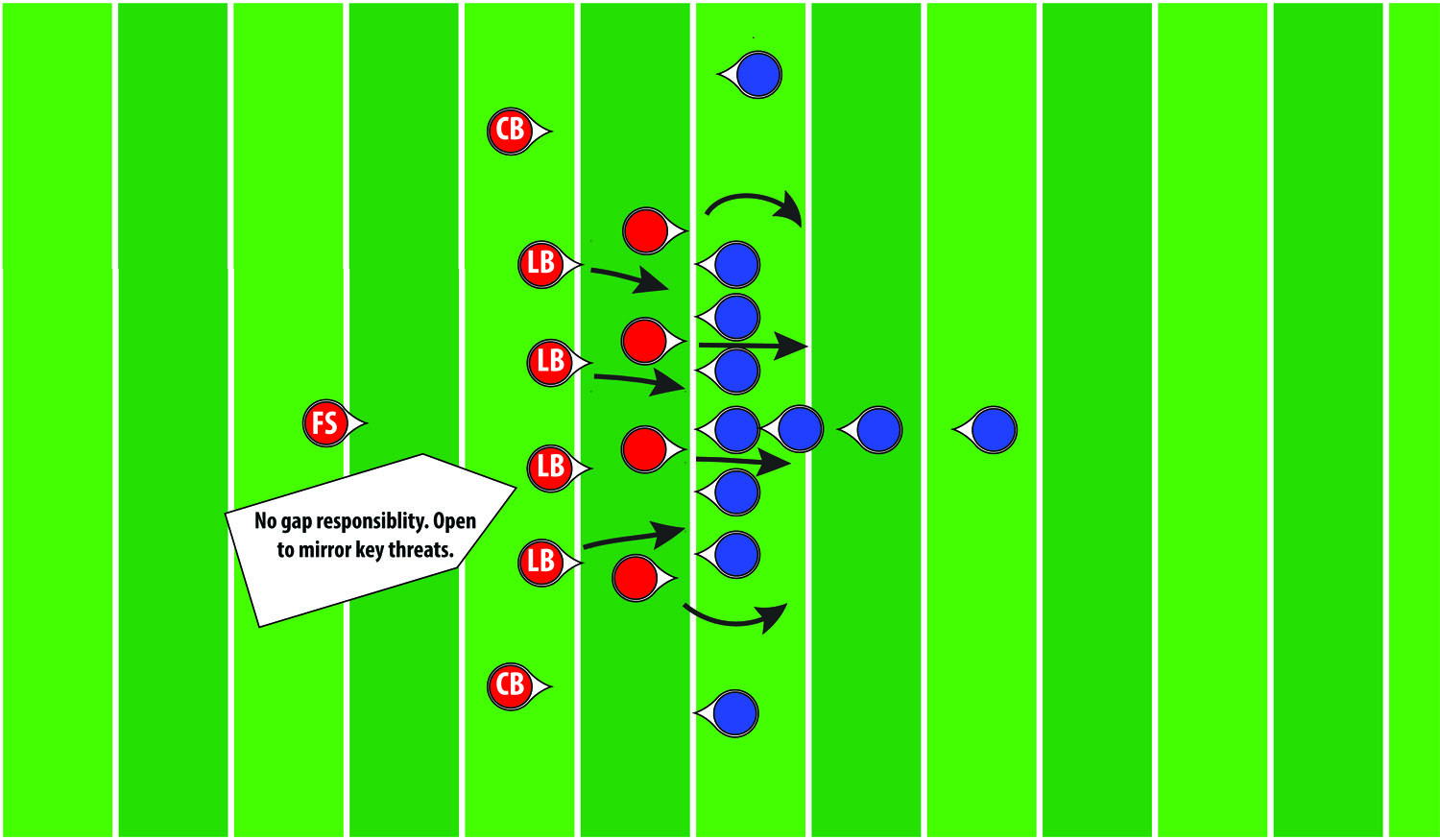
The 4-4 defense is a higher energy defense when compared to the 5-3. This was a good way to make sure you have one linebacker with no gap responsibility. However, you needed to put five players on the line of scrimmage that are head-to-head with offensive linemen. The issue with this is, believe it or not, an offensive lineman is taught to hold. A good offensive lineman is a big powerful athlete with vice grips for hands. So, if a defensive lineman gets caught up with one, they are less able to put themselves in a position to make a play. If you take one of those defensive linemen and back them up 5-6 yards as a linebacker, you’re giving that player that much more time to read and react to the offense without having to overcome an offensive lineman. Plus, you will still have a linebacker with no gap responsibility available to mirror the key offensive threats.
Look at the physical and mental ability of a high school athlete. These athletes are much less capable of making a tackle when the ball carrier has a five or more yards of a running start against a stationary defender. With the 4-4, you now have four vs. three of your best tacklers not only space and time to read and react to a play, but physically they have more momentum to fill a running lane. Remember, defense is a mental battle as well. An offense doesn’t want to get beat up physically. If your linebackers are continuously laying bigger hits on a running back, due to that extra momentum, he is more likely to check out mentally.
Expanding on mental capability, high school athletes do not yet have the experience to effectively communicate with one another as well as college and professional athletes. In the 4-4, a defense has more room to move, or “stem”, during the offensive cadence. This stemming causes major confusion to an inexperienced offense. This makes blitzing more effective and overall penetration more effective. Since you still have a linebacker with no real gap responsibility, you can afford to have a player caught out of position while stemming or blitzing. Stemming also makes blitzing much more effective. The confusion that movement will cause will open gaps and will cause offensive linemen to play a guessing game with which defender will attack which gap (See Diagram).
Challenges with the 4-4 Defense
The issues that arise while using the 4-4 at the high energy pace mentioned are with conditioning and communication. These are two of the most important elements that are a factor in any style of play.
As a coach, I am constantly exercising my player’s communication skills. In every drill, my players are being vocal. In any high energy defense, your players need to communicate what their responsibility is in response to the offense. For example, with a heavy blitz game, players will come across situations where that blitz has to be called off based on how the offense is aligned. When a blitz is called off, that player needs to know where, what and who is their new responsibility, which in turn, will alter the rest of the defenders’ responsibilities. I put this job on both my free safety and my most knowledgeable linebacker’s shoulders. Your FS needs to be much like a quarterback to the defense. Not only does he need to know his responsibilities but the responsibilities of every other player on the defense. The LB will need to manage the other LB’s as well as the defensive line. That LB will need to know the ins and outs of every blitz and gap responsibility. This will give him the ability to call off blitzes and adjust defenders accordingly. But, challenge all your players to know their responsibilities cold.
Conditioning is a major factor in any situation as well. It’s the foundation to all of a player’s abilities. If that player is winded, he will start to sacrifice all of his fundamentals. I come from a small high school where we played seven guys on both sides of the ball. Some, including myself, were on every special teams unit as well. To ask a player to go 100% every play and never come off the field is very demanding. However, in some cases, it can’t be avoided due to program numbers. This is why it is so important to monitor your players in the off-season. High school players like to believe that they don’t have to worry about conditioning until the season starts. It’s your job as a coach to change that thought process. Conditioning is just as important as weight training. I know with high school coaching restrictions in the off-season, it makes it difficult to legally control what your players are doing to condition. Having a dedicated strength and conditioning coach is a great way to maintain contact with your players year-round.
Addressing 4-4 Issues
For communication:
Demand players communicate during every single drill. It doesn’t matter what they are communicating. It’s the fact that they are communicating something that will condition them to do so when it really matters. For example, enforce “run/pass/ball/bingo” calls. This simply means players will be instructed to call out “pass” when they read a pass play from their key reads. Then “ball” calls when the ball is thrown and “bingo,” or any other call you’d like to use when the ball is intercepted. When the run is read, your players will make a “run” call. Again, incorporate this communication in every drill.
For Conditioning/Off-Season Training
First, install the mentality that there is no off-season. The “off-season” is an opportunity to better yourself for the upcoming season. The harder your players work now, the easier the work will be later. You might be thinking, “You said most high school athletes play different sports in the football off-season.” Yes I did. However, too many of these athletes use those sports as an excuse to skip out of training.
To address this issue, I make a mandatory schedule, which I call the “Bible”. Obviously, I won’t be able to work with the players every single day, so this Bible will do my work during my absence. It will contain a weight training routine, conditioning routine and drill routine. High school is a good age to create a nutritional plan because of the high metabolism and growth of teens. This is why I stress a high protein and carbohydrate diet with water as their main fluid, not sports drinks and definitely not soda. The protein and carbs will aid the athlete’s body in growing while being physically demanding. Sugar needs to be kept to an absolute minimum. Because of the high rate of growth athletes go through from their freshman year to their senior year, it is important for them to be active.
About the Author: Ray Diven has coached at both the youth and high school level. A Wisconsin native, he played for four years as an ILB at Lakeland College (WI). During his career at Lakeland, the team won two conference championships.