Proper tackling can be taught through four simple phases.
Teaching proper tackling technique is more important today than in recent years, especially with all the attention and focus on player safety and reducing head injuries. We teach an A-B-C-D progression tackling drill that not only breaks tackling down into phases but also focuses on using proper technique and can be used at any level. The drill is done within 10-yards, which minimizes contact and has a low risk of players getting hurt or injured. I have used this drill at the high school level, for both incoming freshman that have never played football and with varsity players, and the results have been phenomenal.
Phase A
This first phase may seem a little silly for some coaches but I think it is important especially in terms of eliminating any fear associated with tackling and helping kids become more confident. This phase involves the ball carriers running over the tacklers. The drill starts with the players paired with a partner (one being the designated tackler and the other being the ball carrier). All of the tacklers will line up across from their partners and assume an athletic tackling position (knees bent, chest over knees, head up). The tacklers will place their hands right under the thighs or where their thighs meet their buttocks and hold that position.
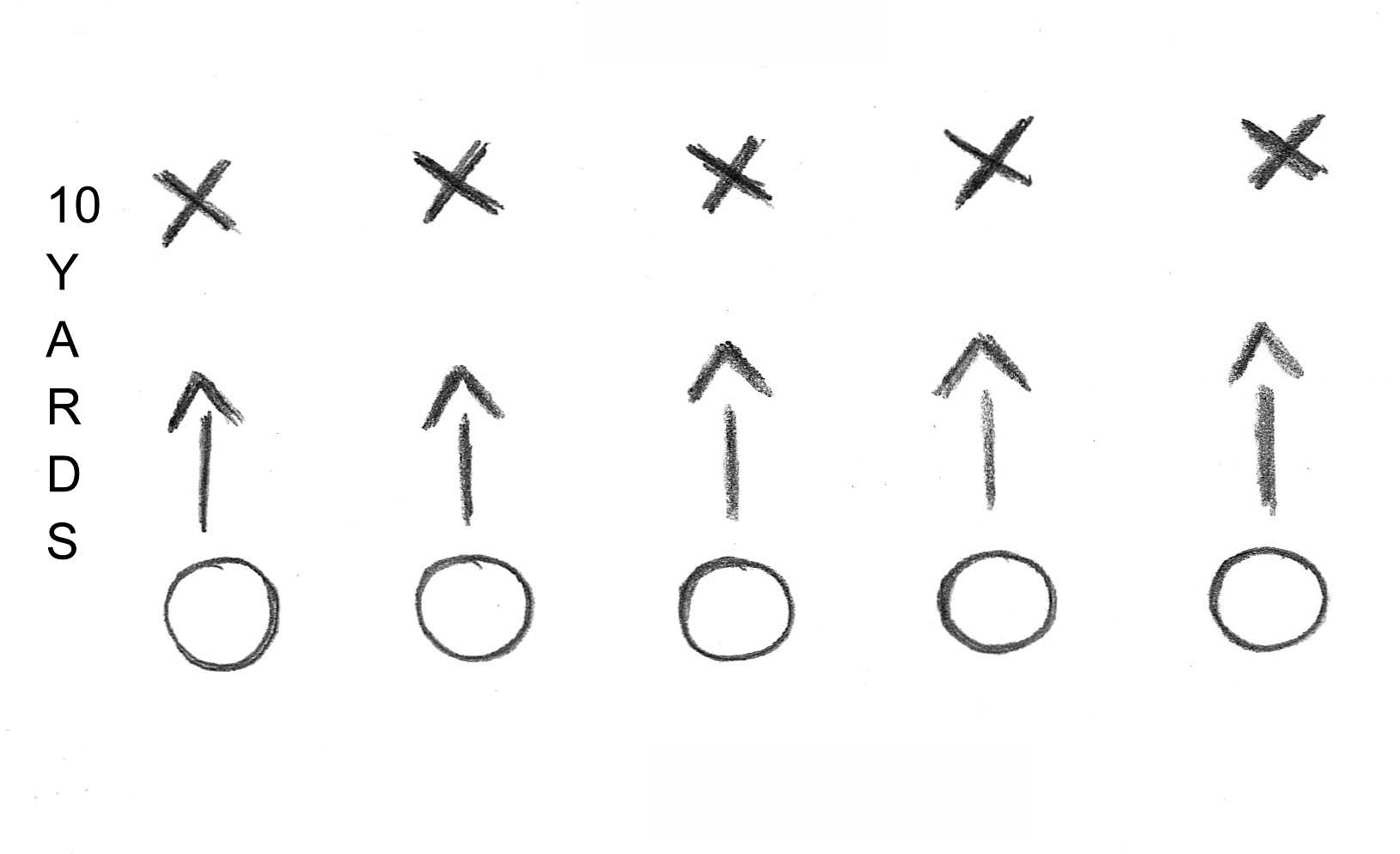
Diagram 1.
On the coach’s command, the ball carriers will run full speed at the tacklers and RUN them over (Diagram 1). It is important to explain this to both tacklers and ball carriers because they will not understand it at first. I do this because many players are afraid to tackle and they are afraid of being run over and being embarrassed. For me, this first step shows them what it feels like to be run over and addresses that fear right away which helps them to move forward and learn how to tackle.
Phase B
Now that some of the fear with tackling has been addressed, we can now move into the actual tackle. This phase focuses on teaching how to explode into the tackle. The drill starts the same as the first phase with partners ten yards apart. The tacklers are in their athletic and tackling position with their hands under their thighs (Diagram 2). On the coach’s command, the ball carriers will run at the tacklers. As the ball carrier approaches, the tacklers will use their hands to roll their hips and pull themselves up and through the ball carrier, exploding off the ground on contact.
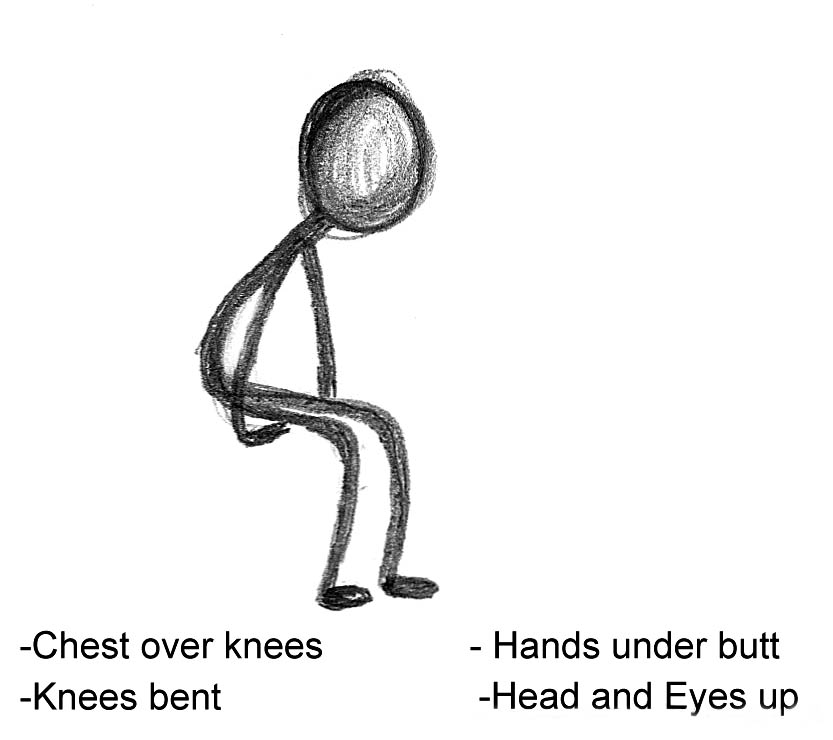
Diagram 2.
It is important that the tacklers really use their hands to thrust themselves and roll their hips into the ball carriers. It is also important, at the same time, that they explode into the ball carriers. They should shoot their heads back and get their eyes to the sky. Contact with the ball carriers should not be made with the helmet but with the hips and shoulder pads. You can stay in this phase for as long as needed until the players really understand the concept of rolling their hips and exploding up and through the ball carrier.
Phase C
This phase is going to combine exploding into the ball carriers and wrapping them up. The drill starts the same as the first two phases. Players are 10 yards apart and with tacklers in an athletic or tackling position. This time they do not have to have their hands under their buttocks but have their hands relaxed or wherever they want them. On the coach’s command, the ball carriers will approach the tacklers and the tacklers will utilize the skill from phase 2 (exploding, rolling the hips, shooting head back, and eyes to the sky) while also wrapping the ball carriers up, grabbing cloth, and securing the tackle. This phase is the same as the second phase with the only difference is that now tacklers are actually shooting their hands and wrapping up the ball carriers.
Phase D
This phase puts it all together. The drill starts off the same as the other phases. In this phase, the tacklers will approach to meet the ball carriers halfway on the coach’s command. In the previous phases, the ball carriers were the only players running forward while the tacklers just stood there and waited for them. However, in this phase, the tacklers go to meet the ball carriers halfway and make contact while on the move (Diagram 3). It is important that the tacklers use the skills learned in the previous phases (rolling the hips, exploding through the ball carrier, and wrapping up).
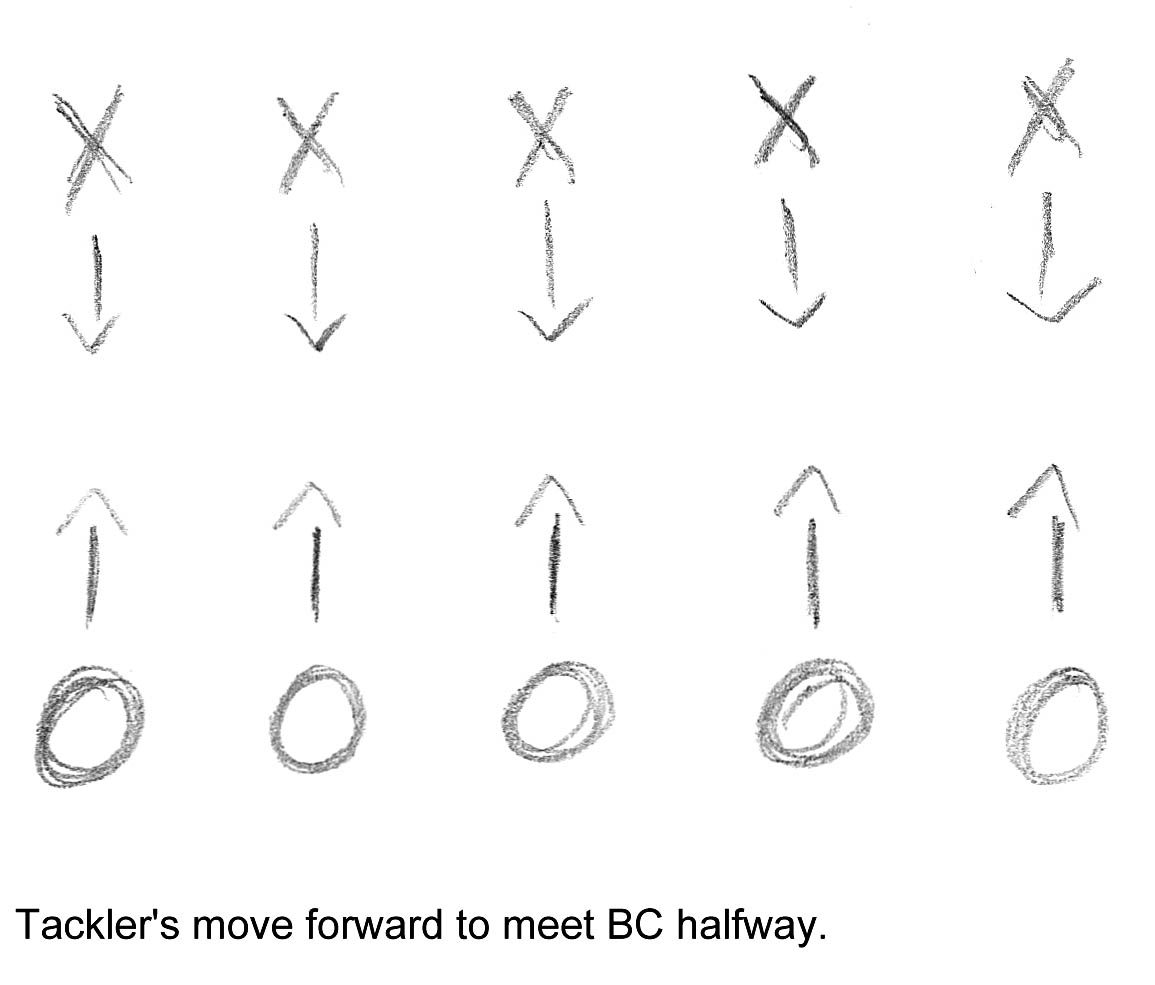
Diagram 3.
In this phase they will now drive the ball carrier back five yards or until the coach’s whistle. This progression drill can be slowed down or tweaked to your liking. It is a drill I like to run a lot and at full speed once the players understand the concept. Once they understand it, two reps at each phase is all I use.
About the Author: Brandon Payne is currently the defensive backs coach at Clairemont High School (CA). He attended Ohio State from 2005-2009 and will be receiving a degree in Sports Psychology this year from National University in California. Payne has coached youth and high school football as well as high school track and field.