Watching film of previous defensive struggles may be frustrating, but fixing some of those problems might not be as difficult as you think. Many times, it may be as easy as building confidence in your defensive personnel. Tackling techniques could be an easy answer. The following drills help to greatly increase your teams tackling, and therefore, individual personal confidence.
In the last few years, we have incorporated these tackling technique drills into our practices twice a week, every week. The team is divided into four groups of about eight in each group. With the head coach’s whistle, round one begins. After about 1-2 minutes, depending on the size of each group, players rotate to the next tackling station on the field. These drills are all based on techniques of safe, proper tackling progressions.
Kick Off Drill
This is a new one I developed when our kick off coverage was struggling. Basically, all takes place between five yards of the field.
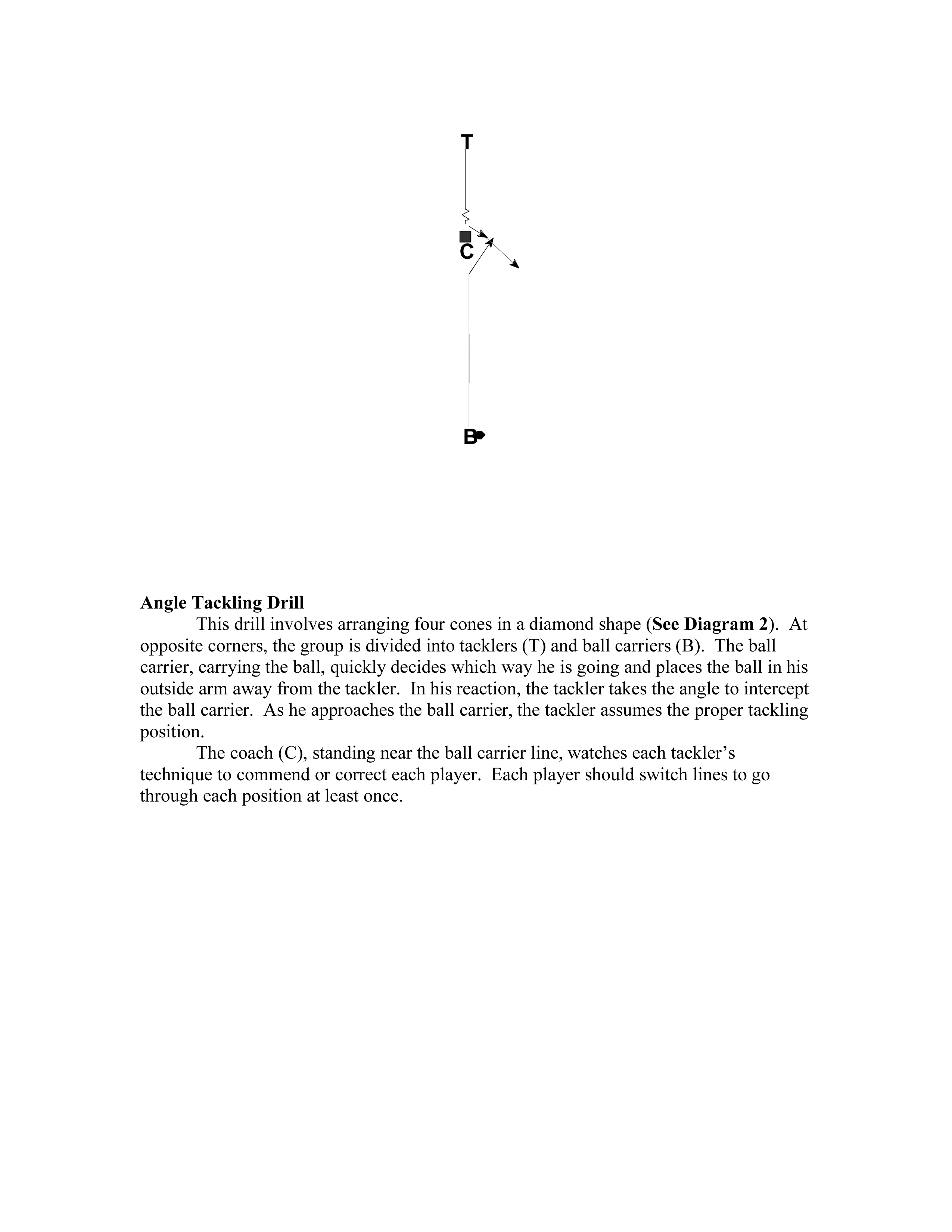
Diagram 1 shows how this drill runs across the field. Players are divided into two groups, the tacklers and the ball carriers. The coach is more involved in this drill because he is on a knee holding the blocking shield at the middle of the drill, between the tackler and ball carrier. Each player starts at a predetermined spot. The ball carrier starts running across the field toward the coach’s back. The tackler reacts and starts running to the coach holding the shield. As the tackler approaches the shield, he breaks down into a good football position eyeing the ball carrier.
The coach holds the shield out at the tackler. As the ball carrier cuts either right or left off the coach’s back, the tackler, using his hands to deflect the shield and moves to attack the ball carrier using proper tackling technique, keeping his feet moving and wrapping the ball carrier. The players then switch roles in the drill.
Angle Tackling Drill
This drill involves arranging four cones in a diamond shape (See Diagram 2).
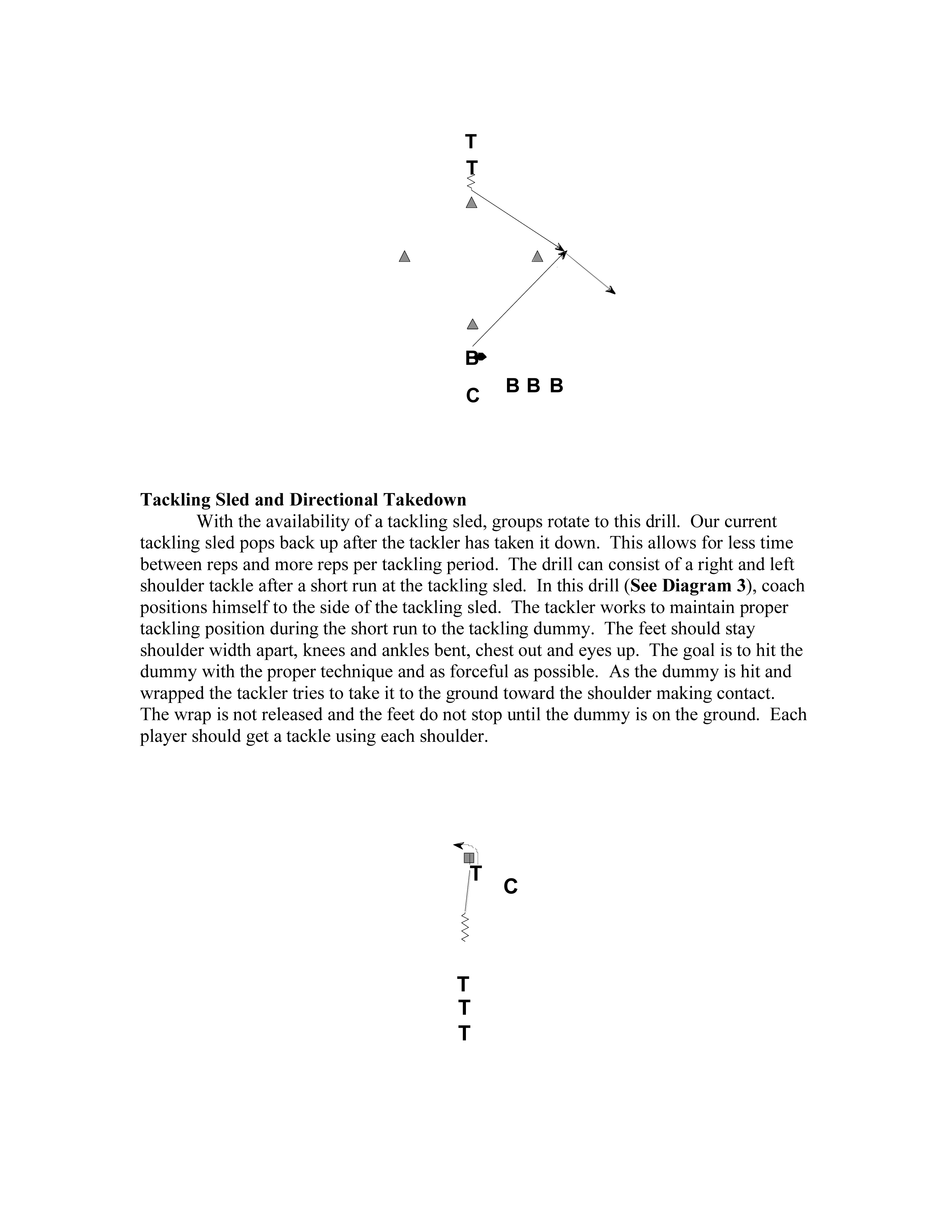
At opposite corners, the group is divided into tacklers (T) and ball carriers (B). The ball carrier, carrying the ball, quickly decides which way he is going and places the ball in his outside arm away from the tackler. In his reaction, the tackler takes the angle to intercept the ball carrier. As he approaches the ball carrier, the tackler assumes the proper tackling position.
The coach (C), standing near the ball carrier line, watches each tackler’s technique to commend or correct each player. Each player should switch lines to go through each position at least once.
Tackling Sled and Directional Takedown
With the availability of a tackling sled, groups rotate to this drill. Our current tackling sled pops back up after the tackler has taken it down. This allows for less time between reps and more reps per tackling period. The drill can consist of a right and left shoulder tackle after a short run at the tackling sled.
In this drill (See Diagram 3), coach positions himself to the side of the tackling sled. The tackler works to maintain proper tackling position during the short run to the tackling dummy. The feet should stay shoulder width apart, knees and ankles bent, chest out and eyes up. The goal is to hit the dummy with the proper technique and as forceful as possible. As the dummy is hit and wrapped the tackler tries to take it to the ground toward the shoulder making contact. The wrap is not released and the feet do not stop until the dummy is on the ground. Each player should get a tackle using each shoulder.
Mirror Tackling
This drill involves using six cones or agility pads spaced a couple feet apart (See Diagram 4).
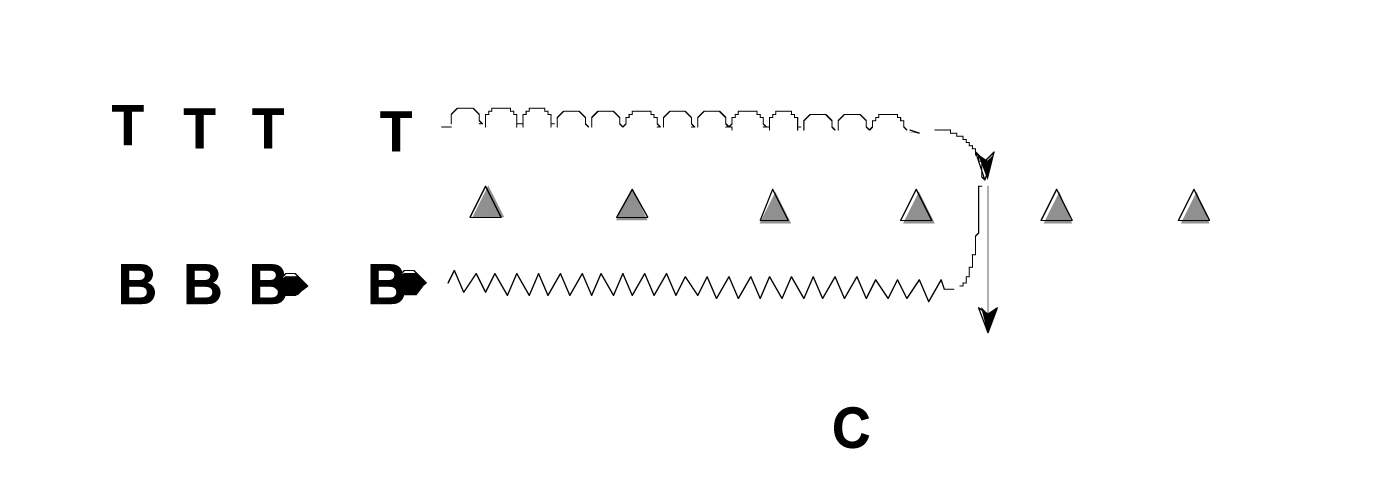
Divide the group that rotates to this station into two smaller groups, ball carriers and the tacklers. The ball carrier should hold a football in his outside arm away from the tackler. The tackler line is on their end of the dummy, and the ball carrier is on their end of the dummy. The coach stands at the end of the dummies behind the path of the ball carrier. The ball carrier faces down the line of dummies while the tackler is in a low football position facing the ball carrier. The ball carrier starts jogging down the line of dummies and cuts up into an alley between the dummies, squaring himself up field. At the same time, the tackler shuffles with the ball carrier, mirroring him, keeping his eyes on the body. As the ball carrier turns up field the tackler attacks the ball carrier with proper tackling technique. The tackler should keep the hips low, feet wide, chest and eyes up. The tackler needs to fill the alley and continue running his feet after the wrap on the ball carrier, putting him back where he came from, but we never try to take anyone to the ground during a drill. Each player in line performs the same sequence. After each player goes one direction on the dummies, we switch ends, keeping the same roles, just coming back the opposite way.
If there is enough time, switch the lines, so the players get a chance to be in the other role. Yet another adaptation to this drill comes on our second day of tackling drills. Put the ball carrier line back a couple yards and in the middle of the line of dummies. The tackler line mirrors the ball carrier line on the opposite side of the dummies, in the middle, back a few yards. The ball carrier approaches the alley he is going to run through, and squares up field. The tackler, from the opposite side, mirrors and attacks the same alley and performs the techniques as described above.
Sideline Tackling
This drill uses the 12th defender, the sideline. In this drill, place two cones five yards apart along the sideline (See Diagram 5).
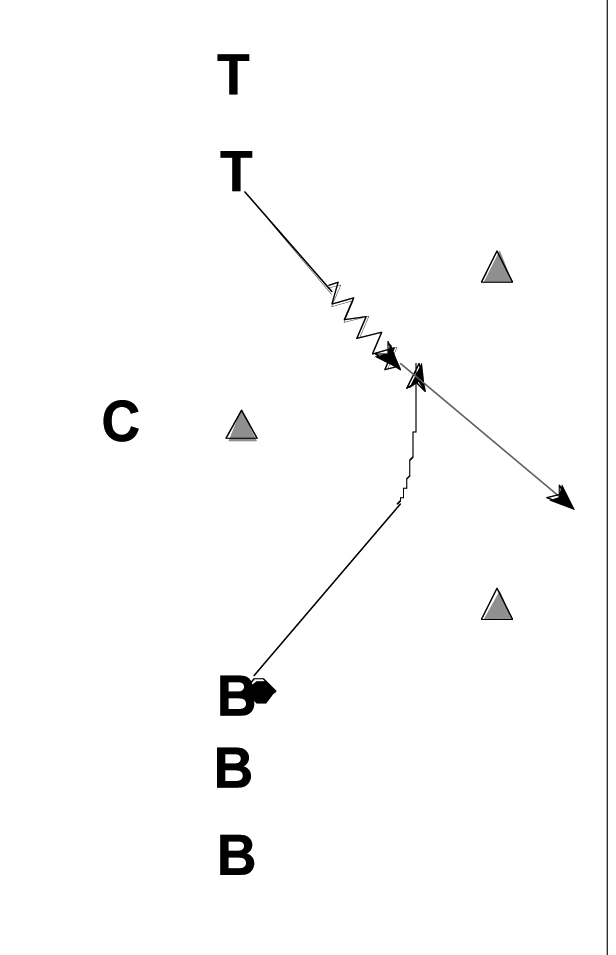
A third cone is about five yards away from the sideline. The coach stands here in order to commend or correct each player. The players at the station are separated into ball carriers and tacklers. The ball carrier runs toward the sideline between the coach’s cone and the near cone on the sideline. At the same time, the tackler runs toward the ball carrier between the coach’s cone and his near sideline cone. In practice, each player must stay within the cones. The tackler should keep his focus on the ball carrier’s field hip and shoulder, to keep him squeezed to the sideline and not to let him escape back to the field. As the ball carrier turns up field along the sideline the tackler begins to break down into a proper tackling position. The tackler wraps up the ball carrier for the tackle, or drives him out of bounds. This should be drilled from both directions. u
Proper tackling position reminders:
1. Eyes on the ball.
2. Feet are shoulder width apart.
3. Angles in the knees and ankles.
4. Chest out with arms ready to wrap around the ball carrier.
5. Feet continue to run through the ball carrier.
About the Author:
Cary Harger began coaching at Oakridge High School in 1995. Since that time as an assistant coach, Cary’s record is 139-26. In 1994, he volunteered as a varsity assistant coach for Grand Haven High School (a 5-4 record) while doing his student teaching. He currently serves as the offensive and defensive line coach and Special Teams coordinator. Previously, Cary was a four year varsity letter winner for Hope College (1990-93) playing guard and center.