OUR TEAM STRESSES fundamentals above all else. We believe that the success of our defense hinges on the performance of three critical fundamentals.
Our players know that they must demonstrate relentless defensive pursuit, an exceptional ability to defeat and shed blocks and — more than anything else — great tackling skills.
Our team begins every practice with a pursuit drill, which is immediately followed by by a fast-paced circuit of tackling drills.
The tackling circuit has several benefits toward building a solid defense.
1. It maintains the up-tempo atmosphere and high level of intensity established during the pursuit drill.
2. It guarantees that all of the players get quality repetitions of tackling within a short period of time.
3. It allows all of our defensive coaches to efficiently and thoroughly coach all of our players.
This last point is especially important. The more that all of the coaches on a staff know the abilities and skill levels of all the players, the more they can collaborate on ideas and perhaps suggest a personnel move. Our team has found many wonderful ideas from coaches who weren’t directly involved in their own idea (such as a defensive line coach suggesting that a second-string cornerback who is hitting hard in tackling drills should be moved to safety).
While we occasionally change the drills used during the circuit, this article describes the four most common stations we use.
One of the biggest keys toward getting the most out of the circuit is to make sure that the drill is organized for maximum repetitions. Developing an efficient way of conducting practices is critically important.
Angle Tackle
The first drill we introduce in the tackling circuit is called the angle tackling drill. This drill can be an excellent drill to start with after proper form tackling has been learned.
This drill does not, however, combine some of the distractions of other drills such as coming off a block, shuffling around bags, etc. Rather, it introduces the concept of tackling — with leverage — on the ball carrier.
DIAGRAM 1: Angle-Tackling Drill.
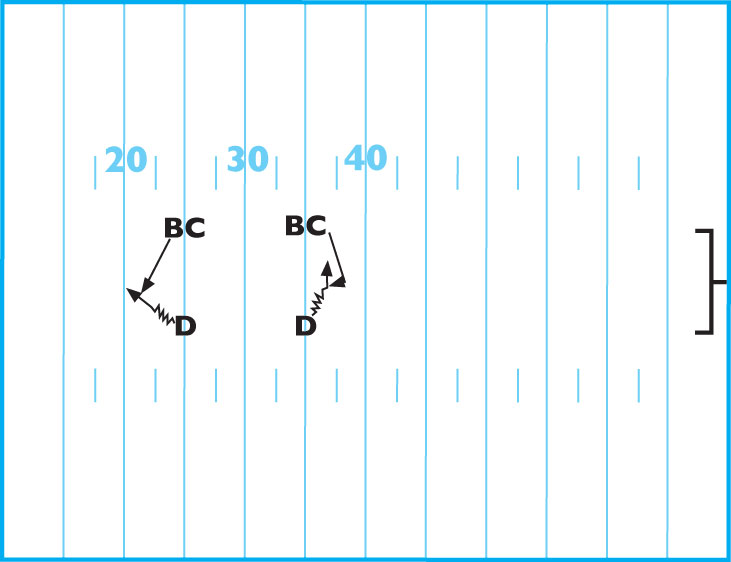
The procedure for this drill is as follows:
- Two defenders line up 5 yards apart from two ball carriers.
- The defenders have their backs to the sideline and must be straddling the same yard line as the ball carrier they’re facing.
- On the coach’s command, both ball carriers break on a 45-degree angle toward the next yard line.
- The defenders must shuffle and stay behind the ball carriers.
- The defenders must remember that their first job is to deny the cut back (we allow our runners to cut back anytime they feel they can get across the defender).
- If the runner cuts back, the defender must attack straight ahead and make the tackle.
- If the runner does not cut back, at the last second, the defender must get his head across the ball carrier and make an angle tackle.
Eye Opener
The next drill we show our players is the eye-opener drill. Most coaches are familiar with this drill. However, we organize and modify this drill to specifically tailor it to the tackling circuit. Like all the drills in this tackling circuit, we’ll have two groups of players going in two directions at once
(see Diagram 2).
DIAGRAM 2: Eye-Opener Drill.
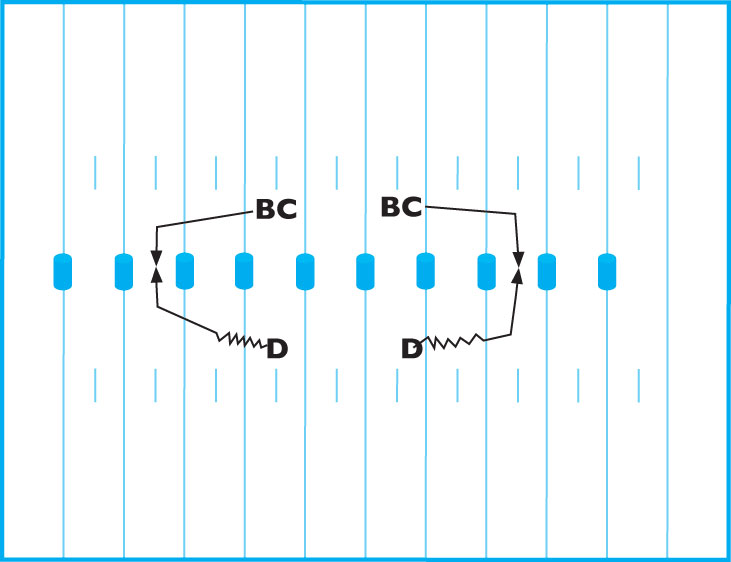
The procedure for this drill is as follows:
- One defender stands in front of an agility bag with three more bags to his right, while the other defender stands in front of an agility bag with three more bags to his left.
- Each defender has a ball carrier facing him on the opposite side of the bag.
- On the coach’s command the runners run between any two bags on his side of the drill.
- The defenders must shuffle, maintain a proper base, square the shoulders and then tackle the runner in the hole.
Shed and Tackle
This is one of our favorite drills because it involves work on shedding a block, as well as tackling fundamentals. This drill has some similarities to the angle-tackling drill, but with two critical differences.
1. Players must shed a block before pursuing the ball carrier.
2. Players don’t know which direction the ball carrier will start toward.
Also, just as in the angle-tackling drill, the defenders align with their backs to the sideline, straddling a yard line (see Diagram 3).
DIAGRAM 3: Shed-And-Tackle Drill. The procedure for this drill is as follows:
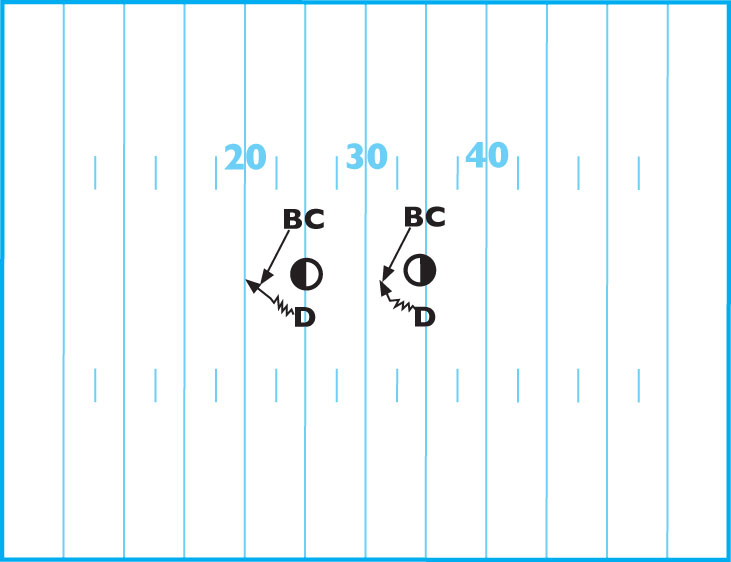
- Two defenders get into a lock-up position on two blockers.
- The defender to the right shades the right side of the blocker and the defender to the left side shades the left side of his blocker.
- A ball carrier is positioned about 5 yards behind each blocker.
- The coach stands behind the defenders and signals to the ball carriers which direction to break.
- On the coach’s command, the two ball carriers break toward the signaled direction, staying within the next yard line.
- The defenders release from their blocks and make the tackle.
Fumble Recovery
Our coaching staff always includes at least one fumble-recovery station into the circuit during every tackling circuit series. While there are many ways to do this and a variety of popular fumble-recovery drills, one of our favorites is the “Scoop-And-Score Drill” (see Diagram 4).
DIAGRAM 4: Scoop-And-Score Drill. The procedure for this drill is as follows:
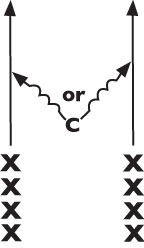
- A coach stands in the middle of two lines of players.
- The coach has a football in each hand and, on his decision, rolls the two balls out in front of each line of players.
- The first two players in each line sprint hard after the ball, battling with one another to scoop it off the ground and run 5 yards downfield.
It’s important for the tempo of the drill that the coach has at least four footballs located close by him at all times. This enables him to quickly roll the next two balls out while the first two players are bringing theirs back to the coach. It must also be stressed to the players that, if they don’t field the ball cleanly immediately, they must dive to cover the ball, drop into fetal position and protect the ball.
Keep The Circuit Fast Paced
To keep the circuit moving as fast as possible, we have made several adjustments over the years to maximize the repetitions the players receive. First, we keep the stations as close together as we can, while maintaining the safety of our players. Before we made this a priority, some coaches had certain spots that they felt comfortable with (often it was the same location as they used during practice for individual periods) and the stations were getting so far apart that we’d lose time as the players ran from station to station.
Direction Of The Circuit Rotation
Another thing we’ve done with our tackling circuit to improve the tempo of the drill is to have the players rotate through the drill on their own. Rather than blowing a whistle to have the groups of players rotate, each player rotates after he finishes his rep at the last station. Having two lines at every station can make this a little confusing at first, so we walk the players through this during a no-pads session and hold an on-the-field meeting before we do the circuit live.
The first thing everyone must understand is the direction of the rotation.
Let’s say that the drill is set up so that a given player performs an angle tackle to his right, then to his left and then moves on to the eye-opener drill (see Diagram 5).
DIAGRAM 5: Proper Rotation For The Circuit Drill.
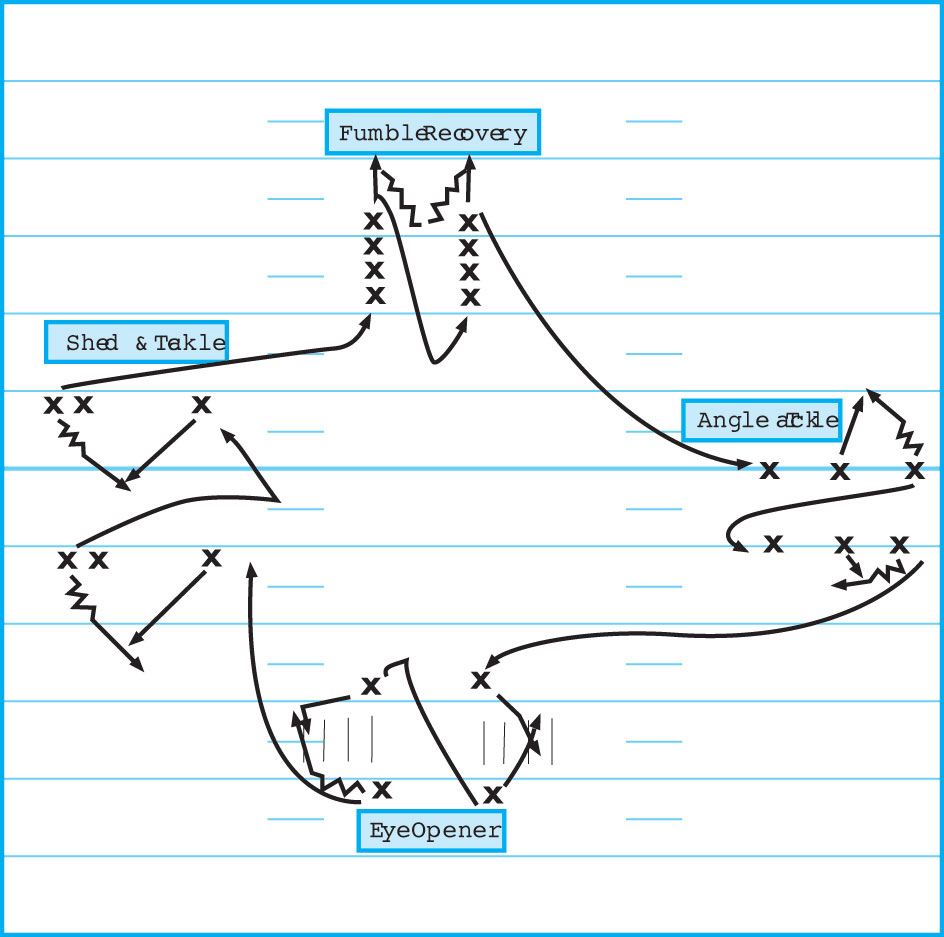
The described rotation probably sounds simple enough, but what about the player who starts off performing an angle tackle to his left? We’ve found that this player must simply move on to the eye-opener drill and he will perform the angle tackle to the right at the end of the circuit.
It should also be noted that the ball carriers are actually just defenders waiting their turn. So, after a player performs and angle tackle to his right, he gets in line to be a ball carrier for the angle tackle to the left. Then, after he has his turn as ball carrier, he tosses the ball to the next person in line and then performs an angle tackle to the left. Then he will get in line to be a ball carrier at the eye opener station and so on.
Circuit Drills Provide Help
These are some of our drills and the arrangements we’ve made to improve our team’s tackling skills. While we certainly don’t claim to have all the answers, we’ve found that since we’ve implemented these drills and principles into a circuit format, it has helped our overall team defense improve dramatically.
E-mail coach John Shea at: coachshea@aol.com with any comments or questions regarding the tackling circuit drills.