DEFENSIVE COORDINATORS are become more creative at disguising their perimeter coverages. Young quarterbacks are increasingly under the gun to recognize various coverage schemes and make good decisions with the football. It is asking a lot of a young QB to look consistently at 11 defenders and quickly diagnose what the defensive coordinator has planned for that snap.
One of the best ways to simplify the QB’s job is to design route combinations that attack a single defender or a single area on the field at the linebacker level.
Rather than giving the QB an entire field to survey, we isolate a defender on certain plays and try to out-leverage one aspect of the defensive coverage. Attacking the Will linebacker is one of the ways we simplify the QB’s job.
The following four plays isolate the Will LB in a variety of situations. The first shows a two-by-two formation illustrating our “Rutgers” play against a cover 3. The second is our Rutgers play with the same route combinations from a two-back set. From there, we attack the cover 4 with a two-by-two set illustrating our Washington play. Finally, the same scheme (Washington) with an extra receiver replacing the tight end.
rutgers vs. cover 3
The following shows how to attack the Will LB in the Rutgers two-by-two formation against a cover 3.
DIAGRAM 1: Rutgers Vs. Cover 3. The X receiver lines up split 6 yards from the sideline and the A receiver is split 5 yards from the outside tackle. The Z receiver is split 6 yards from the other sideline. The tight end takes a 3-foot split from the tackle to ensure enough room for an inside release.
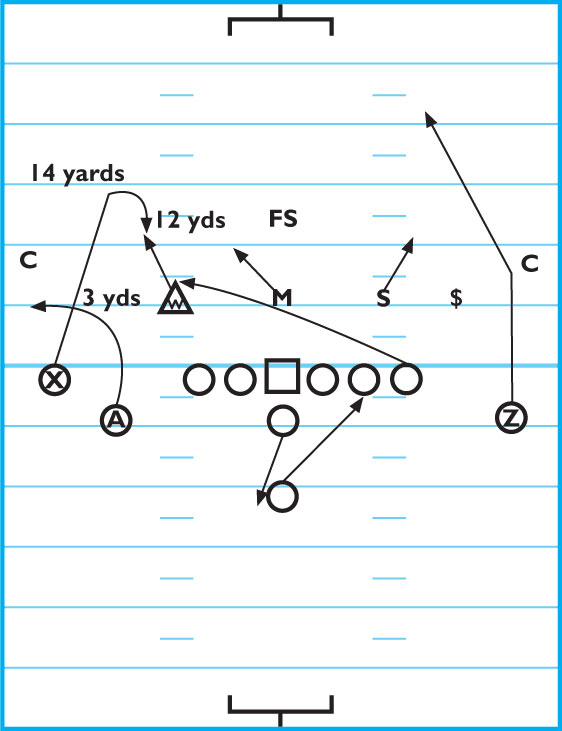
To the open end of the formation, run a curl-flat concept. To do this, X runs a deep curl route to 14 yards at the top end, working back to 12 yards. A runs a speed-out, working up to 5 yards with his head turning around quickly. A is the blitz or “hot” throw in the Will LB blitzes. The TE runs a crossing route working up to 6-8 yards. He should settle in the tackle box so he doesn’t crowd X who is running the curl. Z runs a post or vertical. A throw to Z is the aggressive throw by the QB if there is a favorable matchup.
Each receiver has a specific landmark to attack. The X must push his route deep enough to get the corner bailing, just before settles down with his curl. The A receiver must try to expand the flat defender while working for a little depth and being available to beat the blitz. The TE must get across to hold the Mike LB from drifting into the curl. The crossing pattern by the TE also is a good way to beat man coverage.
The QB takes a 5-step drop. If he reads blitz at pre-snap, he is working the speed-out pass to A immediately. If there is no blitz threat, the QB decides if he wants to take a shot down the field with Z running the post. If he decides to work against the Will LB, he takes a 5-step drop and reads the Will. If the Will expands with the speed-out players (A), the QB must be patient and wait for X’s curl. It is important to locate danger defenders who could jump the curl window. Most of these defenders should be held up by the TE’s crossing pattern. If the Will sinks under the curl or gets a late jump on the speed-out pattern, the ball is thrown to A running the out as the QB’s fifth step hits the ground.
This same route combination can be run from a two-back set against a cover 3. The only difference is substituting a fullback in place of one of the receivers.
DIAGRAM 2: Rutgers Vs. Cover 3 With 2-Back Set. In this circumstance, the A receiver from Diagram 1 is replaced with a fullback (F). The F is running a true, flat route but he is still the blitz or “hot” throw for the QB. The QB needs to recognize running back aren’t going to be as comfortable catching the ball as receivers, so this throw may require more repetitions in practice.
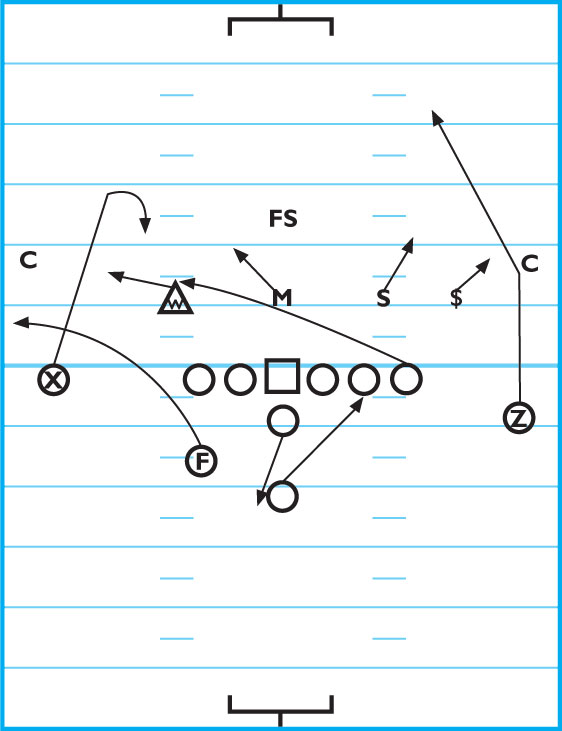
The remaining routes remain the same. X sets up split 6 yards from the sideline and runs a deep curl to 14 yards coming back to 12 yards. The TE runs a cross pattern to about a 6- to 8-yard depth. Z runs a deep vertical and is the aggressive target once again if the QB thinks he has a favorable matchup in that area.
washington vs. Cover 4
Just like in the Rutgers plays, the goal is to isolate the Will LB, which makes reading the defense easier for your QB. Keeping reads and progressions simple for your QB is critical for him to develop timing, confidence and composure in the pocket.
In the Washington group of plays, the QB has a blitz throw, a vertical shot and a combination aimed at out-leveraging one defender. With the Washington play, you are stretching out the Will LB once again.
DIAGRAM 3: Washington Vs. Cover 4. This two-by-two set shows the Washington play against a cover 4.
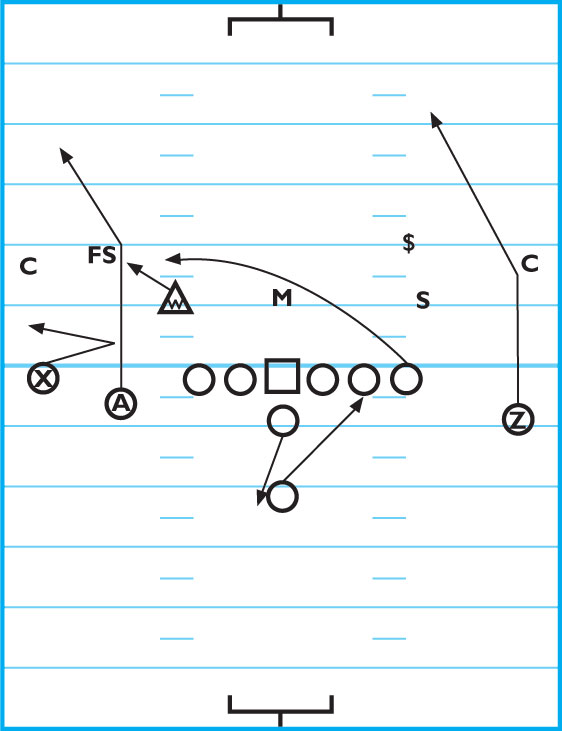
The X receiver takes his normal split and runs a boomerang route. The boomerang route looks like a shallow cross for the first 5 yards across but the receiver plants his up-field foot and works back out toward the sideline. This is a shallow route with the X getting no deeper than 3 yards. X also is the blitz throw. He must make eye contact with the QB on the way into the cross because the ball will be coming quickly is the
Will LB blitzes.
The A receiver runs a corner route breaking at 10 yards. Against cover 4, the Will LB tries to reroute the corner route to carry the receiver to the safety. The TE again runs a crossing route working up to 8 yards. Now, the TE is more of a threat. With the Will carrying the corner route first and being held later by the boomerang of X, the TE easily accelerates into the area vacated by the Will.
Against a cover 2, the QB has a smash-corner concept with the boomerang and the corner combination. In this case, the QB shifts his read to the cornerback playing X. Against man coverage, the QB has good options with Z running a post, the TE running away from a linebacker and A running a corner route against a safety.
DIAGRAM 4: Washington Vs. Cover 4 With 4 WRs. This is the same scheme with an extra receiver (S) replacing the TE. Some teams do not have athletic, pass-catching TEs, so using a receiver to do the same job can work even better. Also, the motion allows Z to get a cleaner release.
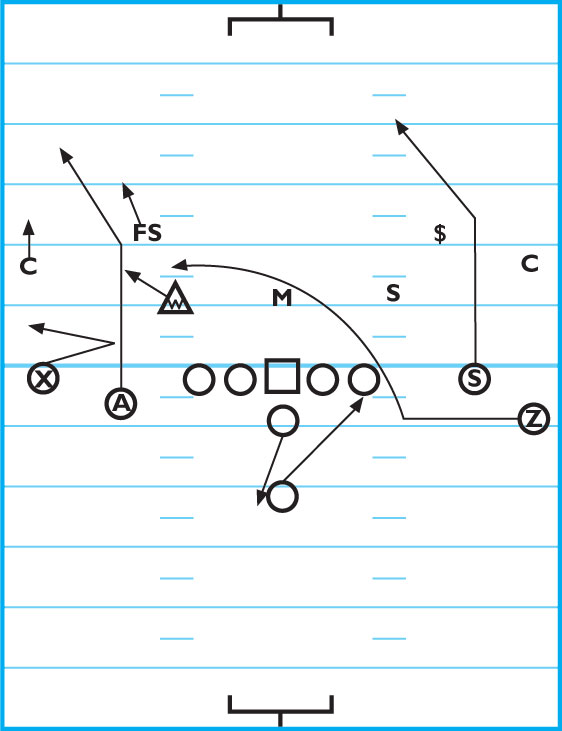
X runs the boomerang again getting no deeper than 3 yards and is the blitz or “hot” receiver. A runs the corner route breaking at 10 yards. The Will either has to commit to A on the deeper route (to push him toward the safety) or to X on the shorter route. In either event, this leaves plenty of room for Z to get open. Z comes in motion before the snap, then runs a crossing pattern to an 8-yard depth to the area vacated by the Will LB. S runs a vertical route to keep that side of the field honest and to give the QB a vertical threat if the match-up is favorable.
This whole package is very user-friendly for your QB. He does not need to out-think the other team’s defensive coordinator. Rather than asking him to read the entire field, he is able to target one specific aspect of any coverage scheme. He has the freedom to get aggressive with a vertical throw and the “hot” blitz throws already are built into the play. Plus, the route combinations are relatively simple to install and allows your offense to attack a variety of coverages.