MOST COACHES ASSUME that since we are a 4-4 defense team, we must play a lot of Cover 3. While Cover 3 is important in our teaching progression, we actually play very little 4-under, 3 deep. In fact, in the first game of last season, we ran 18 different coverage combinations and only two total snaps of Cover 3. We’re primarily a rotated, 2-deep team.
One of the biggest factors in our defensive success comes from our teaching progressions. During camp, we’ll spend the first three days teaching only Cover 3. We want our defensive players to learn the basic coverage zones of Hook-to-Curl and Curl-to-Flat. On the fourth day, we introduce our man coverages. By the sixth day, we start to introduce our base coverage package called “Odd.” Our goal is to first teach the basic zone principles, then the basic man principles and then introduce our man-based zone package.
“Match Responsibility”
In any 2-deep coverage, each of the five possible vertical routes must be accounted for. Deep-coverage players are typically responsible for the vertical routes by the No. 1 receiver. The vertical routes by the No. 2 strong-side receiver, and the No. 3 and No. 2 receivers on the weak side must be picked up by underneath players. We call this a “match responsibility” and it’s a basic tenet of our system that’s assumed by our linebackers, strong safety or safety. The underneath players have man-to-man responsibility if their receiver “goes vertical.”
We rotate our safety to the pass strength and play a “Hard Robber” (or Inverted 2-deep), “Soft Robber” or “Hard Corner” (Cover 2), depending on the split of the No. 2 strong-side receiver. Our backside CB, backside SS (what we call our outside LB’s) and both LBs all employ the same “drops” regardless of the strong-side coverage.
DIAGRAM 1: Cover 3.
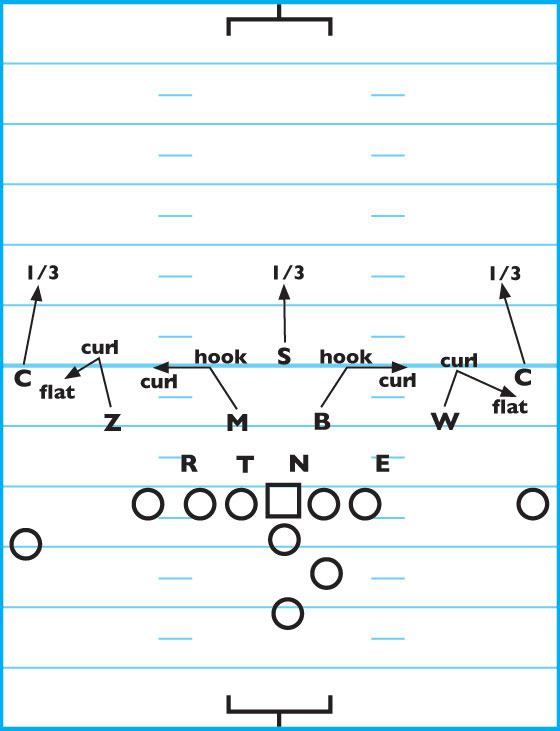
DIAGRAM 2: Hard Robber (Inverted 2-Deep).
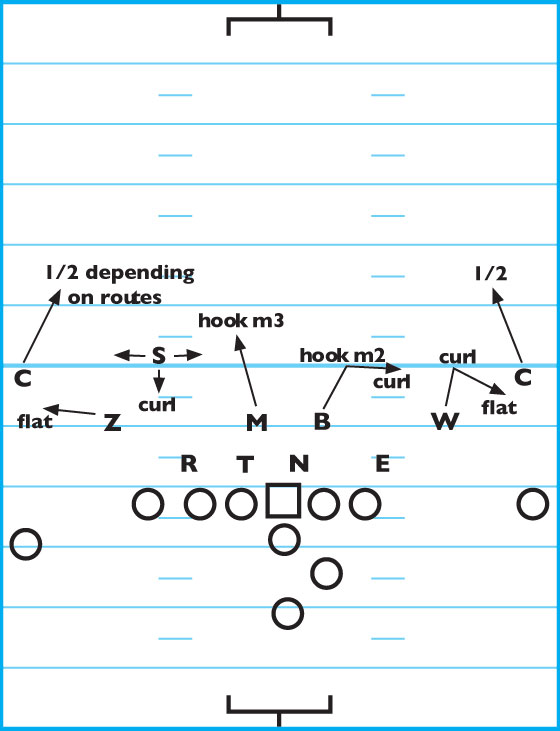
DIAGRAM 3: Soft Robber
(1/4,1/4, 1/2).
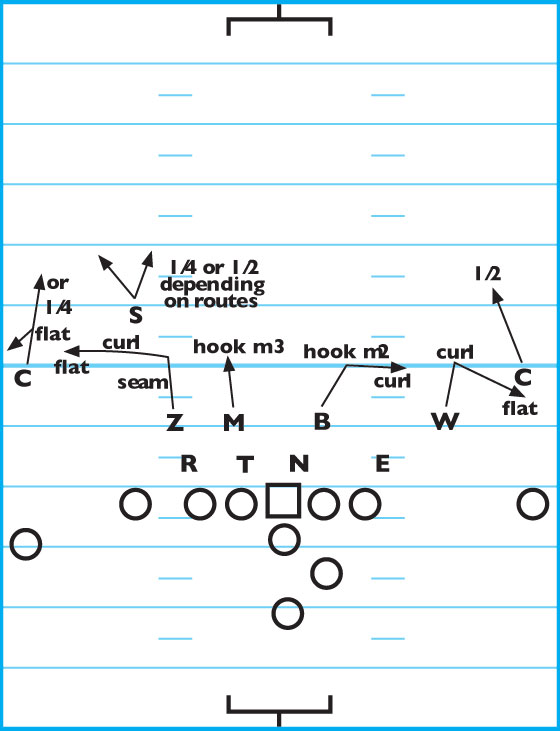
DIAGRAM 4: Hard Corner
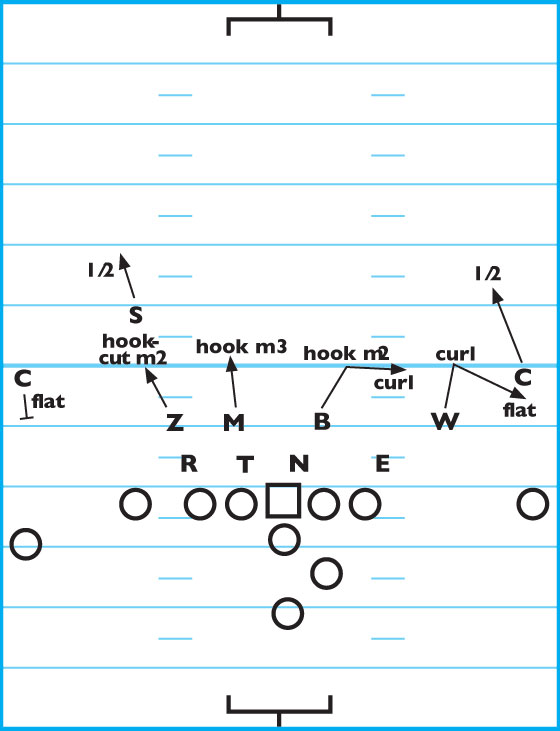
(Cover 2).
To create each of our rotated 2-deep coverages, we modify our Cover 3 by bringing a deep defender up into one of the six underneath zones. The strong-side inside LB “loses” his curl responsibility and becomes merely a Strong Hook player with a match on the No. 3 receiver. The backside inside LB is still a Hook-Curl player just as in Cover 3, but must now match up with the No. 2 receiver on the weak side. The backside SS is a curl-flat dropper with a match on No. 2 if he runs an out cut (such as a wheel). The backside CB is a deep 1/2 player. The vertical route by the No. 2 receiver on the strong side is taken care of by the safety in “Hard Robber” and “Soft Robber” coverage and by the SS in the “Hard Corner” coverage.
Teaching “Drops”
Our staff teaches “drops,” not coverages. Instead of teaching what players must do in each and every coverage, we want our players to learn which drop they should use in a particular coverage. This greatly reduces our teaching time. For all the zone coverage varieties that we use, our LBs only have to know two pass drops: “Hook-Curl” and “Strong-Hook” (with or without matches). Our SS must learn four drops: “Flat,” “Hook-Curl,” “Seam, Curl-Flat” and “Curl-Flat.”
We chart our zone responsibilities to break down the six underneath zone coverages. Though we are a route-progression reading team and do not teach our players in this manner, it can be helpful for coaches to understand our zone coverage.