During my first four years as a head coach my defense did not have an identity. I went through three defensive coordinators and four different base fronts. The kids were confused and were being led in the wrong direction. We were good at stopping the pass, but no one really passed in our conference. We could not stop the run. Within the first four years we gave up 23.5 points a game and made the playoffs just once.
Something had to change if we were going to be successful; we needed an identity. Going into my fifth and final year at Doss High School I hired a friend of mine that played with me at the University of Louisville and later went on to play professionally to help with the defense. Terry Rice-Locket came in with ideas and concepts I was familiar with; that is, a 4-3 defense with some Under and Over. That final year at Doss and our first year at Central High School, we gave up 19 points a game, made the playoffs both years and this year won our first 3A State Championship using this philosophy of defense.
We play a 4-3 Under on early downs and a 4-3 Stack on passing downs. We love the versatility and the different blitzes that we can give you from the Under front. Additionally, we are able to outnumber the offense on both sides. We play some zone but for the purpose of this article we will demonstrate how we are successful at stopping the run with the traditional 4-3 personnel. Unlike the version we played in the NFL, the one that we installed at Louisville Central is a one-gap control scheme.
We letter the gaps on each side of the center just like everyone else does: A, B, C, and D. We line up with a strong side and a weak side. We have used a field call that predetermines the strength before we see formation, but for the most part we call the strength to the TE.
Strong Side
On the strong side we line our Sam on the outside shoulder of the TE. We tell him to take his inside foot and split the crotch of the TE. We teach him to take a 6-inch step with his outside foot and control the TE with his hands while keeping his head outside. He aligns a little looser if he has a near back so that he can get up field on any sweep or pitch plays. We play our DE in a heavy 5 tech, meaning we have him put his inside foot just inside the inside foot of the OT. He plays a similar technique to the Sam and will always take his first step with his outside foot to prevent from getting reached. We line him up tight because unlike the other lineman who are shooting a gap and trying to get up field, he is going to play off the block of the tackle squeezing hard if the tackle comes off inside and tries to block the Mike. We play the shade to the call in Under front. He knows he is going to get double-teamed most of the time and we want him to get double-teamed. We can make a “G” call and slide him to the inside shoulder of the OG to put pressure on that OG and to help squeeze the B gap. If we get a team that loves to pull their guards we will make a “Trey” call and move him to a 3 tech, switching the gap assignment of him and the Mike.
Weak Side
On the weak side we play a 3 tech tackle that is shooting the B gap and squeezing the OG on runs to the strong side. We play our weak side end (Falcon) in a Ghost 6, meaning he is going to line up a half a man wider than the weak OT. He is our best pass rusher and is out that wide to put pressure on that OT and attack the quarterback’s blindside. He is pass rushing and reacting to the run on the move. He will squeeze on the run on the way to the quarterback. If he gets a puller, he is going to wrong arm the first opposite color jersey. The Mike plays over the strong guard and the WLB plays over the WOG with strong B and weak A-gap responsibility (See Diagram 1).
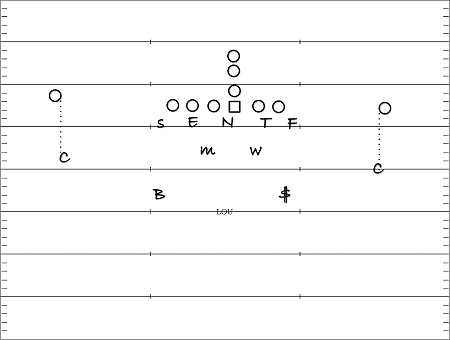
The coverage portion is a man free coverage. We will start with the corners because they are the easiest. They will play inside press technique on the top two receivers by game plan so they lock on number 1 to each side if they are receivers. If we get twins they will lock on 1 and 2 if they are receivers. Because of how we play with the safeties they are taught not to expect help from anyone inside.
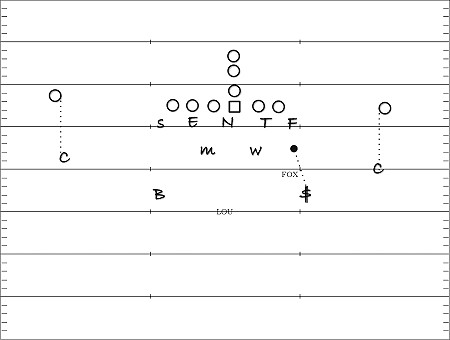
We start off in a Cover 2 shell. Prior to the snap we walk our free safety down to a hide position five yards off the ball behind the Falcon. He will give a “Fox” call telling the linebackers to plus their alignment and that the FS is in the box. It is okay if he is late as long as he is walking to that position at the snap. We don’t want him to be early because we don’t want him to be accounted for in the blocking scheme. He has force on the weak side and is the trail/cutback player on run on the strong side. He is also responsible for the first back out weak M/M. If it is full flow strong he becomes the low hole player, peaks to help the Sam on the TE on a low cross, then helps the corner on a hard inside route by #1 or #2 in twins . In a one back set we will not “Fox” and one of the safeties will take the third receiver. We play our best cover safety on that guy out of the box. We make a “1 back lock” call which tells the Sam to play pass and that his help on the TE is gone (See Diagrams 2 & 3).
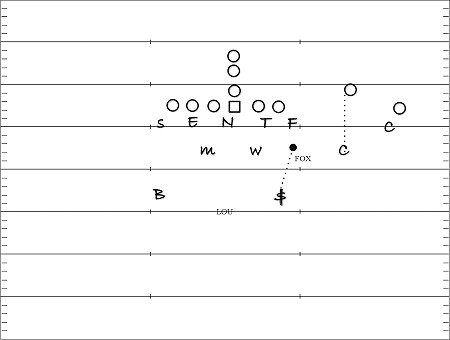
We play our SS at 10 x 2. Unlike most teams that run this guy to the deep middle at the snap we teach him to use more of a quarters drop. This means that he is going to read the TE and help the Sam cover the TE if he releases inside and there is run action at the Sam. We found that teams would try to attack us with play action at the Sam and then hit the TE on a corner or post route. If he sees ball in hand meaning that the back has the ball on a pitch or a sweep he can play fast to the ball. He reads technique off of Sam. On plays weak he is to slow play and take away the post or seam (Diagrams 4, 5 and 6).
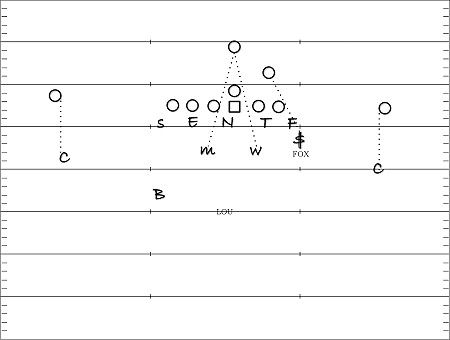
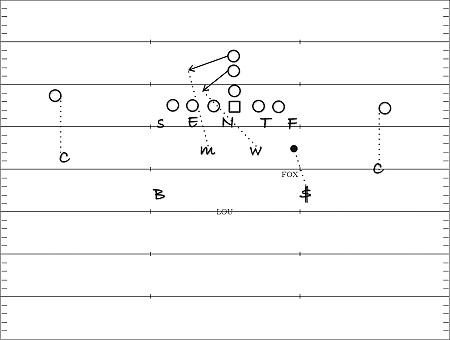
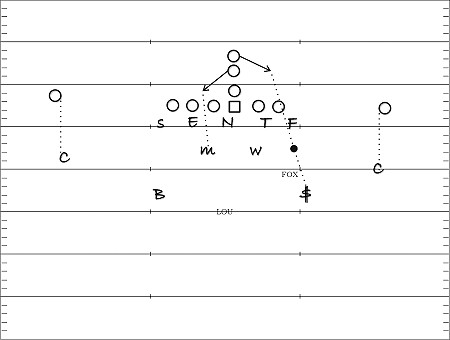
The Sam plays the TE man to man knowing that he can play the run hard because he has help from the SS and the low hole player on full flow. In a one back set with a “Lock” call he knows that he has to pay more attention to the pass potential of the TE because he has lost his deep safety help. But the low hole player on flow to him is the Will and should be there to help. In a two back set the Mike has the first back out strong. On full flow the Mike and Will take the two backs and the FS is the low hole player. On split back flow the Mike and FS take the backs and the Will is the low hole player (See Diagram 7).
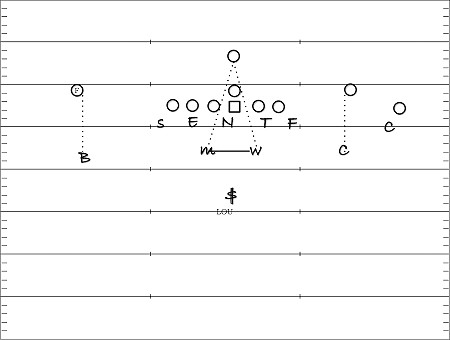
We have had lots of success with this defense because if the strong safety is a player then you basically have created a Bear Front and along with moving the Shade around makes it nearly impossible to run to the strong side. We are attempting to force long yardage situations so that we can get into our zone blitzes and pressure packages.
WHAT IF?
Q1. What if your opponent lines up in a trips formation? What adjustments/responsibilities change for your defense?
If it is still a two back with simply X over then nothing for the front seven changes. We will simply move the weak corner over to the slot receiver. We will still “Fox” down the free safety late and create an eight man box. The slot corner has to be alert for the crack replace. Most teams will want to use that slot receiver to crack on the strong safety who has read force (pitch).
If they are in a one back trips set we will start with a one back “Lock” call telling the Sam he is not to expect help from the strong safety. There is no “Fox” when a “Lock” call is made. The better coverage safety will take the slot receiver with the other one being the deep hole player. The corners will match up on the best two receivers, traditionally the X & Z. Nothing changes for the line. The WLB has to know that he is fast to pitch on any option weak. The Falcon has the QB and the FS is filling the alley.
Q2. What if the offense has a strong screen passing game? If you suspect the screen coming, what adjustments, if any, would you make?
If we suspect screen then we will try not to call a man coverage but say, for instance, they like the screen to the backs out of a two back set. We do a couple of different things to prevent it. We stress to our backers that they have to hug up on their man when they read pass, meaning that we are going to rush the QB through our back. When they read pass they are going to go and get face mask to face mask on their back and grab them if the QB starts to scramble. They are going to then throw their guy down with a push pull technique and attack the QB. Secondly, we call “Peel” with the defense, i.e. (Under Orange Peel). This tells the DE and the Falcon that as they rush the passer, if a back crosses their face, they are to come off of the rush and chase the back forcing the quarterback to either hold the ball, throw it up high to get it over their head, or throw an interception.
We also have a call that tells the ends to rush hard and the tackles to play screen and draw, which is our “Jett” call. Without changing the coverage we can make a “Robber” adjustment i.e. (Under Orange Robber) which we employ in the red zone and vs. screen situations. If the QB is under center and there is one back we lock the MLB on the single back. The WLB will work to the weak side to stop the slant and the quick screen to the X. On the strong side the free safety will employ the same technique looking to take away the slant slip or bubble screen.
Q3. What if you face a great running quarterback that lines up in the shotgun?
We are fortunate enough to be the fastest team in the state so a QB that likes to run has never been something that we have had all that much trouble stopping. In terms of the man free scheme what we do is have our low hole player spy the QB. So, instead of looking to help someone in coverage, he works to the LOS and will tackle the QB when he starts to scramble.
We will also play a White coverage which means that we are going to blitz one of the underneath defenders including the free safety. We also can make a “Jett” call and have those Ends rush hard off the edge and the Tackles sit and react to the QB when he attempts to step up.
We also play a Rainbow coverage out of our Under front that allows us to send a linebacker and the safety to the side of the linebacker blitzing. We will cover his zone giving us 5 rushers with a 3 under-3 deep coverage behind it.
The last thing that we like to do out of a regular personnel set is, when the ball is on the hash, we make a field call and set the front to the field regardless of where the TE is. Most of our opponents don’t give us a lot of TE into the boundary so what we do is bring that boundary corner on a blitz off the edge. We play Cover 2 to the boundary and Cover 4 to the field if the QB boots or rolls to the field. We have our MLB and secondary contain, meaning, blitzing outside in to make the QB pull up or throw early.
Q4. Do you make any changes with your base 4-3 Under or 4-3 Stack alignments?
I think we do a lot more than most high school teams do in terms of the packages that we prepare to use every week. One simple thing that we do in our Under front is to move that Shade tech around. We can play a “G” which moves him from a nose to a 1 tech. We also will make a “trey” call which moves the nose to a 3 tech. Some of the stronger B gap and veer running teams will try to attack that B gap bubble in Under. When we run Under, we use “trey” as a change up to the under and it takes the offense a few series to adjust to it.
We are not afraid to lock our corners up and go with a ‘Black’ coverage sending both OLBs. Setting the front to the field and bringing the boundary corner also is something that we have had success doing. We mainly play our Stack in obvious passing situations; the only semi-adjustment we make to that is to make a “Wide” call and that just tells the DL to get wider in their alignment. This means aligning the ends a whole man wider than the OT. The tackles play in the A and B gaps. When we do that sometimes we will make a “Show” call having the backers show in the gap in which they are responsible so that the QB gets an early look at pressure. This also helps disguise which player(s) we are actually going to send.
When we play a team that really likes to pass or use a lot of spread looks then we will play our Dime package, which brings in a defensive back for the nose. We will stack the linebackers over the three down linemen or we can call all our fronts by sliding the line and moving the Sam down as a stand up end. We normally will still send four after the QB but it seems to create more pressure and gives us one more skill player in coverage.
Ty Scroggins is the Head Coach at State Champion Louisville Central High School. He can be reached at
TyScroggins@GridironStrategies.com.