At Parkview High School, we are a 4-3 defense with a multiple cover 4 package. The things we try and do well are to be gap sound, to be in the right fits, but most importantly to eliminate the big play. We work repetitively with our front 7 on proper alignments and the proper “fits.” We are not as multiple in fronts because we feel that it takes away from reps of being in the right fit, particularly from the linebacker position. If you watch us practice you will hear the term “fit” used a lot. We want to make sure our players understand where they fit on each play and do it a lot through the week. So the front 7 will work these fits over and over. Our secondary is a total separate unit from the front in many ways. The secondary has been given one very important assignment “keep the ball in front of you!” We want teams to beat us by establishing a 12 play drive. If you can drive 12 plays and score without making a mistake we salute you for a good drive. We feel that most teams will make a mistake or most play callers will err during the course of the drive. We uphold this philosophy by not putting our kids in bad spots by trying to make things happen. We want the offense to make the mistakes. With that said, we try to be multiple in coverage while keeping all routes underneath us.
Cover 4 is a great run support coverage; however, by tweaking the concepts, it has also been good to us versus the passing game. This is where we feel we can gain a change up on defense. This cover 4 package has changed and evolved as the game has evolved the last 15 years. For a span of 10 years, the Parkview program played 13 games or more utilizing the same 4-3 system and multiple coverages that evolved over the course of ten years (See Diagram #1).
I am fortunate to have had the opportunity to have come in 2 years ago and work with the core of coaches who were a part of this ten year run and learn this system from them.
Cover 4
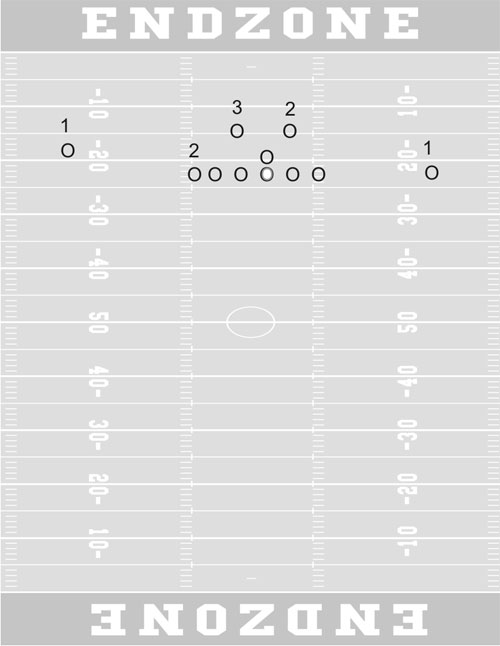
I’ll start with our basic Cover 4. It’s much the same as most cover 4 teams. Versus pro set we would declare strength to the TE side (#2 receiver). We number our receivers from outside-in. Corners read outside-in #1 to #2, and our safeties read inside-out #2 to #1 (See Diagram #2).
Our base alignments (See Diagram #3) in Cover 4 are as follows:
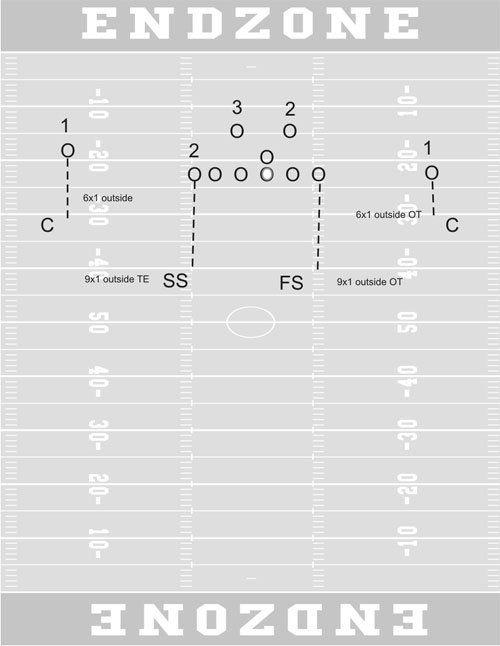
Corners - 6 x 1 outside shade.
Safeties - 9 x 1 outside of last man on LOS.
Our basic reads are as follows:
Corners - Read #1 receiver and play #1 until he leaves. If he leaves then we look to #2. Basically we are playing #1 man-to-man until he leaves us inside. We are locked on all routes vertical to outside from the line of scrimmage to our goal line.
Safeties - Read #2 receiver and play #2 until he leaves. If he leaves, Play #1. If #2 is vertical we play him man-to-man. We are a little different than most cover 4 teams in our safety progression. A lot of teams will play the safety in a run-curl-post mode. We play ours in run-post-curl mode. If #2 leaves us we will open to roll on the post, and then work back down to the curl late.
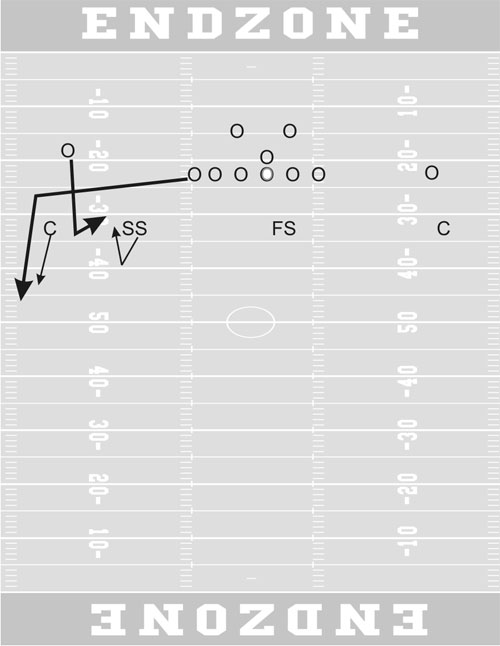
If we get the curl wheel combination – when the #1 receiver runs the curl, he is leaving the corner. As we see #2 expand and threaten our outside 1/4, we will expand and pick up #2 on the wheel route. As #2 leaves the safety, he will look to rob #1 on the curl (See Diagram #4).
Smash Route
There are two ways to play the smash route concept. The first way is to read the smash concept. If #1 hitches and #2 is vertical, play under the flag route with your corner and essentially bracket the flag route – give up the 2 yards and not the twenty. This method takes some time and reps (See Diagram #5).
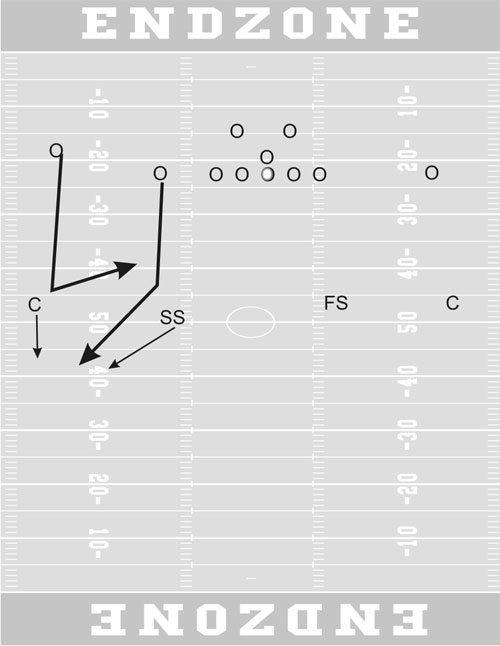
The second method is the simplest in terms of cover 4. If the #1 receiver is running a hitch route, the corner will drive the hitch (basic cover 4 rules). Our safeties are taught alignments over #2 not by depth or width yardage, but by what we call “performance alignment.” He is to align on #2 in a position where he can take away the flag route, the toughest route he has to cover. So the safety will align over the top of #2 and play the flag route over the top (See Diagram #6).
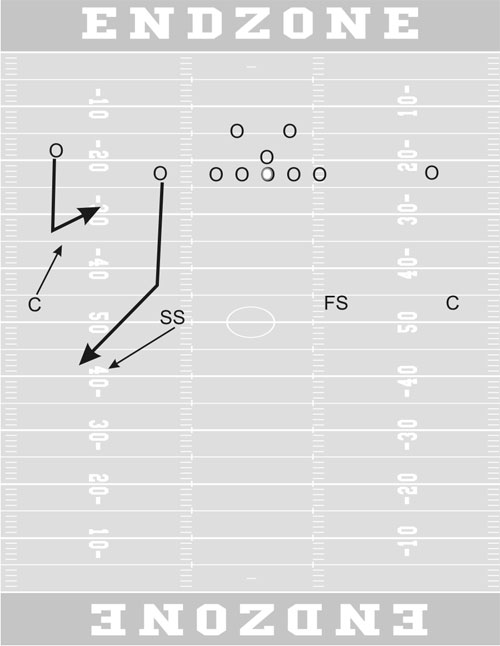
We have played this both ways.
Cover 4 Squat
Staying within the framework of cover 4, our first change up is to run Cover 4 Squat.
In Squat, we like for our corner to step up from 6 yards to an alignment of 3-4 yards pre-snap. We back our safeties out 2 yards pre-snap. We essentially roll up to a cover 2 shell. The corner will press #1 and force him to inside release. When we are pressing #1, we read #2 looking for a quick outside release. When this occurs, the corner will release the #1 receiver to the safety and play #2. The safeties will deepen and widen to 12 yards and now are essentially 1/2 field players. They must be able to play a vertical by #1. If #1 and #2 release vertically, all rules revert back to Cover 4 and we play both receivers man-to-man. We like squat for 2 reasons. It allows us a chance be more physical with the #1 receiver, and naturally teams will try and attack cover 4 in the flats, so we are looking to stop the quick #2 release in the flats by running squat (See Diagram #7).
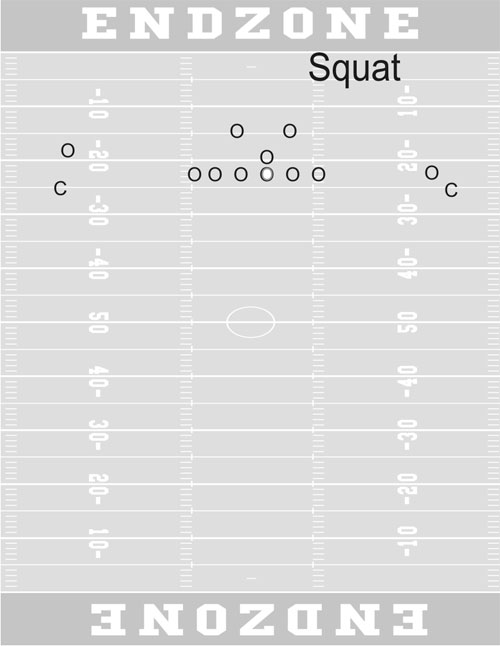
The hardest route combination, and what we teach our players as the “worst case scenario,” is two verticals. The corner must play #1 man-to-man because with two vertical all rules revert to cover 4 (See Diagram #8).
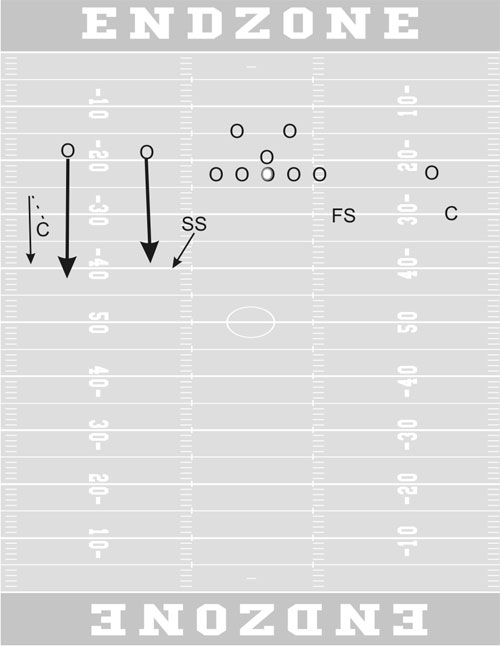
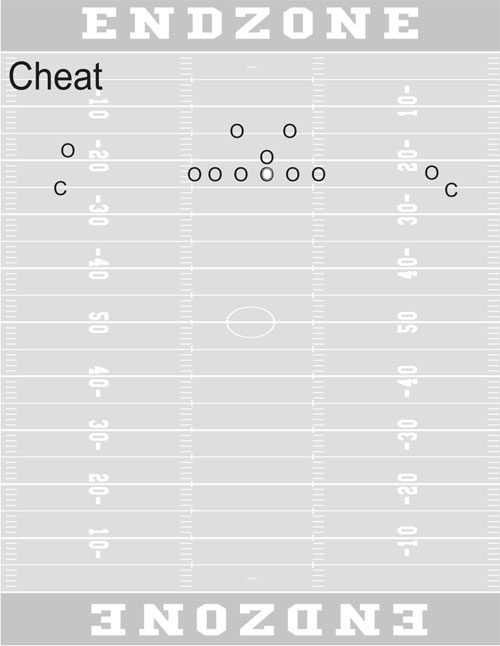
Cover 4 Cheat
Another change up we use is Cover 4 Cheat. Cheat is the same principle as Squat. We will protect the flat and disrupt the receiver. However, Cover 4 Cheat allows the corner to be very physical. I refer to this one as more of a true cover 2 concept from my background. Because the corners will now roll up and jam the receiver, but they will remain in the flats. Corners have no deep pass responsibility. We don’t play a lot of this coverage because our safeties are not Cover 2 deep 1/2 safeties, but it does provide a nice change up for us (See Diagram #9).
Cover 4 Sink
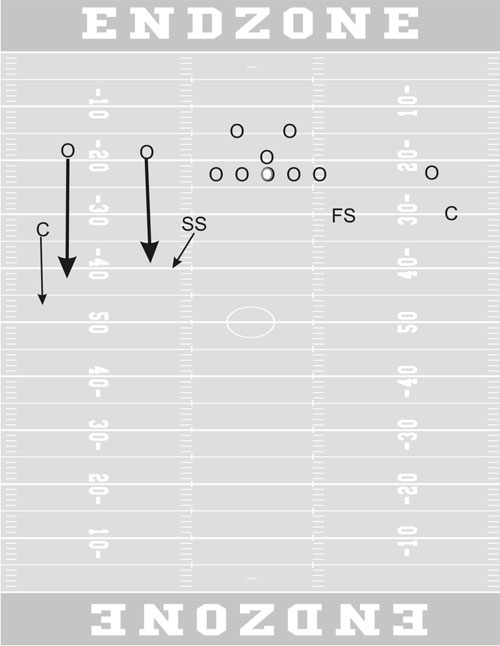
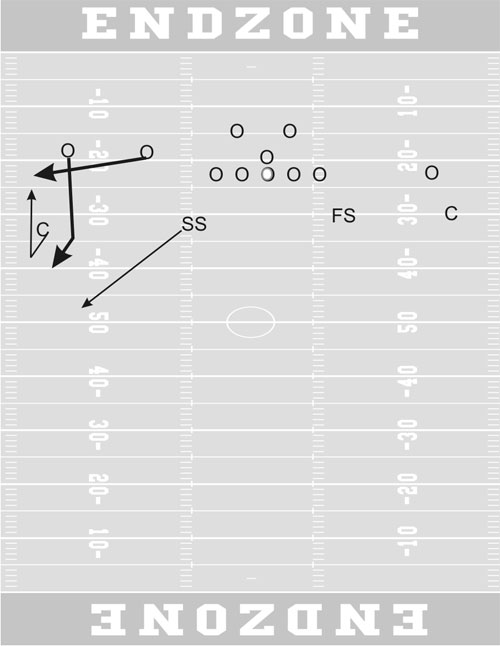
Another change up that we really like to help us protect the flat area is Sink Coverage. We run Sink versus the #2 receiver removed from the formation. Sink coverage versus a #2 receiver removed allows our corners to gain depth pre-snap and we move to an 8 yard depth alignment. The weakness of playing Squat Coverage is the limited vision on #2 as you try and re-route the #1 receiver. The worst case scenario of Squat coverage is 2 verticals. We like to utilize Sink coverage, which allows our corner greater vision to see a bigger picture of the routes developing. He will “sink out” on the snap of the ball as he reads the release of #2 this time. If #2 releases out, he will jump the route and turn #1 over to the safety. If he is vertical, then cover 4 rules apply again (See Diagrams #10 and 11).
Cover 4 Zip
Zip is strictly a tag we utilize if we have been running Squat or Cheat coverage. Obviously teams will try and throw the Smash route versus our corner rolled up and try to beat the safety on the flag. By calling zip coverage we like to roll up early and show a Cheat concept. On the snap of the ball we will flip and bail out looking for the flat route by #2 and try to get under this route. This call is strictly used to get under the flag route.
These are some of our basic variations of cover 4. We also have several adjustments to trips and 4 wide sets that we like to utilize. Whatever we implement coverage wise, we always like to have a change up to answer how the offense is trying to attack us.
About the Author:
Chad McGehee is currently the defensive coordinator at Parkview High School. He has been at Parkview High School for 2 years. Parkview currently holds the longest streak of playoff appearances in AAAAA in the state of Georgia. For 10 seasons the program played 13 games or more from 1995-2004, winning the state title 4 times. Before coming to Parkview Coach McGehee was the head coach at Elkmont High School in Elkmont, Alabama from 2005-2007. From 2000-2005 he served as the defensive coordinator at Grayson High School in Loganville, Georgia.