To be successful coaching defense a staff must always look for new ways to teach technique and get better at what they believe in. Our philosophy, terms, drills, etc. come from many hours of studying, reading and learning from successful defensive coaches. What we try to do, as a staff, is to recruit players into our program who believe in our philosophy and are going to work hard.
Defensive Philosophy -
General
1. Run to the Ball – we have several different types of pursuit drills and will use them every day.
2. Play with physical toughness.
3. Play with mental toughness.
4. Play hard.
5. Play smart.
6. Play together as a team.
7. We believe in keeping our defense simple.
Defensive Philosophy –
Run Situations
1. Gap Control – responsibilities are clear and adjustments are easily made.
2. The ability to mix up line charges and maintain gap control
3. Ability to get into eight-man fronts
4. Zone Defenses – this allows all eleven players to be involved. This keeps our run force lanes sound and we feel we are in the best position to play the option.
Defensive Philosophy –
Pass Situations
1. Pressuring the QB by rushing a combination of 3, 4 or 5 different defenders.
2. Zone coverage decreases the chances for big plays. Should force the offense to execute perfectly to get down field.
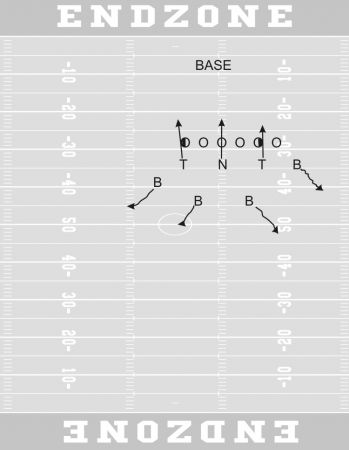
We will base our entire front out of the 3-4-4 defense. The first defense we teach is a base Okie front with all 4 LB’s dropping into coverage (See Diagram #1).
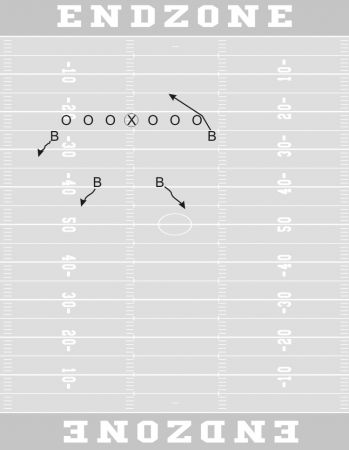
After all BASE responsibilities for run and pass are learned, we will move to what we call our OLB fronts/stunts (See Diagram #2).
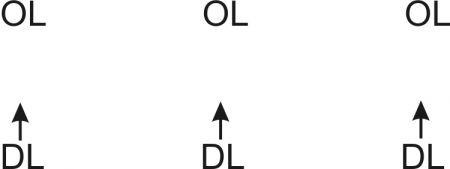
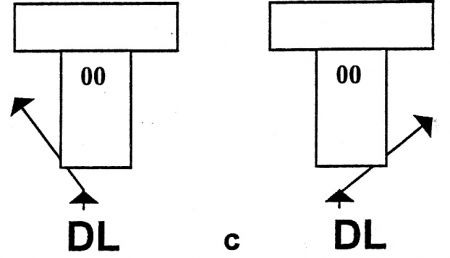
Every front/stunt will be identified by a one-word descriptor (See Diagrams #3a, #3b, #3c).
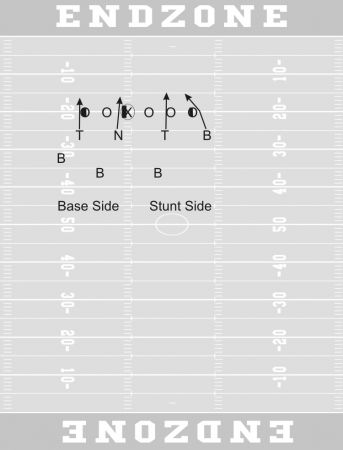
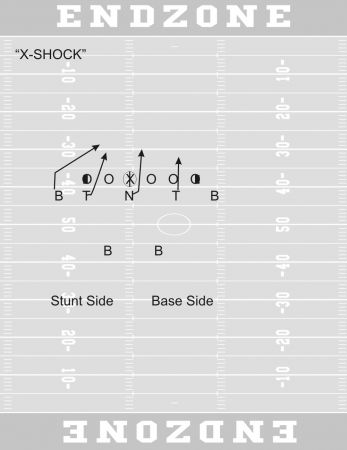
We will determine through game planning how we want to communicate where we want the stunt to be run. For example, tight end side = ‘Y’, split end = ‘X’, field side = RT/LFT and boundary side = RT/LFT.
From here we will teach our ILB + OLB stunts (these will end up being five man attacks). (See Diagrams #4a, #4b)
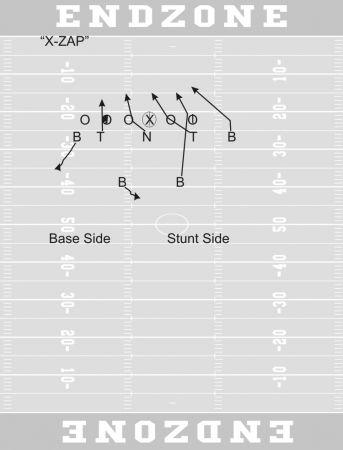
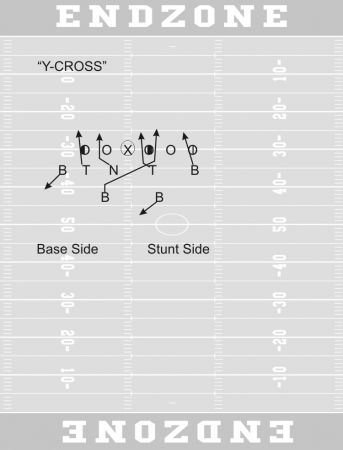
One of our major defensive line techniques is what we call a ‘Shade’ technique. For this technique to work, it is very important that our defensive linemen get in a proper stance, get off the ball, attack, get off blocks, take the correct angle to the ball and make tackles. Any time we have defensive linemen aligning in a gap and moving to another gap at the snap, we designate those calls as stunts.
Any time we are aligning in our gap responsibilities and defending that gap, we use the ‘Shade’ technique. Our shade technique refers to the fronts in our defense. In our shade technique, the defensive linemen have 2 primary areas of responsibility: run defense and pass rush. While we can and do identify formation, down and distance, personnel and OL stance tendencies, our defensive linemen must have great fundamental technique to allow them to play both the run and the pass on any given snap. The 2 key fundamentals of our defensive line are stance and attack. We will begin our individual practice period each day with some form of stance and attack drill to emphasize the importance of each fundamental.
Stance
A 3-point stance will be used that will align your shoulders square to the line of scrimmage. The proper stance we will use is as follows:
1. Inside foot is back with the stagger relationship of toe to heel with the up or outside foot.
2. Feet are shoulder width apart with air under heels.
3. Both feet should be pointed straight forward.
4. Inside hand is down with the outside hand cocked at hip level – this will allow us to have our outside hand and our 2nd step free to defend the reach block and also allows a closing step to the veer block.
5. D-lineman’s nose should be even with the tip of the football (crowd the line of scrimmage).
6. Body weight should be leaning forward, yet under control to avoid overextension at the snap.
7. Head is up with the eyes focused on the neck and shade shoulder of the offensive lineman you are aligned.
Coaching Points: Your knees are over your feet, eyes are over your knuckles.
We will do a stance and starts drill (See Diagram #5) daily to check stances and may combine any number of defensive line fundamental work to increase our practice efficiency (i.e. agility, tackling, pass rush, block reads, etc.).
Stance Drill (See Diagram #5)
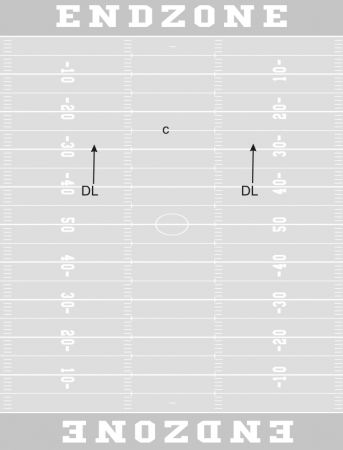
Stance & Starts
Purpose: to teach and practice proper fundamentals of the stance and start.
Procedure:
1. Align DL in 2 single file lines.
2. Set the DL in proper stance.
3. On visual key, DL attack up field past coach.
Coaching Points:
1. Eyes up, flat back, weight 60/40.
2. 1st step replaces down hand.
3. Low pad level charge.
4. Extension of power joints.
5. Lock-out arms on air.
6. Full speed effort past coach.
Suggestions:
1. Add chutes to the drill.
2. OL back-peddle at the snap from 3-yard cushion, DL try to tag OL.
Attack
We are a gap control defense. Our defensive linemen are expected to attack and defend a pre-determined gap, escape from a blocker and then pursue the football. We teach our defensive linemen to align shoulder-pad-to-shoulder-pad with the offensive lineman’s gap pad (See Diagram #6). Our inside or ‘man-hand’ will be on the ground, which will allow our gap hand to be free. We use the shade technique for a number of reasons:
1. It allows our defensive lineman to key the offensive lineman’s shoulder pad for any type of block they will encounter (base, reach, veer, double, scoop, pass set, etc.).
2. It allows our DL to have the mentality of attacking the OL and the LOS vs. reading the OL.
3. It allows us to reach the DL that they already have an advantage over the OL in defending their gap – they are aligned in it.
4. It allows us to sacrifice size for speed with great attack technique.
Shade Alignment
(See Diagram #6)
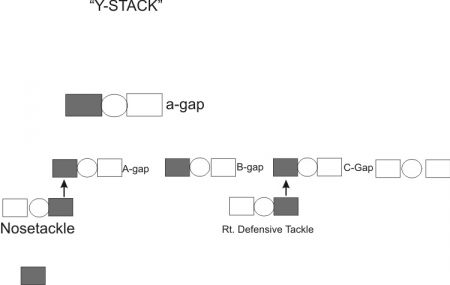
The attack of the defensive lineman must be used to gain an advantage over the offensive lineman. Our attack is used to gain separation from the OL and to disrupt OL releases. We will use this technique to: 1. violently re-establish the line of scrimmage; 2. make it harder for the OL to control the DL on contact; 3. increase vision; and, 4. escape from a blocker. The keys to an effective attack are as follows:
1. Key ball movement with peripheral vision.
2. On-ball movement, fire out with inside foot replacing inside hand.
3. Recoil arms slightly to execute ‘punch’, keep elbows tight to body, thumbs should be pointed up with fingers to the outside.
4. A simultaneous helmet clash and hand punch on the OL, place your facemask in the V of the OL’s neck.
5. ‘Punch’ the inside hand to the top of the OL’s numbers and ‘punch’ the outside hand to the outside of the OL’s shoulder pads.
6. Grab the OL’s jersey with hands (grab cloth).
7. Lock out the arms by extending the hips, knees and ankles.
8. Drive the legs to gain separation, keep the toes pointing straight up-field.
Coaching Points:
1. Pad Level – your eyes must be below your opponent’s.
2. Lead with your hands, your feet will follow.
After we have worked our stance and starts, we will progress immediately to ‘attack’ drills (See Diagrams #7 & #8). Our defensive linemen will attack someone or something each day in a fundamental drill setting in addition to any other type of team work we have planned for the day (i.e. inside run or pass rush period). Either of the two drills listed below can be taught to beginning defensive linemen, converted linebackers or experienced defensive linemen. Again, each drill can be used exclusively for fundamental work and can be grouped with other fundamental skills to enhance the drill.
Attack Drills
The first drill we use to teach our DL proper hand placement, attacking physically, and fighting pressure is our attack-pressure-escape progression drill.
Ape Progression
(Attack-Pressure-Escape)
(See Diagram #7)
Purpose: To teach the proper attack technique from right or left shade, fighting pressure, and escape.
Procedure:
1. Partner up the DL facing each other on knees.
2. Coach gives OL direction to lean to simulate pressure.
3. On ‘hit’, start each phase of the progression (helmet pop).
4. Allow OL & DL to reset after each rep.
From Knees:
• Hand Placement (R&L)
• Hand Placement, Fight Pressure (R&L)
• Hand Placement, Fight Pressure, Rip/Punch (R&L)
From 6-Point:
• Hand Placement (R&L)
• Hand Placement, Fight Pressure (R&L)
• Hand Placement, Fight Pressure, Rip/Punch (R&L)
From Fit Position:
• Fight Pressure (R&L)
• Fight Pressure with eyes closed (R&L)
• Fight Pressure; escape (R&L)
• Fight Pressure with eyes closed, Rip/Punch (R&L)
From 3-Point Stance:
• Hand Placement (R&L) 1-step
• Hand Placement, Fight Pressure (R&L) 1-step
• Hand Placement, Fight Pressure, Rip/Punch (R&L) 2-Steps
Coaching Points:
1. Proper hand placement.
2. Keep pad level underneath OL.
3. Fight pressure with post technique and escape through gap, cross-face technique if ball is run away.
4. From FIT, run the feet and hips.
We use the Lev Sled by Rogers Athletic Co. every day to teach our DL how to maintain pad level, attack physically and gain separation from a blocker. The sled forces us to use great fundamental technique. If a DL does not explode off the football and physically attack the sled with proper pad level and hand placement, the sled does not unlock and will not allow the DL to gain separation. It is an instant display of correct or incorrect technique.
Lev Sled (2 or 3 Man Sled)
(See Diagram #8)
Purpose: to teach and emphasize attacking with proper pad level (check stances).
Procedure:
1. Align 2 single file lines facing sled.
2. On visual key, DL (from 3 pt.) attack & punch sled (chest plate and outside shoulder).
3. DL makes contact with eyes below numbers and work up through sled.
4. Escape to edge of sled.
Coaching Points:
1. Aggressive punch of chest plate and shoulders, eyes on numbers.
2. Quick lock-out and escape.
We believe teaching the fundamentals of the stance and attack allows all of our defensive linemen to experience success (defend their gap) vs. any blocking scheme we face. By focusing our efforts on great technique, we can teach our players to play with great effort and maximum confidence. Their responsibilities are clearly defined and their technique can be improved on a daily basis. We can quickly identify breakdowns in our defense as mental or physical mistakes. While all coaches strive to eliminate mental mistakes, we believe by teaching these fundamental techniques, we can also eliminate most physical mistakes by the defensive line. Using the above drills allows us to progress to escaping different types of blocks and also rushing the QB in passing situations.
Coach Engel completed his second season as the defensive line coach at Minot State University.
Q1. What adjustments do you make when the offense is winning gap control?
We will vary the fronts we play from situation-to-situation to try to make sure the OL isn't seeing the same look again and again. We have a slant (all 3 DL) package, and an angle (2 interior DL in our under front) package we can utilize. Basically we can "slant" all 3 DL strong or weak with a LB call based on formation tendencies. Our slant package uses the old Michigan 50 slant technique with our eyes keying the OL we are moving to. If we are seeing a heavy dose of man blocking schemes (i.e. down, down pull), we will tell our OL to get vertical vs. the down block. We can also align in a traditional over or under front and "angle" our 2 interior DL from over front to under front or vice versa using a LB directional call. Our angle technique is a 90 degree flat step to cross-face 1 OL. Again, if we are seeing down/down/pull schemes, we will immediately cross-face all down blocks coming back at us.
Q2. What pressure changes do you make when you face a 3-step passing game?
We try to take our traditional under front and utilize one or both of our ILB's bluffing or rushing from the L.O.S. We have a few different interior twist games we use to try to create A-gap pressure. One of our favorite "Under" front pressures we use to get A-gap pressure is the "Under M Mike Fire" – which allows us to occupy both the weak side OG and the center, and also ensures the OT will fan or set the edge to account for the Mike in our defense. We essentially pick the OT on the Mike Fire. A key teaching point for the DE in a 3-technique is to attack the OG so his eyes stay with the DE. If he tries to trade back to the Mike twist, the DE should come free inside the OT. The nose must be vertical in the A-gap, and cannot be stopped at the L.O.S. by slide protection. We try to use personnel tendencies to figure out what type of pass protection schemes we will have to defeat. Versus 10 personnel teams (1 RB, 0 TE) the ability to max protect is lessened, so we will work hard at attacking specific protections. Versus 11 personnel teams (1 RB, 1 TE), we usually try to include at least 1 OLB in our pressure package. The 3-step passing game has caused us to be more risk oriented with our DL play and our traditional pass rush schemes. I've chosen to give our DL more freedom in the pass rush "lanes." We are willing to give up contain every now and then to get pressure. I've always known you need to get off the ball, read the QB’s eyes, and get your hands up in the passing lane, but we have tried to be as physical as possible in our pass rush, and if we can get the QB to hold the ball just a little longer, we can get pressure vs. 3-step.
Q3. What is your strategy when facing a spread team with a running QB?
Our general strategy still starts with stopping the run. If that happens to be the QB, we will utilize our okie package to not give the QB an easy read to pre-determine where the QB run plays need to be 'checked.' We play different games with our DL/ILBs/OLBs to change up responsibilities in defeating the QB zone read, and QB trap plays. If we get 10 personnel (2 x 2 formations), we try to control the A and B-gaps with our DL and let our ILBs play C-gaps. We try to force everything to bounce/
spill to the sideline so the QB can't just run downhill on us. Our last resort has been playing with an ILB in 'spy' technique.